Redux And Reduction
In the previous article, we defined a highly abstract framework that considered the subjective expected payout of both sides of a fixed fee derivative. In this article, we will apply that model to the context of credit default swaps and will show that the presence of credit default swaps and synthetic bonds should be expected to reduce the demand for “real” bonds (as opposed to synthetic bonds) and thereby reduce the net exposure of an economy to credit risk.
The Demand For Credit Default Swaps
In the previous article, we plotted the expected payout of each party to a credit default swap as a function of the fee and each party’s subjective valuation of the probability that a default will occur. The simple observation gleaned from that chart was that if we fix the subjective probabilities of default, protection sellers expect to earn more as the price of protection increases and protection buyers expect to earn more as the price of protection decreases. Thus, as the the price of protection increases, we would expect protection seller side “demand” to increase and expect protection buyer side “demand” to decrease. But how can demand be expressed in the context of a credit derivative? The general idea is to assume that holding all other variables constant, the size of the desired notional amount of the CDS will vary with price. So in the case of protection sellers, the greater the price of protection, the greater the notional amount desired by any protection seller.
In order to further formalize this concept, we should consider each reference entity as defining a unique demand curve for each market participant. We should also distinguish between demand for buying protection and demand for selling protection. For convenience’s sake, we will refer to the demand for selling protection as the supply of credit protection and demand for buying credit protection as the demand for credit protection. For example, consider protection seller X’s supply curve and protection buyer Y’s demand curve for CDSs naming ABC as a reference entity. The following chart expresses the total notional amount of all CDSs desired by X and Y as a function of the price of protection.
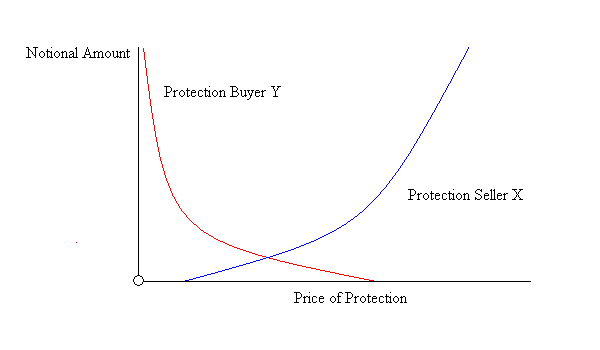
As the price of protection approaches zero, Y’s desired notional amount should approach infinity, since at zero, Y is getting free protection and should desire an unbounded “quantity” of credit protection. The same is true for X as the price of protection approaches infinity.
Synthetic Bonds As Competing Goods With “Real” Bonds
Imagine a world without credit derivatives and therefore without synthetic bonds. In that world, there will be a demand curve for real ABC bonds as a function of the spread the bonds pay over the risk free rate, holding all over variables constant. Now imagine that credit default swaps were introduced to this world. We know that the cash flows of any bond can be synthesized using Treasuries and credit default swaps. For example, assume we have synthesized the cash flows of ABC’s bonds using the method described here. We would expect at least some investors to be indifferent between real ABC bonds and synthetic ABC bonds, since they both produce the same cash flows. Thus, the two are competing products in the sense that investors in real ABC bonds should be potential investors in synthetic ABC bonds. So because some investors will be indifferent between synthetic ABC bonds and real ABC bonds, synthetic ABC bonds will siphon some of the cash that would have otherwise gone to real ABC bonds. Thus, in a world with credit derivatives, we would expect there to be less demand for real bonds than would be present without credit derivatives. In the following chart we express the macroeconomic demand for real ABC bonds in terms of the spread over the risk free rate and the total par value desired by the market.

Thus, the demand for credit derivatives diminishes the demand for real bonds. Although we cannot know exactly what the effect on the demand curve for real bonds will be, we can safely assume that it will be diminished at all levels of return, since at each level, at least some investors will be indifferent to real bonds and synthetic bonds, since each offers the same return.
Real Cash Losses Versus Wealth Transfers Through Derivatives
Economics already has a term to describe payouts under credit default swaps: wealth transfers. Although ordinarily used to describe the cash flows of tax regimes, the term applies equally to the payments under a credit default swap. As described in the previous article, there are no net cash losses under a credit default swap. There is a payment of money from one party to another, the net effect of which is a wealth transfer. That is, credit default swaps, like all derivatives, simply rearrange the current allocation of cash in the financial system, and nothing is lost in process (ignoring transaction costs, which are not relevant to this discussion).
When a real bond defaults, a net cash loss occurs. The borrower has taken the money lent to it by investors, lost it, and the investors are not fully paid back. Therefore, both the borrower and the investors incur a cash loss, creating a net cash loss to the economy. So, in the case of a synthetic ABC bond, upon the default of one of ABC’s bonds, a wealth transfer occurs from the protection seller to the protection buyer and the net effect is null. In the case of a real ABC bond, upon the default of that bond, the investors will lose some of their principle and ABC has already lost some of the money it was lent, the net effect of which is a loss to the economy.
So every dollar siphoned away from real bonds by synthetic bonds is a dollar that will not be lost in the economy upon the occurrence of a credit event. If there were no credit derivatives, then that dollar would have been invested in real bonds and thereby lost upon the occurrence of a credit event. Therefore, the net losses to the economy upon the occurrence of a credit event is less with credit derivatives than without. In the following diagram, the two circles of each transaction represent the parties to that transaction. In the case of real bonds, one of the parties is ABC and the other is an investor. In the case of synthetic bonds, one is the protection seller and the other is the protection buyer of the credit default swap underlying the synthetic bond.

This diagram simply demonstrates what was described above. Namely, that with credit derivatives, some investors will choose synthetic bonds rather than real bonds, thereby reducing the amount of cash exposed to credit risk. Thus, rather than increase the impact of credit risk, credit default swaps actually decrease the impact of credit risk by placating the demand for exposure to credit risk with synthetic instruments that are incapable of producing net losses. However, there may be consequences arising from credit default swaps that cause actual cash losses to an economy, such as a firm failing because of its obligations under credit default swaps. But the failure is not caused by the instrument itself. The nature of the instrument is to reduce the impact of credit risk. The firm’s failure is caused by that firm’s own poor risk management.

 to A, where F is the fee and N is the total amount of A’s exposure, which in the case of a swap would be the
  . If E is the event “ABC defaults on its bonds,” then A and B have entered into a credit default swap where A is short on ABC bonds and B is long. Thus, we can think in terms of a unified price for both sides of the trade and consider how the expected payout for each side of the trade changes as that price changes.
 , then A will accept any fee less than .5 since A’s subjective expected payout under that assumption is
  . If B thinks that E will occur with a probability of
  , then B will accept any fee greater than .25 since his expected payout is
  . Thus, A and B have a bargaining range between .25 and .5. And because each perceives the trade to have a positive payout upon termination within that bargaining range, they will transact. Unfortunately for one of them, only one of them is correct. After many such transactions occur, market participants might choose to report the fees at which they transact. This allows C and D to reference the fee at which the A-B transaction occurred. This process repeats itself and eventually market prices will develop.
 and
and  respectively. If A has positive exposure and B has negative, then in general the subjective expected payouts for A and B are
  and
and  respectively. If we plot the expected payout as a function of F, we get the following:
 where
where  is the price of an ABC series I bond after the risk-event (default) occurs and
  is the par value of an ABC series I bond. For example, if ABC’s series I bonds are trading at 30 cents on the dollar after default,
  and a protection seller would have to payout 70 cents for every dollar of notional amount. The amount that bonds trade at after a default is called the recovery value.
 to the risk-event defined above as the product of (i) the net notional amount of all credit default swaps naming ABC series I bonds as a reference obligation to which
  , and (ii)
  . The net notional amount is simply the difference between the total notional amount of protection bought and the total notional amount of protection sold by
  , will be either negative or zero.
 market participants,
  . The total notional amount of the entire market is given by
  . This is the figure that is most often reported by the media. As is evident, it is impossible to determine the economic significance of this number without first knowing the structure of the market. That is, we must know how much is owed and to whom. However, after we have this information, we can choose different recovery values and then calculate each party’s exposure. This would enable us to determine how much cash each participant would have to set aside for a default at various recovery values (simply calculate each party’s exposure at the various recovery values).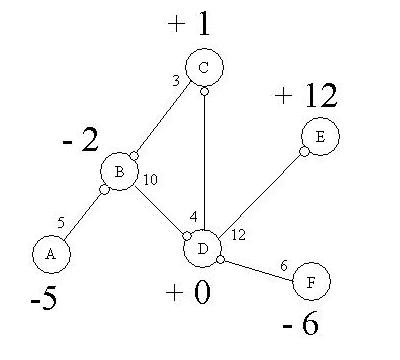
 . As is evident, we can vary the recovery value to determine what each market participant’s exposure would be in that case. We could then consider other risk-events that occur in conjunction with any given risk-event. For example, we could consider the conjunctive risk-event “ABC defaults and B fails to pay under any CDS” (in which case D’s exposure would not be zero) or any other variation that addresses meaningful concerns. For now, we will focus on our single event risk for explanatory purposes. But even if we restrict ourselves to single event risks, there’s more to a CDS than just default. Collateral will move through the above system dynamically throughout the lives of the contracts. In order to understand how we can analyze the systemic risks posed by the dynamic shifting of collateral, we must first examine what it is that causes collateral to be posted under a CDS.
 ?” Because collateral will be posted as the price of protection changes over the life of the agreement and the price of protection provides an implied probability of default, it follows that the answer to this question should have something to do with the flow of collateral.
 where
where  is our assumed implied probability of default and
  different prices. For example, he entered into four contracts at 20 bp and eight contracts at 50bp, and no others. In this case,
  . For each
  , to the sets of contracts that were entered into at different prices by
  be the set of eight contracts entered into at 50bp and let
  be the set of four contracts entered into at 20 bp. Each of these sets will have a net notional amount and an implied probability of default (since each is categorized by price). Define
  as the net notional amount of the contracts in
  and
and  as the implied probability of default of the contracts in
  . We define the expected exposure of
  .
. ,
, .
. Information Overload