The Demand For Risk And A Macroeconomic Theory of Credit Default Swaps: Part 1

A Higher Plane

In this article, I will return to the ideas proposed in my article entitled, “A Conceptual Framework For Analyzing Systemic Risk,” and once again take a macro view of the role that derivatives play in the financial system and the broader economy.  In that article, I said the following:

“Practically speaking, there is a limit to the amount of risk that can be created using derivatives. This limit exists for a very simple reason: the contracts are voluntary, and so if no one is willing to be exposed to a particular risk, it will not be created and assigned through a derivative. Like most market participants, derivatives traders are not in engaged in an altruistic endeavor. As a result, we should not expect them to engage in activities that they don’t expect to be profitable. Therefore, we can be reasonably certain that the derivatives market will create only as much risk as its participants expect to be profitable.”

The idea implicit in the above paragraph is that there is a level of demand for exposure to risk. By further formalizing this concept, I will show that if we treat exposure to risk as a good, subject to the observed law of supply and demand, then credit default swaps should not create any more exposure to risk in an economy than would be present otherwise and that credit default swaps should be expected to reduce the net amount of exposure to risk. This first article is devoted to formalizing the concept of the price for exposure to risk and the expected payout of a derivative as a function of that price.

Derivatives And Symmetrical Exposure To Risk

As stated here, my own view is that risk is a concept that has two components: (i) the occurrence of an event and (ii) a magnitude associated with that event. This allows us to ask two questions: What is the probability of the event occurring? And if it occurs, what is the expected value of its associated magnitude? We say that P is exposed to a given risk if P expects to incur a gain/loss if the risk-event occurs. We say that P has positive exposure if P expects to incur a gain if the risk-event occurs; and that P has negative exposure if P expects to incur a loss if the risk-event occurs.

Exposure to any risk assigned through a derivative contract will create positive exposure to that risk for one party and negative exposure for the other. Moreover the magnitudes of each party’s exposure will be equal in absolute value. This is a consequence of the fact that derivatives contracts cause payments to be made by one party to the other upon the occurrence of predefined events. Thus, if one party gains X, the other loses X. And so exposure under the derivative is perfectly symmetrical. Note that this is true even if a counterparty fails to pay as promised. This is because there is no initial principle “investment” in a derivative. So if one party defaults on a payment under a derivative, there is no cash “loss” to the non-defaulting party. That said, there could be substantial reliance losses. For example, you expect to receive a $100 million credit default swap payment from XYZ, and as a result, you go out and buy $1,000 alligator skin boots, only to find that XYZ is bankrupt and unable to pay as promised. So, while there would be no cash loss, you could have relied on the payments and planned around them, causing you to incur obligations you can no longer afford. Additionally, you could have reported the income in an accounting statement, and when the cash fails to appear, you would be forced to “write-down” the amount and take a paper loss. However, the derivatives market is full of very bright people who have already considered counterparty risk, and the matter is dealt with through the dynamic posting of collateral over the life of the agreement, which limits each party’s ability to simply cut and run. As a result, we will consider only cash losses and gains for the remainder of this article.

The Price Of Exposure To Risk

Although parties to a derivative contract do not “buy” anything in the traditional sense of exchanging cash for goods or services, they are expressing a desire to be exposed to certain risks. Since the exposure of each party to a derivative is equal in magnitude but opposite in sign, one party is expressing a desire for exposure to the occurrence of an event while the other is expressing a desire for exposure to the non-occurrence of that event. There will be a price for exposure. That is, in order to convince someone to pay you $1 upon the occurrence of event E, that other person will ask for some percentage of $1, which we will call the fee.  Note that as expressed, the fee is fixed. So we are considering only those derivatives for which the contingent payout amounts are fixed at the outset of the transaction. For example, a credit default swap that calls for physical delivery fits into this category. As this fee increases, the payout shrinks for the party with positive exposure to the event. For example, if the fee is $1 for every dollar of positive exposure, then even if the event occurs, the party with positive exposure’s payments will net to zero.

This method of analysis makes it difficult to think in terms of a fee for positive exposure to the event not occurring (the other side of the trade). We reconcile this by assuming that only one payment is made under every contract, upon termination. For example, assume that A is positively exposed to E occurring and that B is negatively exposed to E occurring. Upon termination, either E occurred prior to termination or it did not.

sym-exposure2

If E did occur, then B would pay N \cdot(1 - F) to A, where F is the fee and N is the total amount of A’s exposure, which in the case of a swap would be the notional amount of the contract. If E did not occur, then A would pay N\cdot F. If E is the event “ABC defaults on its bonds,” then A and B have entered into a credit default swap where A is short on ABC bonds and B is long. Thus, we can think in terms of a unified price for both sides of the trade and consider how the expected payout for each side of the trade changes as that price changes.

Expected Payout As A Function Of Price

As mentioned above, the contingent payouts to the parties are a function of the fee. This fee is in turn a function of each party’s subjective valuation of the probability that E will actually occur. For example, if A thinks that E will occur with a probability of \frac{1}{2}, then A will accept any fee less than .5 since A’s subjective expected payout under that assumption is N (\frac{1}{2}(1 - F) - \frac{1}{2}F ) = N (\frac{1}{2} - F). If B thinks that E will occur with a probability of \frac {1}{4}, then B will accept any fee greater than .25 since his expected payout is N (\frac{3}{4} F - \frac{1}{4}(1 - F)) = N (F - \frac{1}{4} ). Thus, A and B have a bargaining range between .25 and .5. And because each perceives the trade to have a positive payout upon termination within that bargaining range, they will transact. Unfortunately for one of them, only one of them is correct. After many such transactions occur, market participants might choose to report the fees at which they transact. This allows C and D to reference the fee at which the A-B transaction occurred. This process repeats itself and eventually market prices will develop.

Assume that A and B think the probability of E occurring is p_A and p_B respectively. If A has positive exposure and B has negative, then in general the subjective expected payouts for A and B are N (p_A - F) and N ( F - p_B) respectively. If we plot the expected payout as a function of F, we get the following:

payout-v-fee4

The red line indicates the bargaining range.  Thus, we can describe each participant’s expected payout in terms of the fee charged for exposure. This will allow us to compare the returns on fixed fee derivatives to other financial assets, and ultimately plot a demand curve for fixed fee derivatives as a function of their price.
You’re Trespassing On My Credit Event

Insurable Interests

When you purchase fire insurance on your own home, you are said to have an insurable interest. That is, you have an interest in something and you’d like to insure it against a certain risk. In the case of fire insurance, the insurable interest is your house and the risk is fire burning your house down. Through an insurance policy, and in exchange for a fee, you can effectively transfer, to some 3rd party, financial exposure to the risk that your insurable interest (house) will burn down.

When you purchase protection on a bond through a credit default swap, you may or may not own the underlying bond. As such, you may or may not have something analogous to an insurable interest. David Merkel over at The Aleph Blog brought this issue to my attention in a comment on one of my many rants about credit default swaps. Although you should read his article in its entirety, his argument goes like this: just like you wouldn’t want someone you don’t know taking out a life insurance policy on you (because that would give them an incentive to contribute to your death), corporation ABC doesn’t want swap dealers selling protection on their bonds to those who don’t own them (since these buyers would profit from ABC’s failure). Technically, ABC wouldn’t want protection being sold to those that have a negative economic interest in ABC’s debt.

Courting Disaster

We might find it objectionable that one person takes out an insurance policy on the life of another. This is understandable. After all, we don’t want to incentivize murder. But we already incentivize creating illness. Doctors, hospitals, and pharmaceutical companies all have incentives to create illnesses that only they can cure, thus diverting money from other economic endeavors their way. More importantly, even if you don’t accept the “it’s no big deal” argument, insurance contracts have a feature that prevents the creation of incentives to destroy life and property: they are voluntary, just like derivatives.

In order for you to purchase a policy on my life, someone has to sell it to you. And like most businesses, insurance businesses are not engaged in an altruistic endeavour. So, when you come knocking on their door asking them to issue a $100 million policy on my life, they will be suspicious, and rightfully so. They will probably realize that given the fact that you are not me, $100 million is probably enough money to provide you with an incentive to have me end up under a bus. And of course, they will not issue the policy. But not because they care whether or not I end up under a bus. Rather, they will not issue the policy because it’s a terrible business decision. They know that it doesn’t cost much to kill someone, and therefore, as a general idea, issuing life insurance policies to those who have no interest in the preservation of the insured life is a bad business decision. The same applies to policies on cars, houses, etc that the policy holder doesn’t own. As is evident, the concept of an insurable interest is simply a reflection of common sense business decisions.

You Sunk My Battleship

So why do swap dealers sell protection on ABC’s bonds to people that don’t own them? Isn’t that the same as selling a policy on my life to you? Aren’t they worried that the protection buyer will go out and destroy ABC? Clearly, they are not. If you read this blog often, you know that swap dealers net their exposure. So, is that why they’re not worried? No, it is not. Even though the swap dealer’s exposure is neutral, if the dealer sold protection to one party, the dealer bought protection from another. While the network of transactions can go on for a while, it must be the case that if one party is a net buyer of protection, another is a net seller. So, somewhere along the network, someone is exposed as a net buyer and another is exposed as a net seller.

So aren’t the net sellers worried that the net buyers will go out and destroy ABC? Clearly, they are not. The only practical way to gain the ability to run a company into the ground is to gain control of it. And the only practical way to gain control of it is to purchase a large stake in it. This is an enormous barrier. A would be financial assassin would have to purchase a large enough stake to gain control and at the same time purchase more than that amount in protection through credit default swaps, and do so without raising any eyebrows. If this sounds ridiculous it’s because it is. But even if you think it’s a viable strategy, ABC should be well aware that there are those in the world who would benefit from the destruction of their company. This is not unique to protection buyers, but applies also to competitors who would love to take ABC over and liquidate their assets and take over their distribution network; or plain vanilla short sellers; or environmentalist billionaires who despise ABC’s tire burning business. In short, ABC should realize that there are those who are out to get them, whatever their motive or method, and plan accordingly.

Hands Off My Ether

The fact that others are willing to sell protection on ABC to those who don’t own ABC bonds suggests that any insurable interest that ABC has is economically meaningless. For if it weren’t the case, as in the life policy examples, no one would sell protection. But they do. So, it follows that protection sellers don’t buy the arguments about the opportunities for murderous arbitrage. So what is ABC left with? An ethereal and economically meaningless right to stop other people from referencing them in private contracts. This is akin to saying “you can’t talk about me.” That is, they are left with the right to stop others from trespassing on their credit event. And that’s just strange.

The Mythology Of Credit Default Swaps

Systemic Speculation

Pundits from all corners have been chiming in on the debate over derivatives. And much like the discourse that has dominated the rest of human history, reason, temperance, and facts play no role in the debate. Rather, the spectacular, outrage, and irrational blame have been the big winners lately. As a consequence, credit default swaps have been singled out as particularly dangerous to the financial system. Why credit default swaps have been targeted as opposed to other derivatives is not entirely clear to me, although I do have some theories. In this article I debunk many of the common myths about credit default swaps that are circulating in the popular press. For an explanation of how credit default swaps work, see this article.

The CDS Market Is Not The Largest Thing Known To Humanity

The media likes to focus on the size of the market, reporting shocking figures like $45 trillion and $62 trillion. These figures refer to the notional amount of the contracts, and because of netting, these figures do not provide a meaningful picture of the amount of money that will actually change hands. That is, without knowing the structure of the credit default swap market, we cannot determine the economic significance of these figures. As such, these figures should not be compared to real economic indicators such as GDP.

But even if you’re too lazy to think about how netting actually operates, why would you focus on credit default swaps? Even assuming that the media’s shocking double digit trillion dollar amounts have real economic significance, the credit default swap market is not even close in scale to the interest rate swap market, which is an even more shocking $393 trillion market. But alas, we are in the midst of a “credit crisis” and not an “interest rate crisis.” As such, headlines containing the terms “interest rate swap” will not fare as well as those containing “credit default swap” in search engines or newsstands. Perhaps one day interest rate swaps will have their moment in the sun, but for now they are an even larger and equally unregulated market that’s just as boring and uneventful as the credit default swap market.

Credit Default Swaps Do Not Facilitate “Gambling”

One of the most widely stated criticisms of credit default swaps is that they are a form of gambling. Of course, this allegation is made without any attempt to define the term “gambling.” So let’s begin by defining the term “gambling.” In my mind, the purest form of gambling involves the wager of money on the outcome of events that cannot be controlled or predicted by the person making the wager. For example, I could go to a casino and place a $50 bet that if a casino employee spins a roulette wheel and spins a ball onto the wheel, the ball will stop on the number 3. In doing so, I have posted collateral that will be lost if an event (the ball stopping on the number 3) fails to occur, but will receive a multiple of my collateral if that event does indeed occur. I have no ability to affect the outcome of the event and more importantly for our purposes, I have absolutely no way of predicting what the outcome will be. In short, my “investment” is a blind guess as to the outcome of a random event.

Now let’s compare that with someone (B) buying protection on ABC’s bonds through a credit default swap. Assume that B is as villainous as he could be: that is, assume that he doesn’t own the underlying bond. This evildoer is in effect betting upon the failure of ABC. What a nasty thing to do. And why would he do such a thing? Well, B might reasonably believe that ABC is going to fail in the near future based on market conditions and information disclosed by ABC. But why should someone profit from ABC’s failure? Because if B’s belief in ABC’s impending failure is shared by others, their collective selfish desire to profit will push the price of protection on ABC’s bonds up, which will signal to the market-at-large that the CDS market believes that there will be an event of default on ABC issued debt. That is, a market full of people who specialize in recognizing financial disasters will inadvertently share their expertise with the world.

So, in the case of the roulette wheel, we have money committed to the occurrence of an event that cannot be controlled or predicted by the person making the commitment. Moreover, this “investment” is made for no bona fide economic purpose with an expected negative return on investment. In the case of B buying protection through a CDS on a bond he did not own, we have money committed to the occurrence of an event that cannot be controlled by B but can be reasonably predicted by B, and through collective action we have the serendipitous effect of sharing information. To call the latter gambling is to call all of investing gambling. For there is no difference between the latter and buying stock, buying bonds, investing in the college education of your children, etc.

The Credit Default Swap Market Is Not An Insurance Market

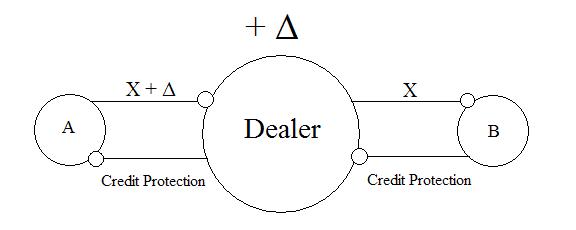
Credit default swaps operate like insurance at a bilateral level. That is, if you only focus on the two parties to a credit default swap, the agreement operates like insurance for both parties. But to do so is to fail to appreciate that a credit default swap is exactly that: a swap, and not insurance. Swap dealers are large players in the swap markets that buy from one party and sell to another, and pocket the difference between the prices at which they buy and sell. In the case of a CDS dealer, dealer (D) sells protection to A and then buys protection from B, and pockets the difference in the spreads between the two transactions. If either A or B has dodgy credit, D will require collateral. Thus, D’s net exposure to the bond is neutral. While this is a simplified explanation, and in reality D’s neutrality will probably be accomplished through a much more complicated set of trades, the end goal of any swap dealer is to get close to neutral and pocket the spread.

cds-swap-dealer

That said, insurance companies such as MBIA and AIG did participate in the CDS market, but they did not follow the business model of a swap dealer. Instead, they applied the traditional insurance business model to the credit default swap market, with notoriously less than stellar results. The traditional insurance business model goes like this: issue policies, estimate liabilities on those policies using historical data, pool enough capital to cover those estimated liabilities, and hopefully profit from the returns on the capital pool and the fees charged under the policies.  Thus, a traditional insurer is long on the assets it insures while a swap dealer is risk-neutral to the assets on which it is selling protection, so long as its counterparties pay. So, a swap dealer is more concerned about counterparty risk: the risk that one of its counterparties will fail to payout. As mentioned above, if either counterparty appears as if it is unable to pay, it will be required to post collateral. Additionally, as the quality of the assets on which protection is written deteriorates, more collateral will be required. Thus, even in the case of counterparty failure, collateral will mitigate losses.

This collateral feature is missing on both ends of the traditional insurance model. Better put, there is no “other end” for a traditional insurer. That is, the insurance business model does not hedge risk, it absorbs it. So if a traditional insurer sold protection on bonds that had risks it didn’t understand, e.g., mortgage backed securities, and it consequently underestimated the amount of capital it needed to store to meet liabilities, it would be in some serious trouble. A swap dealer in the same situation, even if its counterparties failed to appreciate these same risks, would be compensated gradually over the life of the agreement through collateral.
