Credit Default Swaps And Mortgage Backed Securities

Like Your Grandsire In Alibaster

In this article, I will apply my usual dispassionate analysis to the role that credit default swaps play in the world of Mortgage Backed Securities (MBSs). We will take a brief look at the interactions between the issuance of mortgages, MBSs, and how the concept of loss plays out in the context of derivatives and mortgages. Then we will explore how the expectations of the parties to a lender/borrower relationship differ from that of a protection seller/buyer relationship and how credit default swaps, by allowing markets to express a negative view of mortgage default risk, facilitate price correction and mitigate net losses. This is done by applying the concepts in my previous article, The Demand For Risk And A Macroeconomic Theory of Credit Default Swaps: Part 2, to the context of credit default swaps on MBSs. This article can be considered a more concrete application of the concepts in that article, which will hopefully clear up some of the confusion in that article’s comment section.

The Path Of Funds In the MBS Market

Mortgage backed securities allow investors to gain exposure to the housing market by taking on credit risk linked to a pool of mortgages. Although the underlying mortgages are originated by banks, the existence of investor demand for MBSs allows the originators to effectively pass the mortgages off to the investors and pocket a fee. Thus, the greater the demand for MBSs, the greater the total value of mortgages that originators will issue and ultimately pass off to investors. So, the originators might front the money for the mortgages in many cases, but the effective path of funds is from the investors, to the originators, and onto the borrower. As a result, investors in MBSs are the effective lenders in this arrangement, since they bear the credit risk of the mortgages.

This market structure also has an effect on the interest rates charged on the underlying mortgages. As investor demand for MBSs increases, the amount of cash available for mortgages will increase, pushing the interest rates charged on the underlying mortgages down as originators compete for borrowers.

Loss In The Context Of Derivatives And Mortgages

I often note that derivatives cannot create net losses in an economy. That is, they simply transfer money between two parties. If one party loses X, the other gains X, so the net loss between the two parties is zero. For more on this, go here. This is not the case with a mortgage. The lender gives money to the borrower, who then spends this money on a home. Assume that a lender and borrower entered into a mortgage and that before maturity the value of the home falls, prompting the borrower to default on its mortgage. Further assume that the lender forecloses on the property, selling it at a loss. Since the buyer receives none of the foreclosure proceeds, the buyer can be viewed as either neutral or incurring a loss, since at least some of the borrower’s mortgage payments went towards equity ownership and not just occupancy. It follows that there is a loss to the lender and either no change in or a loss to the borrower and therefore a net loss. This demonstrates what we have all recently learned: poorly underwritten mortgages can create net losses.

Net Losses And Efficiency

You can argue that even in the case that both parties to an agreement incur losses, the net loss to the economy is zero, since the cash transferred under the agreement was not destroyed but merely moved through the economy to market participants that are not a party to the agreement. That is, if you expand the number of parties to a sufficient degree, all transactions will net to zero. While this must be the case, it misses an essential point: I am using net losses to bilateral agreements as a proxy for inefficient allocation of capital. That is, both parties expected to benefit from the agreement, yet both lost money, which implies that neither benefited from the agreement. For example, in the case of a mortgage, the borrower expects to pay off the mortgage but benefit from the use and eventual ownership or sale of the home. The lender expects to profit from the interest paid on the mortgage. When both of these expectations fail, I take this as implying that the initial agreement was an inefficient allocation of capital. This might not always be the case and depends on how you define efficiency. But as a general rule, it is my opinion that net losses to a bilateral agreement are a reasonable proxy for inefficient allocation of capital.

Expectations Of Lender/Borrower vs. Protection Seller/Buyer

As mentioned above, under a mortgage, the lender expects to benefit from the interest paid on the mortgage while the borrower expects to benefit from the use and eventual ownership or sale of the home. Implicit in the expectations of both parties is that the mortgage will be repaid. Economically, the lender is long on the mortgage. That is, the lender gains if the mortgage is fully repaid. Although application of the concepts of long and short to the borrower’s position is awkward at best, the borrower is certainly not short on the mortgage. That is, in general, the borrower does not gain if he fails to repay the mortgage. He might however mitigate his losses by defaulting and declaring bankruptcy. That said, the takeaway is that both the lender and the borrower expect the mortgage to be repaid. So, if we consider only lenders and borrowers, there are no participants with a true short position in the market. Thus, price, which in this case is an interest rate, will be determined by participants with similar positive expectations and incentives. Anyone with a negative view of the market has no role to play and therefore no effect on price.

This is not the case with credit default swaps (CDSs) referencing MBSs. In such a CDS, the protection seller is long on the MBS and therefore long on the underlying mortgages, and the protection buyer is short. That is, if the MBS pays out, the protection seller gains on the swap; and if the MBS defaults, the protection buyer gains on the swap. Thus, through the CDS, the two parties express opposing expectations of the performance of the MBS. Thus, the CDS market provides an opportunity to express a negative view of mortgage default risk.

The Effect Of Synthetic Instruments On “Real” Instruments

As mentioned above, the CDS market provides a method of shorting MBSs. But how does that effect the price of MBSs and ultimately interest rates? As described here, the cash flows of any bond, including MBSs, can be synthesized using Treasuries and CDSs. Using this technique, a fully funded synthetic bond consists of the long end of a CDS and a Treasury. The spread that the synthetic instrument pays over the risk free rate is determined by the price of protection that the CDS pays the investor (who in this case is the protection seller). One consequence of this is that there are opportunities for arbitrage between the market for real bonds and CDSs if the two markets don’t reach an equilibrium, removing any opportunity for arbitrage. Because this opportunity for arbitrage is rather obvious, we assume that it cannot persist. That is, as the price of protection on MBSs increases, the spread over the risk free rate paid by MBSs should widen, and visa versa. Thus, as the demand for protection on MBSs increases, we would expect the interest rates paid by MBSs to increase, thereby increasing the interest rates on mortgages. Thus, those with a negative view of MBS default risk can raise the cost of funds on mortgages by buying protection through CDSs on MBSs, thereby inadvertently “correcting” what they view as underpriced default risk.

In addition to the no-obvious-arbitrage argument outlined above, we can consider how the existence of synthetic MBSs affects the supply of comparable investments, and thereby interest rates. As mentioned above, any MBS can be synthesized using CDSs and Treasuries (when the synthetic MBS is unfunded or partially funded, it consists of CDSs and other investments, not Treasuries). Thus, investors will have a choice between investing in real MBSs or synthetic MBSs. And as explained above, the price of each should come to an equilibrium that excludes any opportunity for obvious arbitrage between the two investments. Thus, we would expect at least some investors to be indifferent between the two.

path_of_fundsDepending on whether the synthetics are fully funded or not, the principle investment will go to the Treasuries market or back into the capital markets respectively. Note that synthetic MBSs can exist only when there is a protection buyer for the CDS that comprises part of the synthetic. That is, only when interest rates on MBSs drop low enough, along with the price of protection on MBSs, will protection buyers enter CDS contracts. So when protection buyers think that interest rates on MBSs are too low to reflect the actual probability of default, their desire to profit from this will facilitate the issuance of synthetic MBSs, thereby diverting cash from the mortgage market and into either Treasuries or other areas of the capital markets. Thus, the existence of CDSs operates as a safety valve on the issuance of MBSs. When interest rates sink too low, synthetics will be issued, diverting cash away from the mortgage market.
The Demand For Risk And A Macroeconomic Theory of Credit Default Swaps: Part 2

Redux And Reduction

In the previous article, we defined a highly abstract framework that considered the subjective expected payout of both sides of a fixed fee derivative.  In this article, we will apply that model to the context of credit default swaps and will show that the presence of credit default swaps and synthetic bonds should be expected to reduce the demand for “real” bonds (as opposed to synthetic bonds) and thereby reduce the net exposure of an economy to credit risk.

The Demand For Credit Default Swaps

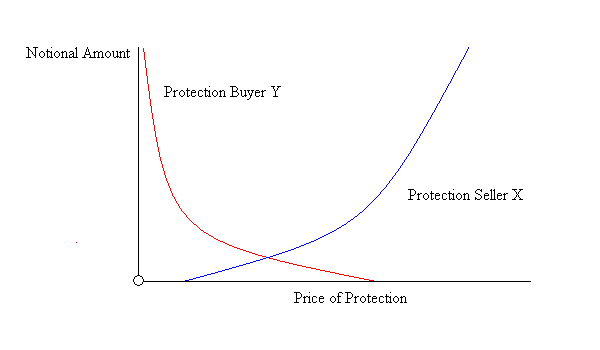
In the previous article, we plotted the expected payout of each party to a credit default swap as a function of the fee and each party’s subjective valuation of the probability that a default will occur. The simple observation gleaned from that chart was that if we fix the subjective probabilities of default, protection sellers expect to earn more as the price of protection increases and protection buyers expect to earn more as the price of protection decreases.  Thus, as the the price of protection increases, we would expect protection seller side “demand” to increase and expect protection buyer side “demand” to decrease.  But how can demand be expressed in the context of a credit derivative? The general idea is to assume that holding all other variables constant, the size of the desired notional amount of the CDS will vary with price. So in the case of protection sellers, the greater the price of protection, the greater the notional amount desired by any protection seller.

In order to further formalize this concept, we should consider each reference entity as defining a unique demand curve for each market participant. We should also distinguish between demand for buying protection and demand for selling protection. For convenience’s sake, we will refer to the demand for selling protection as the supply of credit protection and demand for buying credit protection as the demand for credit protection. For example, consider protection seller X’s supply curve and protection buyer Y’s demand curve for CDSs naming ABC as a reference entity. The following chart expresses the total notional amount of all CDSs desired by X and Y as a function of the price of protection.

supply-demand-credit-exposure1

As the price of protection approaches zero, Y’s desired notional amount should approach infinity, since at zero, Y is getting free protection and should desire an unbounded “quantity” of credit protection. The same is true for X as the price of protection approaches infinity.

Synthetic Bonds As Competing Goods With “Real” Bonds

Imagine a world without credit derivatives and therefore without synthetic bonds. In that world, there will be a demand curve for real ABC bonds as a function of the spread the bonds pay over the risk free rate, holding all over variables constant. Now imagine that credit default swaps were introduced to this world. We know that the cash flows of any bond can be synthesized using Treasuries and credit default swaps. For example, assume we have synthesized the cash flows of ABC’s bonds using the method described here. We would expect at least some investors to be indifferent between real ABC bonds and synthetic ABC bonds, since they both produce the same cash flows. Thus, the two are competing products in the sense that investors in real ABC bonds should be potential investors in synthetic ABC bonds. So because some investors will be indifferent between synthetic ABC bonds and real ABC bonds, synthetic ABC bonds will siphon some of the cash that would have otherwise gone to real ABC bonds. Thus, in a world with credit derivatives, we would expect there to be less demand for real bonds than would be present without credit derivatives. In the following chart we express the macroeconomic demand for real ABC bonds in terms of the spread over the risk free rate and the total par value desired by the market.

demand-with-credit-derivatives

Thus, the demand for credit derivatives diminishes the demand for real bonds. Although we cannot know exactly what the effect on the demand curve for real bonds will be, we can safely assume that it will be diminished at all levels of return, since at each level, at least some investors will be indifferent to real bonds and synthetic bonds, since each offers the same return.

Real Cash Losses Versus Wealth Transfers Through Derivatives

Economics already has a term to describe payouts under credit default swaps: wealth transfers. Although ordinarily used to describe the cash flows of tax regimes, the term applies equally to the payments under a credit default swap. As described in the previous article, there are no net cash losses under a credit default swap. There is a payment of money from one party to another, the net effect of which is a wealth transfer. That is, credit default swaps, like all derivatives, simply rearrange the current allocation of cash in the financial system, and nothing is lost in process (ignoring transaction costs, which are not relevant to this discussion).

When a real bond defaults, a net cash loss occurs. The borrower has taken the money lent to it by investors, lost it, and the investors are not fully paid back. Therefore, both the borrower and the investors incur a cash loss, creating a net cash loss to the economy. So, in the case of a synthetic ABC bond, upon the default of one of ABC’s bonds,  a wealth transfer occurs from the protection seller to the protection buyer and the net effect is null. In the case of a real ABC bond, upon the default of that bond, the investors will lose some of their principle and ABC has already lost some of the money it was lent, the net effect of which is a loss to the economy.

So every dollar siphoned away from real bonds by synthetic bonds is a dollar that will not be lost in the economy upon the occurrence of a credit event. If there were no credit derivatives, then that dollar would have been invested in real bonds and thereby lost upon the occurrence of a credit event. Therefore, the net losses to the economy upon the occurrence of a credit event is less with credit derivatives than without. In the following diagram, the two circles of each transaction represent the parties to that transaction. In the case of real bonds, one of the parties is ABC and the other is an investor. In the case of synthetic bonds, one is the protection seller and the other is the protection buyer of the credit default swap underlying the synthetic bond.

net-losses-with-derivatives

This diagram simply demonstrates what was described above. Namely, that with credit derivatives, some investors will choose synthetic bonds rather than real bonds, thereby reducing the amount of cash exposed to credit risk. Thus, rather than increase the impact of credit risk, credit default swaps actually decrease the impact of credit risk by placating the demand for exposure to credit risk with synthetic instruments that are incapable of producing net losses. However, there may be consequences arising from credit default swaps that cause actual cash losses to an economy, such as a firm failing because of its obligations under credit default swaps. But the failure is not caused by the instrument itself. The nature of the instrument is to reduce the impact of credit risk. The firm’s failure is caused by that firm’s own poor risk management.

Derivatives/Synthetic Instruments Demystified

What Is A Derivative?

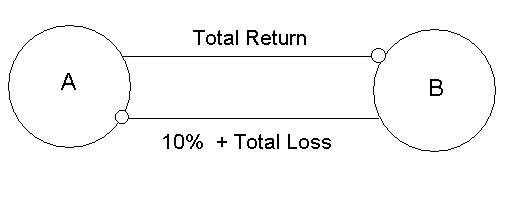
A derivative is a contract that derives its value by reference to “something else.” That something else can be pretty much anything that can be objectively observed and measured. For example, two parties, A and B, could get together and agree to take positions on the Dow Jones Industrial Average (DJIA). That’s an index that can be objectively observed and measured. A could agree to pay B the total percentage-wise return on that index from October 31, 2007 to October 31, 2008 multiplied by a notional amount, where that amount is to be paid on October 31, 2008. In exchange, B could agree to make quarterly payments of some percentage of the notional amount (the swap fee) over that same time frame. Let’s say the notional amount is $100 (a position that even Joe The Plumber can take on); the swap fee is 10% per annum; and the total return on the DJIA over that period is 15%. It doesn’t take Paul Erdős to realize that this leaves B in the money and A out of the money (A pays $15 and receives $10, so he loses $5).

But what if the DJIA didn’t gain 15%? What if it tanked 40% instead? In that case, we have to look to our agreement. Our agreement allocated the DJIA’s returns to B and fixed payments to A. It didn’t mention DJIA loss. The parties can agree to distribute gain and loss in the underlying reference (the DJIA) any way they like: that’s the beauty of enforceable contracts. Let’s say that under their agreement, B agreed to pay the negative returns in the DJIA multiplied by the notional amount.  If the market tanked 40%, then B would have made the fixed payments of 10% over the life of the agreement, plus another 40% at the end. That leaves him down $50. Bad year for B.

Follow The Money

So what is the net effect of that agreement? B always pays 10% to A, whether the DJIA goes up, down, or stays flat over the relevant time frame. If the DJIA goes up, A has to pay B the percentage-wise returns. If the DJIA goes down, B has to pay A the percentage-wise losses. So, A profits if the DJIA goes down, stays flat, or goes up less than 10% and B profits if the DJIA goes up more than 10%. So, A is short on the DJIA going up 10% and B is long on the DJIA going up 10%. This is accomplished without either of them taking actual ownership of any stocks in the DJIA. We say that A is synthetically shorting the DJIA and B is synthetically long on the DJIA. This type of agreement is called a total return swap (TRS). This TRS exposes A to the risk that the DJIA will appreciate by more than 10% over the life of the agreement and B to the risk that the DJIA will not appreciate by more than 10%.

What Is Risk?

There are a number of competing definitions depending on the context. My own personal view is that risk has two components: (i) the occurrence of an event and (ii) a magnitude associated with that event. This allows us to ask two questions: What is the probability of the event occurring? And if it occurs, what is the expected value of its associated magnitude? We say that P is exposed to a given risk if P expects to incur a gain/loss if the risk-event occurs. For example, in the TRS between A and B, A is exposed to the risk that the DJIA will appreciate by more than 10% over the life of agreement. That risk has two components: the event (the DJIA appreciating by more than 10%) and a magnitude associated with that event (the amount by which it exceeds 10%). In this case, the occurrence of the event and its associated magnitude are equivalent (any non-zero positive value for the magnitude implies that the event occurred) and so our two questions reduce to one question: what is the expected value of the DJIA at the end of the agreement? That obviously depends on who you ask. So, can we then infer that A expects the DJIA to gain less than 10% over the life of the agreement? No, we cannot. If A actually owns $100 worth of the DJIA, A is fully hedged and the agreement is equivalent to bona fide financing. That is, A has no exposure to the DJIA (short on the DJIA through the TRS and long through actually owning it) and makes money only through the swap fee. B’s position is the same whether A owns the underlying index or not: B is long on the DJIA, as if he actually owned it. That is, B has synthesized exposure to the DJIA. So, if A is fully hedged the TRS is equivalent to a financing agreement where A “loans” B $100 to buy $100 worth of the DJIA, and then A holds the assets for the life of agreement (like a collateralized loan). As such, B will never agree to pay a swap fee on a TRS that is higher than his cost of financing (since he can just go get a loan and buy the reference asset).

How Derivatives Create, Allocate, And “Transfer” Risk

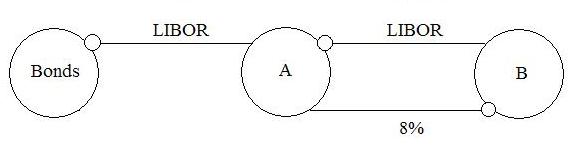
It is commonly said that derivatives transfer risk. This is not technically true, but often appears to be the case.  Derivatives operate by creating risks that were not present before the parties entered into the derivative contract. For example, assume that A and B enter into an interest rate swap, where A agrees to pay B a fixed annual rate of 8% and B agrees to pay A a floating annual rate, say LIBOR, where each is multiplied by a notional amount of $100. Each party agrees to make quarterly payments. Assume that on the first payment date, LIBOR = 4%.  It follows that A owes B $2 and B owes A $1. So, after netting, A pays B $1.

Through the interest rate swap, A is exposed to the risk that LIBOR will fall below 8%. Similarly, B is exposed to the risk that LIBOR will increase above 8%. The derivative contract created these risks and assigned them to A and B respectively. So why do people say that derivatives transfer risk? Assume that A is a corporation and that before A entered into the swap, A issued $100 worth of bonds that pay investors LIBOR annually. By issuing these bonds, A became exposed to the risk that LIBOR would increase by any amount. Assume that the payment dates on the bonds are the same as those under the swap. A’s annual cash outflow under the swap is (.08 – LIBOR) x 100. It’s annual payments on the bonds are LIBOR x 100. So it’s total annual cash outflow under both the bonds and the swap is:

(.08 – LIBOR) x 100 +  LIBOR x 100 = .08 x 100 – LIBOR x 100  + LIBOR x 100 = 8%.

So, A has taken its floating rate LIBOR bonds and effectively transformed them into fixed rate bonds. We say that A has achieved this fixed rate synthetically.

At first glance, it appears as though A has transferred its LIBOR exposure to B through the swap.  This is not technically true. Before A entered into the swap, A was exposed to the risk that LIBOR would increase by any amount. After the swap, A is exposed to the risk that LIBOR will fall under 8%. So, even though A makes fixed payments, it is still exposed to risk: the risk that it will pay above its market rate of financing (LIBOR). For simplicity’s sake, assume that B was not exposed to any type of risk before the swap. After the swap, B is exposed to the risk that LIBOR will rise above 8%. This is not the same risk that A was exposed to before the swap (any increase in LIBOR) but it is a similar one (any increase in LIBOR above 8%).

So What Types Of Risk Can Be Allocated Using Derivatives?

Essentially any risk that has an objectively observable event and an objectively measureable associated magnitude can be assigned a financial component and allocated using a derivative contract. There are derivative markets for risks tied to weather, energy products, interest rates, currency, etc. Wherever there is a business or regulatory motivation, financial products will appear to meet the demand. What is important is to realize that all of these products can be analyzed in the same way: identify the risks, and then figure out how they are allocated. This is usally done by simply analyzing the cash flows of the derivative under different sets of assumptions (e.g., the DJIA goes up 15%).

Netting Demystified

Netting Is For Everyone, Not Just Fancy Swap Traders

Unlike most terms used in the derivatives world, netting is a good one. It has an intuitive, albeit hokey, feel (unlike other rather sterile terms such as “synthetic collateralized debt obligation”). After all, economics is about human decisions and actions, and as such, it can stand to be a bit hokey. So what is netting? The concept stems from a very simple observation: if I owe you $5 and you owe me $10, you should just give me $5. We could have several debts between the two of us, (e.g., I owe you $2 from Wednesday, $3 from Thursday), but assume we add those up into one debt per person, resulting in one transactional leg (line connecting us) each. In this case, netting would save us a bit of trouble since we only exchange money once, instead of twice.

That Is So Obvious And Trivial That It Can’t Be Right

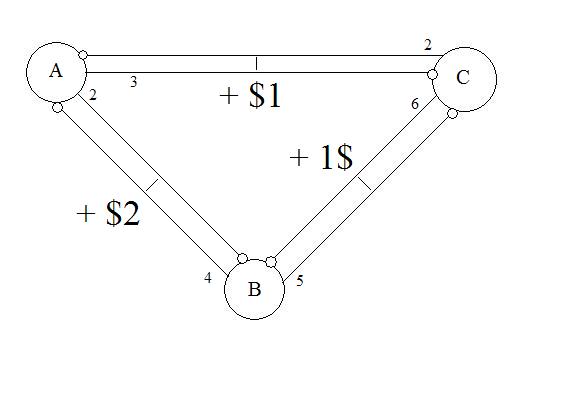
The observation above is indeed an example of the same principle (netting) that is applied to swaps. Our example however, only has 2 parties. The time saved from engaging in 1 transaction instead of 2 is minimal, especially when it’s a transaction for such a small amount of money. This is a result of the fact that when there are only 2 parties, let’s say you and me, there are only 2 legs to the transaction: the money coming out of me and the money coming out of you. The netting example above reduces that to 1 leg (you pay me). That’s called bilateral netting. Again, when there are only 2 parties, the application of netting is simple. But the number of legs increases dramatically as we increase the number of parties (for my fellow graph theorists, the number of legs is twice the number of edges in a complete graph with N nodes, where N is the number of parties). For example,  consider the obligations of 3 friends: A, B and C. A owes B $2; A owes C $3; B owes A $4; B owes C $5; C owes A $2; and finally C owes B $6.

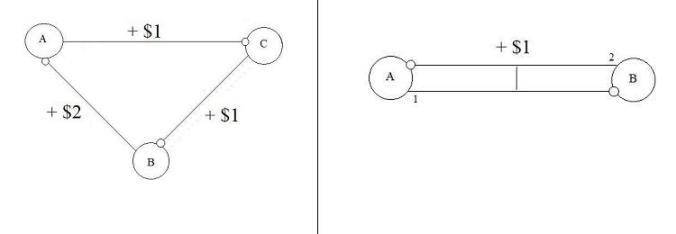
We apply bilateral netting to each of the pairs. That leaves us with the following: A owes C $1; B owes A $2; and C owes B $1. We could just execute 3 transactions and call it a day. But we’re smarter than that. We notice that C is basically passing the $1 from A onto B. That is, his inflow is the same as his outflow, so he serves no purpose in our transaction. So, we cut him out of the picture:

Note that the last step we just took, cutting C out, was not bilateral netting. It was a different kind of netting. It required a different observation, but the principle is the same: only engage in necessary transactions. Finally, we apply bilateral netting to the transaction between A and B. So, in the end, that complex sea of relationships boiled down to B paying A $1.

Balsamic Reduction

Rather then execute a disastrously complicated web of transactions, swap dealers, and ordinary banks, use clearing houses to do exactly what we just did above, but on a gigantic scale. Obviously, this is done by an algorithm, and not by hand. Banks, and swap dealers, prefer to strip down the number of transactions so that they only part with their cash when absolutely necessary. There are all kinds of things that can go wrong while your money spins around the globe, and banks and swap dealers would prefer, quite reasonably, to minimize those risks.

An Engine Of Misunderstanding

As you can see from the transactions above, the total amount of outstanding debts is completely meaningless. That complex web of relationships between A, B, and C, reduced to 1 transaction worth $1. Yet, the media would have certainly reported a cataclysmic 2 + 3 + 4 + 5 + 2 + 6 = $22 in total debts.