Genetic Alignment
Because of relatively recent advances in genetic sequencing, we can now read entire mtDNA genomes. However, because mtDNA is circular, it’s not clear where you should start reading the genome. As a consequence, when comparing two genomes, you have no common starting point, and the selection of that starting point will impact the number of matching bases. As a simple example, consider the two fictitious genomes 


It turns out that mtDNA is unique in that it is inherited directly from the mother, generally without any mutations at all. As such, the intuition for combinations of sequences typically associated with genetics is inapplicable to mtDNA, since there is no combination of traits or sequences inherited from the mother and the father, and instead a basically perfect copy of the mother’s genome is inherited. As a result, it makes perfect sense to use a global alignment, which we did above, where we compared one entire genome
For example, consider genomes 


Note that the number of possible global alignments is simply the length of the genome. That is, when using a global alignment, you “fix” one genome, and “rotate” the other, one base at a time, and that will cover all possible global alignments between the two genomes. In contrast, the number of local alignments is much larger, since you have to consider all local alignments of each possible length. As a result, it is much easier to consider all possible global alignments between two genomes, than local alignments. In fact, it turns out there is exactly one plausible global alignment for mtDNA, making global alignments extremely attractive in terms of efficiency. Specifically, it takes 0.02 seconds to compare a given genome to my entire dataset of roughly 650 genomes using a global alignment. Performing the same task using a local alignment takes one hour, and the algorithm I’ve been using considers only a small subset of all possible local alignments. That said, local alignments allow you to take a closer look at two genomes, and find common segments, which could indicate a common evolutionary history. This note discusses global alignments, I’ll write something soon that discusses local alignments, as a second look to support my work on mtDNA generally.
Nearest Neighbor
The Nearest Neighbor algorithm can provably generate perfect accuracy for certain Euclidean datasets. That said, DNA is obviously not Euclidean, and as such, the results I proved do not hold for DNA datasets. However, common sense suggests we might as well try it, and it turns out, you get really good results that are significantly better than chance. To apply the Nearest Neighbor algorithm to an mtDNA genome 

The Global Distribution of mtDNA
It turns out the distribution of mtDNA is truly global, and a result, we should not be surprised that the accuracy of the Nearest Neighbor method as applied to my dataset is a little low, though as noted, it is significantly higher than chance and therefore plainly not producing random predictions. That is, if we ask what is e.g., the best match for a Norwegian genome, you could find that it is a Mexican genome, which is in fact the case for this Norwegian genome. Now you might say this is just a Mexican person that lives in Norway, but I’ve of course thought of this, and each genome has been diligenced to ensure that the stated ethnicity of the person is e.g., Norwegian.
Now keep in mind that this is literally the closest match for this Norwegian genome, and it’s somehow on the other side of the world. But high school history teaches us about migration over the Bering Strait, and this could literally be an instance of that, but it doesn’t have to be. The bottom line is, mtDNA mutates so slowly, that outcomes like this are not uncommon. In fact, by definition, because the accuracy of the Nearest Neighbor method is 38.07% when applied to predicting ethnicity, it must be the case that 100% – 38.07% = 69.13% of genomes have a Nearest Neighbor that is of a different ethnicity.
One interpretation is that, oh well, the Nearest Neighbor method isn’t very good at predicting ethnicity, but this is simply incorrect, because the resultant match counts are almost always over 99% of the entire genome. Specifically, 605 of the 664 genomes in the dataset (i.e., 91.11%) map to a Nearest Neighbor that is 99% or more identical to the genome in question. Further, 208 of the 664 genomes in the dataset (i.e., 31.33%) map to a Nearest Neighbor that is 99.9% or more identical to the genome in question. The plain conclusion is that more often than not, nearly identical genomes are found in different ethnicities, and in some cases, the distances are enormous.
In particular, the Pashtuns are the Nearest Neighbors of a significant number of global genomes. Below is a chart showing the number of times (by ethnicity) that a Pashtun genome was a Nearest Neighbor of that ethnicity. So e.g., returning to Norway (column 7), there are 3 Norwegian genomes that have a Pashtun Nearest Neighbor, and so column 7 has a height of 3. More generally, the chart is produced by running the Nearest Neighbor algorithm on every genome in the dataset, and if a given genome maps to a Pashtun genome, we increment the applicable column for the genome’s ethnicity (e.g., Norway, column 7). There are 20 Norwegian genomes, so 
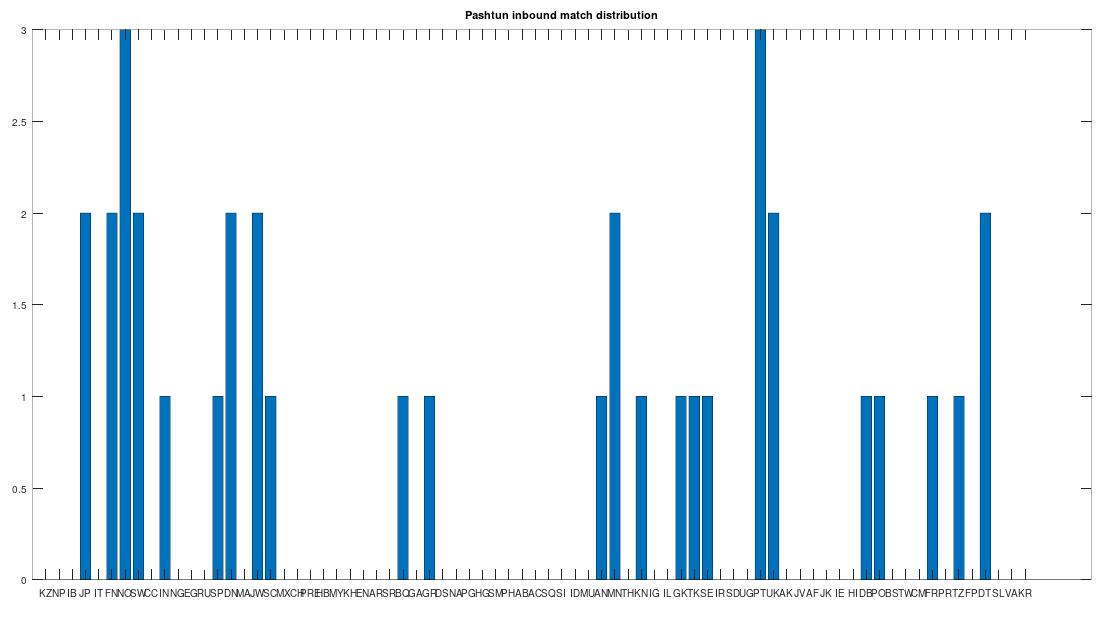
The chart above is not normalized to show percentages, and instead shows the integer number of Pashtun Nearest Neighbors for each column. However, it turns out that a significant percentage of genomes in ethnicities all over the world map to the Pashtuns, which is just not true generally of other ethnicities. That is, it seems the Pashtuns are a source population (or closely related to that source population) of a significant number of people globally. This is shown in the chart below, which is normalized by dividing each column by the number of genomes in that column’s population, producing a percentage.
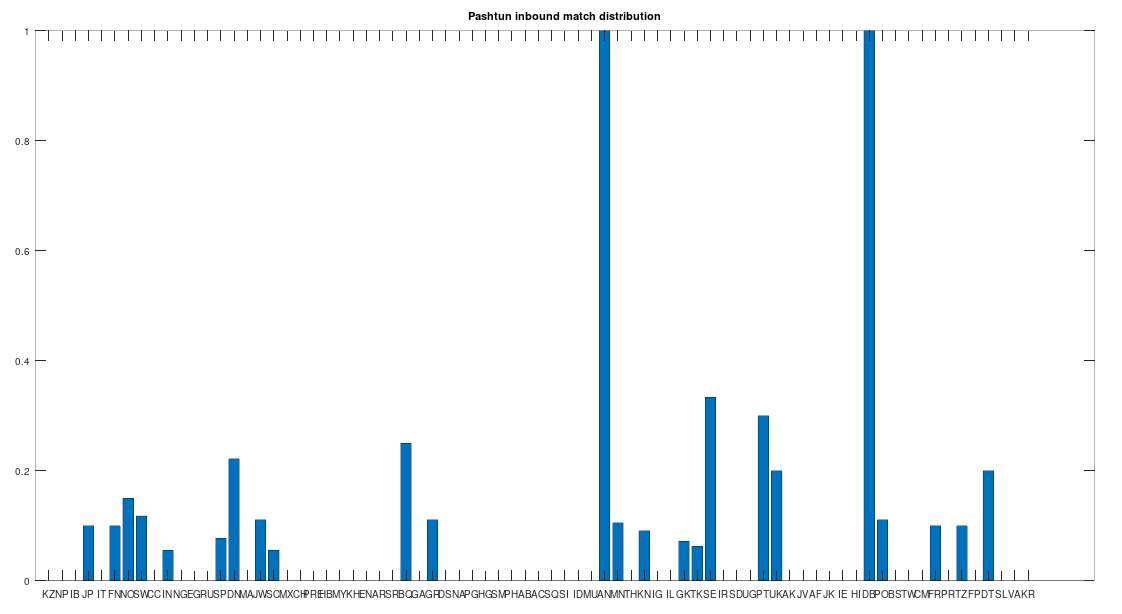
As you can see, a significant percentage of Europeans (e.g., Finland, Norway, and Sweden, columns 6, 7, and 8 respectively), East Asians (e.g., Japan and Mongolia, columns 4 and 44, respectively), and Africans (e.g., Kenya and Tanzania, columns 46 and 70, respectively), have genomes that are closest to Pashtuns. Further, the average match count to a Pashtun genome over this chart is 
All of this is instead consistent with what I’ve called the Migration-Back Hypothesis, which is that humanity begins in Africa, migrates to Asia, and then migrates back to Africa and Europe, and further into East Asia. This is a more general hypothesis that many populations, including the Pashtuns, migrated back from Asia to Africa and Europe, and extended their presence into East Asia. The question is, can we also establish that humanity began in Africa using these and other similar methods? Astonishingly, the answer is yes, and this is discussed at some length in a summary on mtDNA that I’ve written.
 change as a function of
  . His answer was to look at the derivative of
  as a function of
  through
  , and that you have a prediction function on that dataset
  . Now imagine you add a set of weights
  , for
, for ![\theta_i \in [0,1]](https://s0.wp.com/latex.php?latex=%5Ctheta_i+%5Cin+%5B0%2C1%5D&bg=ffffff&fg=444444&s=0&c=20201002) , so that you instead consider the function
, so that you instead consider the function  . That is, we’ve added weights that will reduce the contribution of each dimension simply by multiplying by a constant in
 ![[0,1]](https://s0.wp.com/latex.php?latex=%5B0%2C1%5D&bg=ffffff&fg=444444&s=0&c=20201002) . This is one of the most basic things you’ll learn in Machine Learning, and the rate of change in accuracy as a function of each
. This is one of the most basic things you’ll learn in Machine Learning, and the rate of change in accuracy as a function of each  will provide information about how important each dimension is to the prediction function. This is basically what Fisher did, except almost one hundred years ago, effectively discovering a fundamental tool of Machine Learning.
 , which is less than
  . There is however no proof in that book of the general case, and instead only a proof of the finite case, expressed as a counting argument. I looked up proofs, and all the proofs I could find seem to have the same hole, which I’ll discuss.
 denote the power set of
  . That is, we are assuming arguendo that the cardinality of
  such that
  is surjective, which means that all elements of
  . That is, because we know
  . That said, a simple additional step will prove that we can always define
  , which will produce a non-empty set
  .
. . Because
  , there must be
  , such that
  , and
, and  . Because
  such that
  and
and  . If
. If  or
or  , then
  and
and  . Now define
  and
and  , but otherwise
  for
for  . If
. If  and
and  . If either is not a singleton (or both are not singletons), then it must be the case that either
  Note that
  such that
  . It must be the case that either
  or
or  . If
. If  , since by definition,
  . If
. If  , which completes the proof.
 , and let’s apply the proof above. Generally speaking, we would assume that the power set of the empty set contains one element, namely a set that contains the empty set as a singleton, represented as
  . Assuming we can even define
  . Because
  , it must be the case that
  . However, if we want
  , it must be the case that
  , even though
  , and instead,
  since
since  . That is, the accepted proof assumes
  , and let’s apply the proof above. The power set of a singleton is generally defined as
  . Because the accepted proof does not explicitly define
  . Because
  ,
,  . Again, the accepted proof fails.
 , which is defined as the logarithm of
  , i.e.,
  . You can read more about it in
  , which satisfies our intuition, that zero represents no substance. Further, in this case, zero is the amount of information contained in a system that has exactly one state. This is plainly true, since a system that never changes cannot meaningfully store information, and instead simply exists. Similarly,
  is defined, because that is simply the product
  , taken a countable number of times. Basic assumptions of arithmetic imply the following inequality:
 .
. , it must be the case that
  .
. .
. such that
  , for all
  and
and  . Therefore,
  does not exist. As a result, we learn nothing from taking the logarithm, since
  .
. .
. , for all
  is not defined. In contrast,
  is just the number of bits contained in two machines, and more generally,
  is simply the number of bits contained in
  machines. It’s not clear how to think about a collection of machines
  Information Overload