The Asymmetry Between Gains and Losses

It dawned on me a while back that there’s a fundamental asymmetry between financial gains and losses, in that gains are strictly positive events from a utility or other subjective preference perspective, whereas losses are strictly negative events, but with the possibility to cause catastrophic knock-on events. Specifically, gains will never cause a default, whereas a loss can. That is, if someone gives you money, or your net worth appreciates for some other reason, this simply cannot cause a default. In contrast, if someone steals your money, or your net worth otherwise decreases for some other reason, you could default on existing liabilities, which will create not only losses for others, but potentially catastrophic financial consequences on an individual level (e.g., homelessness or even death in the case of losing health insurance). This implies that we should seek to avoid defaults as a society, as opposed to losses, which are not innately harmful to others, and not generally catastrophic to individuals (e.g., just because you lose some money in the market doesn’t mean you’ll lose your home).

The problem is that default risks are idiosyncratic, in that one firm could be perfectly fine incurring a million dollars in losses over some period of time, whereas another would go bankrupt. This means that the market for hedging loss of income (which doesn’t to my knowledge exist yet) is going to be heterogeneous, and probably not exchange traded. But so what, so is lending, and that’s nothing new to banks.

In fact, you can posit a simple market that is basically unfinanced credit exposure, where firm A buys protection on some level of income for a fixed period of time, from bank B. Specifically, firm A pays bank B to underwrite the risk that a particular asset ends up generating less than a particular amount of revenue over a particular amount of time. For example, imagine a large food chain buys such a contract from a bank, so that if one of their franchises fails to produce at least $1,000,000 in revenue per year, for a window of let’s say 5 years, the bank writes them a check for $1,000,000 – X, where X is the revenue actually generated in the year the shortfall occurred. The bank would charge a fee based upon the revenue history of the particular franchise, which is distinct from (but of course related to) the credit risk of the franchise. In fact, the whole point of this, is for the franchise itself to avoid contributing to an overall default by the food chain. I would call it a revenue shortfall swap.

This is potentially a really attractive product from the perspective of the bank, because they can contract with the food chain holding company, presumably a much better credit than the specific franchise location. As a result, the bank gets a corporate quality credit (as a counterparty), but the exposure is to a potentially highly diversified set of revenue streams, across huge, and individually selected geographies, with different consumer profiles. This should be attractive to the corporates as well, because they can micromanage revenue risk, over specific periods of time, where they might be willing e.g., to forgo some profit, in exchange for stability.

In thinking further about this, I think it could set the stage for individual employment insurance, something this country (the U.S.) desperately needs. Specifically, banks can probably use in-house municipal bond experts that have knowledge of state and local economies. This would allow them to at least contribute to the knowledge necessary to create the corporate products above, but also potentially create a market where people can buy insurance on their income (e.g., get fired, get a payout for one year equal to your previous income). This will probably be too expensive for most low income people, and frankly, banks won’t write those contracts because they’re probably bad credits, and also they won’t trust poor people to maintain employment. As a fix, I think we could instead require everyone in e.g., New York to buy employment insurance, unless you have one year in after-tax savings. This would be paid for by the state, and the high income earners (including seriously high earners that in this state make $10 million and $100 million per year), would also have to participate, unless they again have one year’s worth of after-tax cash. So e.g., Jamie Dimon would not pay into this system today, because he’s worth over a $1 billion, and makes about $40 million per year. However, a young Jamie Dimon would have to pay in, until his savings reached the one year after-tax threshold. That kind of revenue, will attract banks, and might even be enough revenue to pay for the system (people like that generally don’t get fired, and banks know this, in particular J.P. Morgan).

The Reality Of Mortgage Modification

Also published on the Atlantic Monthly’s Business Channel.

Why A Decline In Home Prices Should Not Cause Defaults

It seems that we have taken as an axiom the idea that if the price of a home drops below the face value of the mortgage, the borrower will default on the mortgage. That sounds like a good rule, since it’s got prices dropping and people defaulting at the same time, so there’s a certain intuitive appeal to it. But in reality, it makes no sense. Either the borrower can afford the mortgage based on her income alone or not.  However, it does make sense if you also assume that the borrower intended to access the equity in her home before the maturity of the mortgage. That is, the home owner bought the home with the intention of either i) selling the home for a profit before maturity or ii) refinancing the mortgage at a higher principle amount.

If neither of these are true, then why would a homeowner default simply because the home they lived in dropped in value? She wouldn’t. She might be irritated that she paid too much for a home. Additionally, she might experience a diminution in her perception of her own wealth, which may change her consumption habits. But the fact remains that at the time of purchase, she thought her home was worth X. And she agreed to a clearly defined schedule of monthly payments over the life of the mortgage assuming a price of X. The fact that the value of her home suddenly drops below X has no impact on her ability to pay, unless she planned to access equity in the home to satisfy her payment obligations.  Annoyed as she might be, she could continue to make her mortgage payments as promised.  Thus, those mortgages which default due to a drop in home prices are the result of a failed attempt to access equity in the home, otherwise known as failed speculation.

In short, if a home drops in value, it does not affect the cash flows of the occupants so long as no one plans to access equity in the home. And so, the ability of a household to pay a mortgage is unaffected in that situation. This is in contrast to being fired, having a primary earner die, or divorce. These events have a direct impact on the ability of a household to pay its mortgage.

I am unaware of any proposal to date which offers assistance to households in need under such circumstances.

The Dismal Science Of Mortgage Modification

Simply put, available evidence suggests that mortgage modifications do not work.

[IMAGES REMOVED BY UST; SEE REPORT LINK BELOW]

The charts above are from a study conducted by the Office Of the Comptroller of the Currency. The full text is available here. As the charts above demonstrate, within 8 months, just under 60% of modified mortgages redefault. That is, the borrowers default under the modified agreement. If we look only at Subprime mortgages, just over 65% of modified mortgages redefault within 8 months. This may come as a surprise to some. But in my mind, it reaffirms the theory that many borrowers bought homes relying on their ability to i) sell the home for a profit or ii) refinance their mortgage. That is, it reaffirms the theory that many borrowers were unable to afford the homes they bought using their income alone, and were actually speculating that the value of their home would increase.

Morally Hazardous And Theoretically Dubious

Why should mortgages be adjusted at all? Well, one obvious reason to modify is that the terms of the mortgages are somehow unfair. That’s a fine reason. But when did they become unfair? Were they unfair from the outset? That seems unlikely given that both the borrower and the lender voluntarily agree to the terms of a mortgage. Although people like to fuss about option arm mortgages and the like, the reality is, it’s not that hard for a borrower to understand that her payments will increase at some point in the future. Either she can afford the increased payments or not. This will be clear from the outset of the mortgage.

So, it doesn’t seem like there’s much of a case for unfairness at the outset of the agreement. Well then, did the mortgage become unfair? Maybe. If so, since the terms didn’t change, it must be because the home dropped in value and therefore the borrower is now paying above the market price for the home. That does sound unfortunate. But who should bear the loss? Should the bank? The tax payer? How about the borrower? Well, the borrower explicitly agreed to bear the loss when she agreed to repay a fixed amount of money. That is, the borrower promised “to pay back X plus interest within 30 years.” This is in contrast to “I promise to pay back X plus interest within 30 years, unless the price of my home drops below X, in which case we’ll work something out.” Both are fine agreements. But the former is what borrowers actually agree to.

Not enforcing voluntary agreements leads to uncertainty. Uncertainty leads to inefficiency. This is because those who have agreements outstanding or would like to enter into other agreements cannot rely on the terms of those agreements. And so the value of such agreements decreases and the whole purpose of contracting is defeated. In a less abstract sense, uncertainty creates an environment in which it is impossible to plan and conduct business. As a result, this type of regulatory behavior undermines the availability of credit.

But even if we do not accept that voluntary agreements should be enforced for reasons of efficiency, mortgages represent some of the most clear and unambiguous promises to repay an obligation imaginable. The fact that a borrower was betting that home prices would rise should not excuse them from their obligations. There are some situations where human decency and compassion could justify a readjustment of terms and socializing the resultant losses. For example, the death of a primary earner or an act of war or terrorism. But making a bad guess about future home prices is not an act that warrants anyone’s sympathy, let alone the socialization of the losses that follow.

The Elephant In The Room

This notion that Subprime borrowers were victimized as a result of some fraudulent wizardry perpetuated by Wall Street is utter nonsense. Whether securitized assets performed as promised to investors is Wall Street’s problem. Whether people pay their mortgages falls squarely on the shoulder of the borrower. Despite this, we are spending billions of public dollars, at a time when money is scarce and desperately needed, on a program that i) is demonstrably ineffective at achieving its stated goals (helping homeowners avoid foreclosure) and ii) rewards poor decision making and imprudent borrowing. Given the gravity of the moment, a greater failure is difficult to imagine. But then again, we live in uncertain times, so my imagination might prove inadequate.

Credit Default Swaps And Mortgage Backed Securities

Like Your Grandsire In Alibaster

In this article, I will apply my usual dispassionate analysis to the role that credit default swaps play in the world of Mortgage Backed Securities (MBSs). We will take a brief look at the interactions between the issuance of mortgages, MBSs, and how the concept of loss plays out in the context of derivatives and mortgages. Then we will explore how the expectations of the parties to a lender/borrower relationship differ from that of a protection seller/buyer relationship and how credit default swaps, by allowing markets to express a negative view of mortgage default risk, facilitate price correction and mitigate net losses. This is done by applying the concepts in my previous article, The Demand For Risk And A Macroeconomic Theory of Credit Default Swaps: Part 2, to the context of credit default swaps on MBSs. This article can be considered a more concrete application of the concepts in that article, which will hopefully clear up some of the confusion in that article’s comment section.

The Path Of Funds In the MBS Market

Mortgage backed securities allow investors to gain exposure to the housing market by taking on credit risk linked to a pool of mortgages. Although the underlying mortgages are originated by banks, the existence of investor demand for MBSs allows the originators to effectively pass the mortgages off to the investors and pocket a fee. Thus, the greater the demand for MBSs, the greater the total value of mortgages that originators will issue and ultimately pass off to investors. So, the originators might front the money for the mortgages in many cases, but the effective path of funds is from the investors, to the originators, and onto the borrower. As a result, investors in MBSs are the effective lenders in this arrangement, since they bear the credit risk of the mortgages.

This market structure also has an effect on the interest rates charged on the underlying mortgages. As investor demand for MBSs increases, the amount of cash available for mortgages will increase, pushing the interest rates charged on the underlying mortgages down as originators compete for borrowers.

Loss In The Context Of Derivatives And Mortgages

I often note that derivatives cannot create net losses in an economy. That is, they simply transfer money between two parties. If one party loses X, the other gains X, so the net loss between the two parties is zero. For more on this, go here. This is not the case with a mortgage. The lender gives money to the borrower, who then spends this money on a home. Assume that a lender and borrower entered into a mortgage and that before maturity the value of the home falls, prompting the borrower to default on its mortgage. Further assume that the lender forecloses on the property, selling it at a loss. Since the buyer receives none of the foreclosure proceeds, the buyer can be viewed as either neutral or incurring a loss, since at least some of the borrower’s mortgage payments went towards equity ownership and not just occupancy. It follows that there is a loss to the lender and either no change in or a loss to the borrower and therefore a net loss. This demonstrates what we have all recently learned: poorly underwritten mortgages can create net losses.

Net Losses And Efficiency

You can argue that even in the case that both parties to an agreement incur losses, the net loss to the economy is zero, since the cash transferred under the agreement was not destroyed but merely moved through the economy to market participants that are not a party to the agreement. That is, if you expand the number of parties to a sufficient degree, all transactions will net to zero. While this must be the case, it misses an essential point: I am using net losses to bilateral agreements as a proxy for inefficient allocation of capital. That is, both parties expected to benefit from the agreement, yet both lost money, which implies that neither benefited from the agreement. For example, in the case of a mortgage, the borrower expects to pay off the mortgage but benefit from the use and eventual ownership or sale of the home. The lender expects to profit from the interest paid on the mortgage. When both of these expectations fail, I take this as implying that the initial agreement was an inefficient allocation of capital. This might not always be the case and depends on how you define efficiency. But as a general rule, it is my opinion that net losses to a bilateral agreement are a reasonable proxy for inefficient allocation of capital.

Expectations Of Lender/Borrower vs. Protection Seller/Buyer

As mentioned above, under a mortgage, the lender expects to benefit from the interest paid on the mortgage while the borrower expects to benefit from the use and eventual ownership or sale of the home. Implicit in the expectations of both parties is that the mortgage will be repaid. Economically, the lender is long on the mortgage. That is, the lender gains if the mortgage is fully repaid. Although application of the concepts of long and short to the borrower’s position is awkward at best, the borrower is certainly not short on the mortgage. That is, in general, the borrower does not gain if he fails to repay the mortgage. He might however mitigate his losses by defaulting and declaring bankruptcy. That said, the takeaway is that both the lender and the borrower expect the mortgage to be repaid. So, if we consider only lenders and borrowers, there are no participants with a true short position in the market. Thus, price, which in this case is an interest rate, will be determined by participants with similar positive expectations and incentives. Anyone with a negative view of the market has no role to play and therefore no effect on price.

This is not the case with credit default swaps (CDSs) referencing MBSs. In such a CDS, the protection seller is long on the MBS and therefore long on the underlying mortgages, and the protection buyer is short. That is, if the MBS pays out, the protection seller gains on the swap; and if the MBS defaults, the protection buyer gains on the swap. Thus, through the CDS, the two parties express opposing expectations of the performance of the MBS. Thus, the CDS market provides an opportunity to express a negative view of mortgage default risk.

The Effect Of Synthetic Instruments On “Real” Instruments

As mentioned above, the CDS market provides a method of shorting MBSs. But how does that effect the price of MBSs and ultimately interest rates? As described here, the cash flows of any bond, including MBSs, can be synthesized using Treasuries and CDSs. Using this technique, a fully funded synthetic bond consists of the long end of a CDS and a Treasury. The spread that the synthetic instrument pays over the risk free rate is determined by the price of protection that the CDS pays the investor (who in this case is the protection seller). One consequence of this is that there are opportunities for arbitrage between the market for real bonds and CDSs if the two markets don’t reach an equilibrium, removing any opportunity for arbitrage. Because this opportunity for arbitrage is rather obvious, we assume that it cannot persist. That is, as the price of protection on MBSs increases, the spread over the risk free rate paid by MBSs should widen, and visa versa. Thus, as the demand for protection on MBSs increases, we would expect the interest rates paid by MBSs to increase, thereby increasing the interest rates on mortgages. Thus, those with a negative view of MBS default risk can raise the cost of funds on mortgages by buying protection through CDSs on MBSs, thereby inadvertently “correcting” what they view as underpriced default risk.

In addition to the no-obvious-arbitrage argument outlined above, we can consider how the existence of synthetic MBSs affects the supply of comparable investments, and thereby interest rates. As mentioned above, any MBS can be synthesized using CDSs and Treasuries (when the synthetic MBS is unfunded or partially funded, it consists of CDSs and other investments, not Treasuries). Thus, investors will have a choice between investing in real MBSs or synthetic MBSs. And as explained above, the price of each should come to an equilibrium that excludes any opportunity for obvious arbitrage between the two investments. Thus, we would expect at least some investors to be indifferent between the two.

path_of_fundsDepending on whether the synthetics are fully funded or not, the principle investment will go to the Treasuries market or back into the capital markets respectively. Note that synthetic MBSs can exist only when there is a protection buyer for the CDS that comprises part of the synthetic. That is, only when interest rates on MBSs drop low enough, along with the price of protection on MBSs, will protection buyers enter CDS contracts. So when protection buyers think that interest rates on MBSs are too low to reflect the actual probability of default, their desire to profit from this will facilitate the issuance of synthetic MBSs, thereby diverting cash from the mortgage market and into either Treasuries or other areas of the capital markets. Thus, the existence of CDSs operates as a safety valve on the issuance of MBSs. When interest rates sink too low, synthetics will be issued, diverting cash away from the mortgage market.
The Demand For Risk And A Macroeconomic Theory of Credit Default Swaps: Part 2

Redux And Reduction

In the previous article, we defined a highly abstract framework that considered the subjective expected payout of both sides of a fixed fee derivative.  In this article, we will apply that model to the context of credit default swaps and will show that the presence of credit default swaps and synthetic bonds should be expected to reduce the demand for “real” bonds (as opposed to synthetic bonds) and thereby reduce the net exposure of an economy to credit risk.

The Demand For Credit Default Swaps

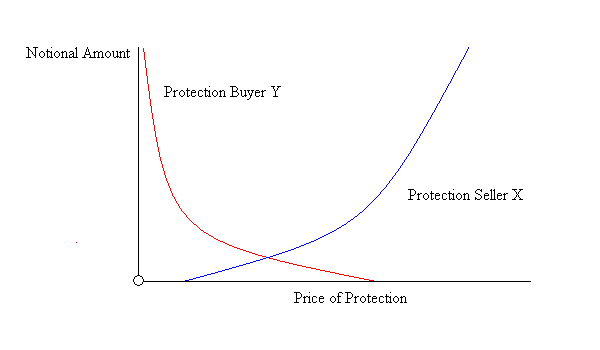
In the previous article, we plotted the expected payout of each party to a credit default swap as a function of the fee and each party’s subjective valuation of the probability that a default will occur. The simple observation gleaned from that chart was that if we fix the subjective probabilities of default, protection sellers expect to earn more as the price of protection increases and protection buyers expect to earn more as the price of protection decreases.  Thus, as the the price of protection increases, we would expect protection seller side “demand” to increase and expect protection buyer side “demand” to decrease.  But how can demand be expressed in the context of a credit derivative? The general idea is to assume that holding all other variables constant, the size of the desired notional amount of the CDS will vary with price. So in the case of protection sellers, the greater the price of protection, the greater the notional amount desired by any protection seller.

In order to further formalize this concept, we should consider each reference entity as defining a unique demand curve for each market participant. We should also distinguish between demand for buying protection and demand for selling protection. For convenience’s sake, we will refer to the demand for selling protection as the supply of credit protection and demand for buying credit protection as the demand for credit protection. For example, consider protection seller X’s supply curve and protection buyer Y’s demand curve for CDSs naming ABC as a reference entity. The following chart expresses the total notional amount of all CDSs desired by X and Y as a function of the price of protection.

supply-demand-credit-exposure1

As the price of protection approaches zero, Y’s desired notional amount should approach infinity, since at zero, Y is getting free protection and should desire an unbounded “quantity” of credit protection. The same is true for X as the price of protection approaches infinity.

Synthetic Bonds As Competing Goods With “Real” Bonds

Imagine a world without credit derivatives and therefore without synthetic bonds. In that world, there will be a demand curve for real ABC bonds as a function of the spread the bonds pay over the risk free rate, holding all over variables constant. Now imagine that credit default swaps were introduced to this world. We know that the cash flows of any bond can be synthesized using Treasuries and credit default swaps. For example, assume we have synthesized the cash flows of ABC’s bonds using the method described here. We would expect at least some investors to be indifferent between real ABC bonds and synthetic ABC bonds, since they both produce the same cash flows. Thus, the two are competing products in the sense that investors in real ABC bonds should be potential investors in synthetic ABC bonds. So because some investors will be indifferent between synthetic ABC bonds and real ABC bonds, synthetic ABC bonds will siphon some of the cash that would have otherwise gone to real ABC bonds. Thus, in a world with credit derivatives, we would expect there to be less demand for real bonds than would be present without credit derivatives. In the following chart we express the macroeconomic demand for real ABC bonds in terms of the spread over the risk free rate and the total par value desired by the market.

demand-with-credit-derivatives

Thus, the demand for credit derivatives diminishes the demand for real bonds. Although we cannot know exactly what the effect on the demand curve for real bonds will be, we can safely assume that it will be diminished at all levels of return, since at each level, at least some investors will be indifferent to real bonds and synthetic bonds, since each offers the same return.

Real Cash Losses Versus Wealth Transfers Through Derivatives

Economics already has a term to describe payouts under credit default swaps: wealth transfers. Although ordinarily used to describe the cash flows of tax regimes, the term applies equally to the payments under a credit default swap. As described in the previous article, there are no net cash losses under a credit default swap. There is a payment of money from one party to another, the net effect of which is a wealth transfer. That is, credit default swaps, like all derivatives, simply rearrange the current allocation of cash in the financial system, and nothing is lost in process (ignoring transaction costs, which are not relevant to this discussion).

When a real bond defaults, a net cash loss occurs. The borrower has taken the money lent to it by investors, lost it, and the investors are not fully paid back. Therefore, both the borrower and the investors incur a cash loss, creating a net cash loss to the economy. So, in the case of a synthetic ABC bond, upon the default of one of ABC’s bonds,  a wealth transfer occurs from the protection seller to the protection buyer and the net effect is null. In the case of a real ABC bond, upon the default of that bond, the investors will lose some of their principle and ABC has already lost some of the money it was lent, the net effect of which is a loss to the economy.

So every dollar siphoned away from real bonds by synthetic bonds is a dollar that will not be lost in the economy upon the occurrence of a credit event. If there were no credit derivatives, then that dollar would have been invested in real bonds and thereby lost upon the occurrence of a credit event. Therefore, the net losses to the economy upon the occurrence of a credit event is less with credit derivatives than without. In the following diagram, the two circles of each transaction represent the parties to that transaction. In the case of real bonds, one of the parties is ABC and the other is an investor. In the case of synthetic bonds, one is the protection seller and the other is the protection buyer of the credit default swap underlying the synthetic bond.

net-losses-with-derivatives

This diagram simply demonstrates what was described above. Namely, that with credit derivatives, some investors will choose synthetic bonds rather than real bonds, thereby reducing the amount of cash exposed to credit risk. Thus, rather than increase the impact of credit risk, credit default swaps actually decrease the impact of credit risk by placating the demand for exposure to credit risk with synthetic instruments that are incapable of producing net losses. However, there may be consequences arising from credit default swaps that cause actual cash losses to an economy, such as a firm failing because of its obligations under credit default swaps. But the failure is not caused by the instrument itself. The nature of the instrument is to reduce the impact of credit risk. The firm’s failure is caused by that firm’s own poor risk management.

The Demand For Risk And A Macroeconomic Theory of Credit Default Swaps: Part 1

A Higher Plane

In this article, I will return to the ideas proposed in my article entitled, “A Conceptual Framework For Analyzing Systemic Risk,” and once again take a macro view of the role that derivatives play in the financial system and the broader economy.  In that article, I said the following:

“Practically speaking, there is a limit to the amount of risk that can be created using derivatives. This limit exists for a very simple reason: the contracts are voluntary, and so if no one is willing to be exposed to a particular risk, it will not be created and assigned through a derivative. Like most market participants, derivatives traders are not in engaged in an altruistic endeavor. As a result, we should not expect them to engage in activities that they don’t expect to be profitable. Therefore, we can be reasonably certain that the derivatives market will create only as much risk as its participants expect to be profitable.”

The idea implicit in the above paragraph is that there is a level of demand for exposure to risk. By further formalizing this concept, I will show that if we treat exposure to risk as a good, subject to the observed law of supply and demand, then credit default swaps should not create any more exposure to risk in an economy than would be present otherwise and that credit default swaps should be expected to reduce the net amount of exposure to risk. This first article is devoted to formalizing the concept of the price for exposure to risk and the expected payout of a derivative as a function of that price.

Derivatives And Symmetrical Exposure To Risk

As stated here, my own view is that risk is a concept that has two components: (i) the occurrence of an event and (ii) a magnitude associated with that event. This allows us to ask two questions: What is the probability of the event occurring? And if it occurs, what is the expected value of its associated magnitude? We say that P is exposed to a given risk if P expects to incur a gain/loss if the risk-event occurs. We say that P has positive exposure if P expects to incur a gain if the risk-event occurs; and that P has negative exposure if P expects to incur a loss if the risk-event occurs.

Exposure to any risk assigned through a derivative contract will create positive exposure to that risk for one party and negative exposure for the other. Moreover the magnitudes of each party’s exposure will be equal in absolute value. This is a consequence of the fact that derivatives contracts cause payments to be made by one party to the other upon the occurrence of predefined events. Thus, if one party gains X, the other loses X. And so exposure under the derivative is perfectly symmetrical. Note that this is true even if a counterparty fails to pay as promised. This is because there is no initial principle “investment” in a derivative. So if one party defaults on a payment under a derivative, there is no cash “loss” to the non-defaulting party. That said, there could be substantial reliance losses. For example, you expect to receive a $100 million credit default swap payment from XYZ, and as a result, you go out and buy $1,000 alligator skin boots, only to find that XYZ is bankrupt and unable to pay as promised. So, while there would be no cash loss, you could have relied on the payments and planned around them, causing you to incur obligations you can no longer afford. Additionally, you could have reported the income in an accounting statement, and when the cash fails to appear, you would be forced to “write-down” the amount and take a paper loss. However, the derivatives market is full of very bright people who have already considered counterparty risk, and the matter is dealt with through the dynamic posting of collateral over the life of the agreement, which limits each party’s ability to simply cut and run. As a result, we will consider only cash losses and gains for the remainder of this article.

The Price Of Exposure To Risk

Although parties to a derivative contract do not “buy” anything in the traditional sense of exchanging cash for goods or services, they are expressing a desire to be exposed to certain risks. Since the exposure of each party to a derivative is equal in magnitude but opposite in sign, one party is expressing a desire for exposure to the occurrence of an event while the other is expressing a desire for exposure to the non-occurrence of that event. There will be a price for exposure. That is, in order to convince someone to pay you $1 upon the occurrence of event E, that other person will ask for some percentage of $1, which we will call the fee.  Note that as expressed, the fee is fixed. So we are considering only those derivatives for which the contingent payout amounts are fixed at the outset of the transaction. For example, a credit default swap that calls for physical delivery fits into this category. As this fee increases, the payout shrinks for the party with positive exposure to the event. For example, if the fee is $1 for every dollar of positive exposure, then even if the event occurs, the party with positive exposure’s payments will net to zero.

This method of analysis makes it difficult to think in terms of a fee for positive exposure to the event not occurring (the other side of the trade). We reconcile this by assuming that only one payment is made under every contract, upon termination. For example, assume that A is positively exposed to E occurring and that B is negatively exposed to E occurring. Upon termination, either E occurred prior to termination or it did not.

sym-exposure2

If E did occur, then B would pay N \cdot(1 - F) to A, where F is the fee and N is the total amount of A’s exposure, which in the case of a swap would be the notional amount of the contract. If E did not occur, then A would pay N\cdot F. If E is the event “ABC defaults on its bonds,” then A and B have entered into a credit default swap where A is short on ABC bonds and B is long. Thus, we can think in terms of a unified price for both sides of the trade and consider how the expected payout for each side of the trade changes as that price changes.

Expected Payout As A Function Of Price

As mentioned above, the contingent payouts to the parties are a function of the fee. This fee is in turn a function of each party’s subjective valuation of the probability that E will actually occur. For example, if A thinks that E will occur with a probability of \frac{1}{2}, then A will accept any fee less than .5 since A’s subjective expected payout under that assumption is N (\frac{1}{2}(1 - F) - \frac{1}{2}F ) = N (\frac{1}{2} - F). If B thinks that E will occur with a probability of \frac {1}{4}, then B will accept any fee greater than .25 since his expected payout is N (\frac{3}{4} F - \frac{1}{4}(1 - F)) = N (F - \frac{1}{4} ). Thus, A and B have a bargaining range between .25 and .5. And because each perceives the trade to have a positive payout upon termination within that bargaining range, they will transact. Unfortunately for one of them, only one of them is correct. After many such transactions occur, market participants might choose to report the fees at which they transact. This allows C and D to reference the fee at which the A-B transaction occurred. This process repeats itself and eventually market prices will develop.


Assume that A and B think the probability of E occurring is p_A and p_B respectively. If A has positive exposure and B has negative, then in general the subjective expected payouts for A and B are N (p_A - F) and N ( F - p_B) respectively. If we plot the expected payout as a function of F, we get the following:

payout-v-fee4

The red line indicates the bargaining range.  Thus, we can describe each participant’s expected payout in terms of the fee charged for exposure. This will allow us to compare the returns on fixed fee derivatives to other financial assets, and ultimately plot a demand curve for fixed fee derivatives as a function of their price.

Synthetic CDOs, Ratings, And Super Senior Tranches: Part 3

Prescience and Precedent

In the previous articles (part 1 and part 2), we discussed both the modeling and rating of  CDOs and their tranches. In this article, we will discuss the rating of synthetic CDOs and those fabled “super senior” tranches. As mentioned in the previous articles, I highly recommend that you read my article on Synthetic CDOs and my article on tranches.

Funded And Unfunded Synthetic CDOs

As explained here, the asset underlying a synthetic CDO is a portfolio of the long positions of credit default swaps. That is, investors in synthetic CDOs have basically sold protection on various entities to the CDS market through the synthetic CDO structure. Although most CDS agreements will require collateral to be posted based on who is in the money (and may also require an upfront payment), as a matter of market practice, the protection seller does not fund the long position. That is, if A sold $1 million worth of protection to B, A would not post the $1 million to B or a custodian. (Note that this is a market convention and could change organically or by fiat at any moment given the current market context). Thus, B is exposed to the risk that A will not payout upon a default.

Because the long position of a CDS is usually unfunded, Synthetic CDOs can be funded, unfunded, or partially funded. If the investors post the full notional amount of protection sold by the SPV, then the transaction is called a fully funded synthetic CDO. For example, if the SPV sold $100 million worth of protection to the swap market, the investors could put up $100 million in cash at the outset of the synthetic CDO transaction. In this case, the investors would receive some basis rate, usually LIBOR, plus a spread. Because the market practice does not require a CDS to be funded, the investors could hang on to their cash and simply promise to payout in the event that a default occurs in one of the CDSs entered into by the SPV. This is called an unfunded synthetic CDO. In this case, the investors would receive only the spread over the basis rate. If the investors put up some amount less than the full notional amount of protection sold by the SPV, then the transaction is called a partially funded synthetic CDO. Note that the investors’ exposure to default risk does not change whether the transaction is funded or unfunded. Rather, the SPV’s counterparties are exposed to counterparty risk in the case of an unfunded transaction. That is, the investors could fail to payout upon a default and therefore the SPV would not have the money to payout on the protection it sold to the swap market. Again, this is not a risk borne by the investors, but by the SPV’s counterparties.

Analyzing The Risks Of Synthetic CDOs

As mentioned above, whether a synthetic CDO is funded, unfunded or partially funded does not affect the default risks that investors are exposed to. That said, investors in synthetic CDOs are exposed to counterparty risk. That is, if a counterparty fails to make a swap fee payment to the SPV, the investors will lose money. Thus, a synthetic CDO exposes investors to an added layer of risk that is not present in an ordinary CDO transaction. So, in addition to being exposed to the risk that a default will occur in any of the underlying CDSs, synthetic CDO investors are exposed to the risk that one of the SPV’s counterparties will fail to pay. Additionally, there could be correlation between these two risks. For example, the counterparty to one CDS could be a reference entity in another CDS. Although such obvious examples of correlation may not exist in a given synthetic CDO, counterparty risk and default risk could interact in much more subtle and complex ways. Full examination of this topic is beyond the scope of this article.

In a synthetic CDO, the investors are the protection sellers and the SPV’s counterparties are the protection buyers. As such, the payments owed by the SPV’s counterparties could be much smaller than the total notional amount of protection sold by the SPV. Additionally, any perceived counterparty risk could be mitigated through the use of collateral. That is, those counterparties that have or are downgraded to low credit ratings could be required to post collateral. As a result, we might choose to ignore counterparty risk altogether as a practical matter and focus only on default risk. This would allow us to more easily compare synthetic and ordinary CDOs and would allow us to use essentially the same model to rate both. Full examination of this topic is also beyond the scope of this article. For more on this topic and and others, go here.

Synthetic CDO Ratings And Super Senior Tranches

After we have decided upon a model and run some simulations, we will produce a chart that provides the probability that losses will exceed X. We will now compare two synthetic CDOs with identical underlying assets but different tranches. Assume that the tranches are broken down by color in the charts below. Additionally, assume that in our rating system (Joe’s Rating System), a tranche is AAA rated if the probability of full repayment of principle and interest is at least 99%.

default-model-tranched-sidebyside2

Note that our first synthetic CDO has only 3 tranches, whereas the second has 4, since in in the second chart, we have subdivided the 99th percentile. The probability that losses will reach into the green tranche is lower than the probability that losses will reach into the yellow tranches of either chart. Because the yellow tranches are AAA rated in both charts, certain market participants refer to the green tranche as super senior. That is, the green tranche is senior to a AAA rated tranche. This is a bit of a misnomer. Credit ratings and seniority levels are distinct concepts and the term “super senior” conflates the two. A bond can be senior to all others yet have a low credit rating. For example, the most senior obligations of ABC corporation, which has been in financial turmoil since incorporation, could be junk-rated. And a bond can be subordinate to all others but still have a high credit rating. So, we must treat each concept independently. That said, there is a connection between the two concepts. At some point, subordination will erode credit quality. That is, if we took the same set of cash flows and kept subdividing and subordinating rights in that set of cash flows, eventually the lower tranches will have a credit rating that is inferior to the higher tranches. It seems that the two concepts have been commingled in the mental real estate of certain market participants as a result of this connection.

Blessed Are The Forgetful

So is there a difference between AAA notes subordinated to some “super senior” tranche and plain old senior AAA rated notes? Yes, there is, but that shouldn’t surprise you if you distinguish between credit ratings and seniority. You should notice that the former note is subordinated while the latter isn’t. And bells should go off in your mind once you notice this. The rating “AAA” describes the probability of full payment of interest and principle. Under Joe’s Ratings, it tells you that the probability that losses will reach the AAA tranche is less than 1%. The AAA rating makes no other statements about the notes. If losses reach the point X = L*, investors in the subordinated AAA notes (the second chart, yellow tranche) will receive nothing while investors in the senior AAA notes (the first chart, yellow tranche) will not be fully paid, but will receive a share of the remaining cash flows. This difference in behavior is due to a difference in seniority, not credit rating. If we treat these concepts as distinct, we should anticipate such differences in behavior and plan accordingly.

Systemic Counterparty Confusion: Credit Default Swaps Demystified

It Is A Tale Told By An Idiot

The press loves a spectacle. There’s a good reason for this: panic increases paranoia, which increases the desire for information, which increases their advertising revenues. Thus, the press has an incentive to exaggerate the importance of the events they report. As such, we shouldn’t be surprised to find the press amping up fears about the next threat to the “real economy.”

When written about in the popular press, terms such as “derivative” and “mortgage backed security” are almost always preceded by adjectives such as “arcane” and “complex.” They’re neither arcane nor complex. They’re common and straightforward. And the press shouldn’t assume that their readers are too dull to at least grasp how these instruments are structured and used. This is especially true of credit default swaps.

Much Ado About Nothing

So what is the big deal about these credit default swaps? Surely, there must be something terrifying and new about them that justifies all this media attention? Actually, there really isn’t. That said, all derivatives allow risk to be magnified (which I plan to discuss in a separate article). But risk magnification isn’t particular to credit default swaps. In fact, considering the sheer volume of spectacular defaults over the last year, the CDS market has done a damn good job of coping.  Despite wild speculation of impending calamity by the press, the end results have been a yawn . So how is it that Reuters went from initially reporting a sensational $365 billion in losses to reporting (12 days later) only $5.2 billion in actual payments? There’s a very simple explanation: netting, and the fact that they just don’t understand it. The CDS market is a swap market, and as such, the big players in that market aren’t interested in taking positions where their capital is at risk. They are interested in making money by creating a market for swaps and pocketing the difference between the prices at which they buy and sell. They are classic middlemen and essentially run an auction house.

Deus Ex Machina

The agreements that document credit default swaps are complex, and in fairness to the press, these are not things we learn about in grammar school – for a more detailed treatment of these agreements, look here. Despite this, the basic mechanics of a credit default swap are easy to grasp. Let’s begin by introducing everyone: protection buyer (B) is one party and swap dealer (D) is the other. These two are called swap counterparties or just counterparties for short. Let’s first explain what they agree to under a credit default swap, and then afterward, we’ll examine why they would agree to it.

What Did You Just Agree To?

Under a typical CDS, the protection buyer, B, agrees to make regular payments (let’s say monthly) to the protection seller, D. The amount of the monthly payments, called the swap fee, will be a percentage of the notional amount of their agreement. The term notional amount is simply a label for an amount agreed upon by the parties, the significance of which will become clear as we move on. So what does B get in return for his generosity? That depends on the type of CDS, but for now we will assume that we are dealing with what is called physical delivery. Under physical delivery, if the reference entity defaults, D agrees to (i) accept delivery of certain bonds issued by the reference entity named in the CDS and (ii) pay the notional amount in cash to B. After a default, the agreement terminates and no one makes anymore payments. If default never occurs, the agreement terminates on some scheduled date. The reference entity could be any entity that has debt obligations.

Now let’s fill in some concrete facts to make things less abstract. Let’s assume the reference entity is ABC. And let’s assume that the notional amount is $100 million and that the swap fee is at a rate of 6% per annum, or $500,000 per month. Finally, assume that B and D executed their agreement on January 1, 2008 and that B made its first payment on that day.  When February 1, 2008 rolls along, B will make another $500,000 payment. This will go on and on for the life of the agreement, unless ABC triggers a default under the CDS. Again, the agreements are complex and there are a myriad of ways to trigger a default. We consider the most basic scenario in which a default occurs: ABC fails to make a payment on one of its bonds. If that happens, we switch into D’s obligations under the CDS. As mentioned above, D has to accept delivery of certain bonds issued by ABC (exactly which bonds are acceptable will be determined by the agreement) and in exchange D must pay B $100 million.

Why Would You Do Such A Thing?

To answer that, we must first observe that there are two possibilities for B’s state of affairs before ABC’s default: he either (i) owned ABC issued bonds or (ii) he did not. I know, very Zen. Let’s assume that B owned $100 million worth of ABC’s bonds. If ABC defaults, B gives D his bonds and receives his $100 million in principal (the notional amount). If ABC doesn’t default, B pays $500,000 per month over the life of the agreement and collects his $100 million in principal from the bonds when the bonds mature. So in either case, B gets his principal. As a result, he has fully hedged his principal. So, for anyone who owns the underlying bond, a CDS will allow them to protect the principal on that bond in exchange for sacrificing some of the yield on that bond.

Now let’s assume that B didn’t own the bond. If ABC defaults, B has to go out and buy $100 million par value of ABC bonds. Because ABC just defaulted, that’s going to cost a lot less than $100 million. Let’s say it costs B $50 million to buy ABC issued bonds with a par value of $100 million. B is going to deliver these bonds to D and receive $100 million. That leaves B with a profit of $50 million. Outstanding. But what if ABC doesn’t default? In that case, B has to pay out $500,000 per month for the life of the agreement and receives nothing. So, a CDS allows someone who doesn’t own the underlying bond to short the bond. This is called synthetically shorting the bond. Why? Because it sounds awesome.

So why would D enter into a CDS? Again, most of the big protection sellers buy and sell protection and pocket the difference. But, this doesn’t have to be the case. D could sell protection without entering into an offsetting transaction. In that case, he has synthetically gone long on the bond. That is, he has almost the same cash flows as someone who owns the bond.