Netting Demystified

Netting Is For Everyone, Not Just Fancy Swap Traders

Unlike most terms used in the derivatives world, netting is a good one. It has an intuitive, albeit hokey, feel (unlike other rather sterile terms such as “synthetic collateralized debt obligation”). After all, economics is about human decisions and actions, and as such, it can stand to be a bit hokey. So what is netting? The concept stems from a very simple observation: if I owe you $5 and you owe me $10, you should just give me $5. We could have several debts between the two of us, (e.g., I owe you $2 from Wednesday, $3 from Thursday), but assume we add those up into one debt per person, resulting in one transactional leg (line connecting us) each. In this case, netting would save us a bit of trouble since we only exchange money once, instead of twice.

That Is So Obvious And Trivial That It Can’t Be Right

The observation above is indeed an example of the same principle (netting) that is applied to swaps. Our example however, only has 2 parties. The time saved from engaging in 1 transaction instead of 2 is minimal, especially when it’s a transaction for such a small amount of money. This is a result of the fact that when there are only 2 parties, let’s say you and me, there are only 2 legs to the transaction: the money coming out of me and the money coming out of you. The netting example above reduces that to 1 leg (you pay me). That’s called bilateral netting. Again, when there are only 2 parties, the application of netting is simple. But the number of legs increases dramatically as we increase the number of parties (for my fellow graph theorists, the number of legs is twice the number of edges in a complete graph with N nodes, where N is the number of parties). For example,  consider the obligations of 3 friends: A, B and C. A owes B $2; A owes C $3; B owes A $4; B owes C $5; C owes A $2; and finally C owes B $6.
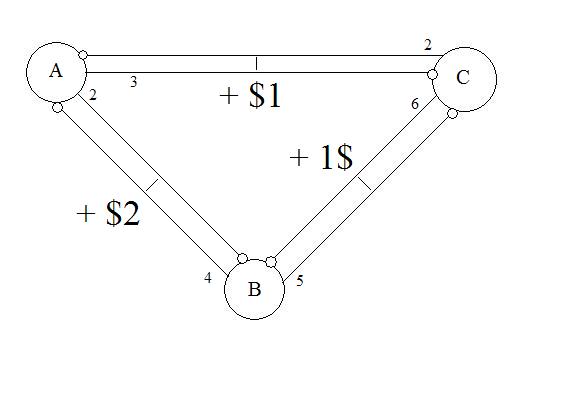
We apply bilateral netting to each of the pairs. That leaves us with the following: A owes C $1; B owes A $2; and C owes B $1. We could just execute 3 transactions and call it a day. But we’re smarter than that. We notice that C is basically passing the $1 from A onto B. That is, his inflow is the same as his outflow, so he serves no purpose in our transaction. So, we cut him out of the picture:
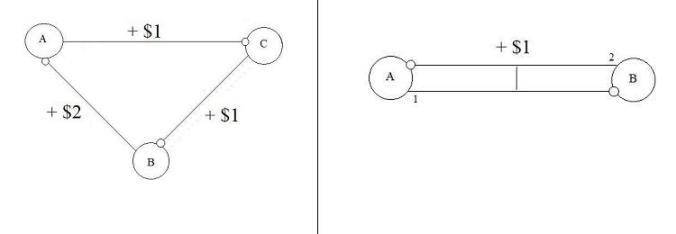
Note that the last step we just took, cutting C out, was not bilateral netting. It was a different kind of netting. It required a different observation, but the principle is the same: only engage in necessary transactions. Finally, we apply bilateral netting to the transaction between A and B. So, in the end, that complex sea of relationships boiled down to B paying A $1.

Balsamic Reduction

Rather then execute a disastrously complicated web of transactions, swap dealers, and ordinary banks, use clearing houses to do exactly what we just did above, but on a gigantic scale. Obviously, this is done by an algorithm, and not by hand. Banks, and swap dealers, prefer to strip down the number of transactions so that they only part with their cash when absolutely necessary. There are all kinds of things that can go wrong while your money spins around the globe, and banks and swap dealers would prefer, quite reasonably, to minimize those risks.

An Engine Of Misunderstanding

As you can see from the transactions above, the total amount of outstanding debts is completely meaningless. That complex web of relationships between A, B, and C, reduced to 1 transaction worth $1. Yet, the media would have certainly reported a cataclysmic 2 + 3 + 4 + 5 + 2 + 6 = $22 in total debts.

Systemic Counterparty Confusion: Credit Default Swaps Demystified

It Is A Tale Told By An Idiot

The press loves a spectacle. There’s a good reason for this: panic increases paranoia, which increases the desire for information, which increases their advertising revenues. Thus, the press has an incentive to exaggerate the importance of the events they report. As such, we shouldn’t be surprised to find the press amping up fears about the next threat to the “real economy.”

When written about in the popular press, terms such as “derivative” and “mortgage backed security” are almost always preceded by adjectives such as “arcane” and “complex.” They’re neither arcane nor complex. They’re common and straightforward. And the press shouldn’t assume that their readers are too dull to at least grasp how these instruments are structured and used. This is especially true of credit default swaps.

Much Ado About Nothing

So what is the big deal about these credit default swaps? Surely, there must be something terrifying and new about them that justifies all this media attention? Actually, there really isn’t. That said, all derivatives allow risk to be magnified (which I plan to discuss in a separate article). But risk magnification isn’t particular to credit default swaps. In fact, considering the sheer volume of spectacular defaults over the last year, the CDS market has done a damn good job of coping.  Despite wild speculation of impending calamity by the press, the end results have been a yawn . So how is it that Reuters went from initially reporting a sensational $365 billion in losses to reporting (12 days later) only $5.2 billion in actual payments? There’s a very simple explanation: netting, and the fact that they just don’t understand it. The CDS market is a swap market, and as such, the big players in that market aren’t interested in taking positions where their capital is at risk. They are interested in making money by creating a market for swaps and pocketing the difference between the prices at which they buy and sell. They are classic middlemen and essentially run an auction house.

Deus Ex Machina

The agreements that document credit default swaps are complex, and in fairness to the press, these are not things we learn about in grammar school – for a more detailed treatment of these agreements, look here. Despite this, the basic mechanics of a credit default swap are easy to grasp. Let’s begin by introducing everyone: protection buyer (B) is one party and swap dealer (D) is the other. These two are called swap counterparties or just counterparties for short. Let’s first explain what they agree to under a credit default swap, and then afterward, we’ll examine why they would agree to it.

What Did You Just Agree To?

Under a typical CDS, the protection buyer, B, agrees to make regular payments (let’s say monthly) to the protection seller, D. The amount of the monthly payments, called the swap fee, will be a percentage of the notional amount of their agreement. The term notional amount is simply a label for an amount agreed upon by the parties, the significance of which will become clear as we move on. So what does B get in return for his generosity? That depends on the type of CDS, but for now we will assume that we are dealing with what is called physical delivery. Under physical delivery, if the reference entity defaults, D agrees to (i) accept delivery of certain bonds issued by the reference entity named in the CDS and (ii) pay the notional amount in cash to B. After a default, the agreement terminates and no one makes anymore payments. If default never occurs, the agreement terminates on some scheduled date. The reference entity could be any entity that has debt obligations.

Now let’s fill in some concrete facts to make things less abstract. Let’s assume the reference entity is ABC. And let’s assume that the notional amount is $100 million and that the swap fee is at a rate of 6% per annum, or $500,000 per month. Finally, assume that B and D executed their agreement on January 1, 2008 and that B made its first payment on that day.  When February 1, 2008 rolls along, B will make another $500,000 payment. This will go on and on for the life of the agreement, unless ABC triggers a default under the CDS. Again, the agreements are complex and there are a myriad of ways to trigger a default. We consider the most basic scenario in which a default occurs: ABC fails to make a payment on one of its bonds. If that happens, we switch into D’s obligations under the CDS. As mentioned above, D has to accept delivery of certain bonds issued by ABC (exactly which bonds are acceptable will be determined by the agreement) and in exchange D must pay B $100 million.

Why Would You Do Such A Thing?

To answer that, we must first observe that there are two possibilities for B’s state of affairs before ABC’s default: he either (i) owned ABC issued bonds or (ii) he did not. I know, very Zen. Let’s assume that B owned $100 million worth of ABC’s bonds. If ABC defaults, B gives D his bonds and receives his $100 million in principal (the notional amount). If ABC doesn’t default, B pays $500,000 per month over the life of the agreement and collects his $100 million in principal from the bonds when the bonds mature. So in either case, B gets his principal. As a result, he has fully hedged his principal. So, for anyone who owns the underlying bond, a CDS will allow them to protect the principal on that bond in exchange for sacrificing some of the yield on that bond.

Now let’s assume that B didn’t own the bond. If ABC defaults, B has to go out and buy $100 million par value of ABC bonds. Because ABC just defaulted, that’s going to cost a lot less than $100 million. Let’s say it costs B $50 million to buy ABC issued bonds with a par value of $100 million. B is going to deliver these bonds to D and receive $100 million. That leaves B with a profit of $50 million. Outstanding. But what if ABC doesn’t default? In that case, B has to pay out $500,000 per month for the life of the agreement and receives nothing. So, a CDS allows someone who doesn’t own the underlying bond to short the bond. This is called synthetically shorting the bond. Why? Because it sounds awesome.

So why would D enter into a CDS? Again, most of the big protection sellers buy and sell protection and pocket the difference. But, this doesn’t have to be the case. D could sell protection without entering into an offsetting transaction. In that case, he has synthetically gone long on the bond. That is, he has almost the same cash flows as someone who owns the bond.