Sketches of the inchoate

The outlines of a day

It’s Syttende Mai, we’re in the living room of our apartment, there’s a TV mounted on a white wall.

You take your earrings off, which are large, and silver, and quite reflective, your hair is blonde.

Our bedroom is quite sunny, as is the entire apartment –

I watch your hands as you take your earrings off, your ear is almost glowing a bit in the light, and I can see the faint outlines of the vessels branching under your skin, and your earlobes look like small, slightly opaque gumdrops in context.

It’s all a bit disorienting, and I’m relieved we’re finally home, and it’s nice that you seem so comfortable around me, undressing slowly and casually, with something between indifference and affection, occasionally making eye-contact with me, and smiling warmly.

I’m borderline offended by your pantyhose, which take me by surprise, given that what you’re wearing is tantamount to a costume from my perspective –

The translucent brown top is high-waisted, looks a bit cheap, like a beer bottle, but I can see the outlines of your underwear in the bright light of the room, which compensates.

Our apartment is not that big, but it’s certainly not small  –

My snobbishness keeps me from fully appreciating most things, including our home, though you are the rare exception, leaving even my exhausting pretensions at a loss, unable to find an unflattering aspect of your appearance, or behavior.

The bedroom has what looks like floor to ceiling windows, and the room is filled with typical Scandinavian summer sunlight, ultra-bright and white.

Your knees are shaking somewhat, planted into the bed, with your palms also flat on the bed, supporting you, with your back approximately upright –

Your hair is down, obscuring your face, which is looking into your lap, just a few inches away from mine.

I drank beer for most of the day, to avoid getting too drunk, and acting like a jerk, so I must really like you, and it seems as though we love each other, but I’m nonetheless concerned with your opinion of me, which is atypical –

It breaks my confidence, leaving me less free to enjoy my drunkenness than I’m accustomed to, which I dismiss as an unavoidable consequence of adulthood, and a mature relationship.

We’re engaged, and I can feel pangs of financial anxiety at times when I see your ring, and my obnoxious car, and my obnoxious clothing, my obnoxious expenses generally, all tethered about some pretentious drivel that I do, pushing papers about a desk, quantifying some nonsense risk, all of which leave me carrying the constant weight of a career that appeals in many ways to what is worst about me –

An overly aggressive jack ass, eager to remind everyone else that they probably wouldn’t fare terribly well but for the constraints of civility.

You elicit something else in me that I’ve grown dangerously addicted to, perhaps because I’m being paid to be my worst self most days, providing me with an escape –

An exaggerated privacy that is all ours:

We both enjoy the same pretentious bull shit, shamelessly enjoy the way we both look, the fact that we share the same set of cues that lets everyone around us know exactly where we fit in now, and where we expect to be;

Nonetheless, we seem to really love each other, and spend a significant amount of time laughing at each other’s expense, suggesting that despite healthy mutual admiration, there’s a current running under it all that keeps us from slipping too far into our own graces.

The light cuts through a glass plant vase, through the soil, illuminating its roots, which distracts me from you –

It’s on a table near the bed, to the righthand side from my perspective, just a few feet away from my eyes.

Your legs are shaking, seated near me in the center of the bed, as I’m still laying on my back, and you’re crying.

You say, in a disappointed tone, with inappropriately long pauses, “Charles, … ”

“I want us, to have a kid.”

You don’t look at me, struggling with your delivery of the idea, using the word, “kid”, which I’m not sure was entirely deliberate, though you say it with the insistence of a demand, and not a suggestion, so it’s clear to me that you’re serious, and that you’ve been hiding this idea from me.

I become nervous, and uncomfortable, expecting something quite different initially, but I noticed a change in your mood, so I expected something.

The birds are up and chirping quite a bit, which is seriously annoying me, and subtracting significantly from the gravity of the moment.

Without much pause, I sit up a bit, placing my lefthand on your arm and say, “OK”, though I’m still not sure of the merits of the idea, and I grow worried that my apprehensions have shown in my delivery or expression.

You slip your arm out, and place your hand in mine, and I squeeze it, with a firmness consciously adjusted to convey both manly assurance, and sensitivity.

I was drinking Carlsberg, or Tuborg –

I don’t remember which one, but it was a green glass bottle, for sure.

The curtains are open, we’re on a somewhat high floor, so no one can see in as a practical matter, and the Sun is so bright, it cuts through the fabric of the curtains –

We must look like lit up cutouts from a distance, haplessly entangled in each other, while our handler is off doing otherwise.

You have extremely beautiful eyes, and some freckles near them, and though I’m used to seeing you at this point, I’m always taken back by your appearance, especially now –

Faint outlines of your lips flash, mixed in with the bright sunlight bouncing around your hair, and your skin smells and looks simply wonderful, and as you lean in to adjust your posture, I can see droplets on your eyelashes, which remind me of the light breaking through the roots of the plant minutes earlier, though I can’t make sense of why I made such a superficial association at a moment like this.

“You think it’s, OK, that we have a child together?”

To an American, you have a sophisticated accent, suggesting plainly that you grew up speaking British English, but you nonetheless have the charm of a Norwegian bumpkin, with the typical bouncy pronunciation when speaking English.

You start laughing, at yourself, and my thoughtless response, for a bit, for having been so emotional, which suggests it’s out of character for you, which might be why I’m actually worried about what you think of me.

You wipe your eyes, and your nose, collecting yourself, and though an imposingly mature person emerges, I can see that part of your persona has been shattered a bit by your own honesty, which brings me a bit of pride, and guilt, but mostly pride.

You slap my right shoulder quite hard, laughing harder, and say,

“You’re such a prick! Charles,” sounding this time entirely British, and I gather that you measured my placating had grown to something else entirely, leaving you confident in my love for you, and your expectations, though its realization may have been a bit off from what you had hoped.

You slip in the shower afterward, and hit your head, which leaves me feeling legitimately hopeless, for the first time in my life –

The prospect of an impossible loss becomes a possibility, and my arrogance shrinks into meekness.

It’s something I’ve never known, and I resent having let myself slip so far into my affections for you, but my concern for you preoccupies my thoughts, after a moment of initial hesitance in reflection –

All I can see is your wet hair stuck to the bones of your naked back, and the top of your head, your hair roughly split down the middle, darkened from the falling water, and I’m terrified that I’m about to see blood color the soap running down the drain.

I cautiously move your hair back from the left side of your head, as you’re still seated on the shower floor, not saying anything at all, or moving, simply staring forward –

Your skin has been scraped off a bit near your left eye, but you don’t seem to have any serious injury to your head, which I find relieving, though I did hear something crack, so I sit behind you and take your right hand, and lean in toward you, giving you a moment to organize yourself, and your thoughts.

You slip your fingers in between mine, and the water becomes a bit of a nuisance to us both.

Just before she fell in the shower

She resents that her professional life has forced her into thinking like an adult, which is now creeping into her personal life –

The poisons of reason, observation, and strategy.

So she wishes you were different –

Realizing that your petty criticisms are entertaining when it’s at the expense of her outfit, or someone else’s hairline, but then she imagines your cruelty directed at her child, that perhaps has some unchangeable aspect that disappoints you, and that no matter how well you mask your thoughts on the matter, a subtle glance or comment will reveal the stinging criticisms of someone whose opinion is deeply valued, changing their own mental image, which is something she’s felt when your references overlap a bit too much with her life –

The loud joke about an ostensible stranger at a dinner, of course painted as some idiot, with ruthless disregard for anything other than clarity, leading to the quiet realization that she has more than nothing in common with this stranger, and that perhaps you did it on purpose, though your thoughtlessness suggests otherwise.

The realization that you operate as a type of highly entertaining constraint on her self image –

Vacillating between the immediate, physical and emotional love for her that you make no secret of, the relentlessness of which leaves her numb, and a bit guilty, because no normal person has the energy to sustain something like this.

The feeling of being constantly celebrated by another person:

She can see that every new moment with her, if she just opens a door, sets off a carnival in your eyes, an energy too big to be contained, that borders on embarrassing, even when no one else is around to see it.

But the horrendous things you say about other people, suggest at least the possibility that somewhere in your mind lives a small box of devastating insults that you keep handy, in the off chance that she ever decides to leave –

So that if you can’t have her, then she’ll be ruined for everyone else.

That all of her happiness, and all of her memories with you, exist in a set of places, at particular times, when both of you behaved in a particular manner –

That you voluntarily, but perhaps unconsciously, limited your options in life, simply because you are so happy.

It creates a window within which she is the happiest that she’s ever been, but it is nonetheless a range of conduct, beyond which a terrible anxiety exists.

Making things worse, she realizes that you may simply echo the hostilities of our environment –

Some kind of evolutionary bargain that allows for otherwise impossible, unconditional love, that she never questions.

In her weakness, she can see at least the possibility that she probably wouldn’t find you attractive if you weren’t so cruel –

That your love for her would otherwise appear foolish.

She imagines the possibility of getting sick while pregnant, and being unable to feed herself, remembering how automatic your care for her is at moments like that, able to see how the rest of the world falls completely out of your focus, leaving not even yourself, and only her –

An aperture that drops to a single fixed point, her;

A total animal that has invested all of its psychological well-being into a single, exogenous thing, her.

She knows this makes her emotionally lazy, and that your predictability allows you to be manipulated, but she also knows that you’re plainly conscious of it, and that you don’t care, and so she doesn’t find it unattractive.

That on balance, compromise is inevitable, leaving her with a temporary sense of being completely trapped.

The realization that morality necessarily implies that love operates as a trap, while at the same time, basic emotional needs suggest the alternative is less desirable.

The economics suggest the same conclusions, and she feels guilty for even thinking about those things, but she’s afraid of you, because she realizes that you probably are a trap, otherwise you wouldn’t make sense –

That she has to make a decision over a set of two drastically different outcomes, suggesting in that sense that she has already been trapped.

These considerations lead her to the possibility that she’s just as petty as you are.

The day we found our apartment

The door to our apartment is painted matted black, with brushed chrome accents and components, and the modern finishes give the hallway the overall aesthetic of the interior of a high-end sports car.

The door, and lock tumbler are both very high quality, as are the hinges upon which the door is mounted.

The key is however cut by the building, and is quite cheep to the touch, with an awful, hard plastic casing around the top, which annoys me.

There is no handle to the door, and you instead simply turn the key, and push the door in, which I quite like in terms of simplicity of gesture, and the resulting overall finish of the door, and the hallway.

The apartment itself is immediately bright, and sun-filled, the moment you open the door, with high ceilings, painted white brick walls, grey concrete floors, and a large flowering tree by the windows, housed in a large, green glass vase filled with dark soil, and a mix of matted and partially reflective stones –

A significantly larger version of the same vase that’s in our bedroom.

There are small glass accents scattered about, that light up when the apartment has enough incoming sunlight, which we both really enjoy coming home to.

I sold nearly all of my belongings in New York before moving, other than my primary guitar, which is now stored in a closet, as instructed, producing an aesthetic that is a severe compromise on my part, skewed heavily towards your preferences.

None of it is too effeminate, and is instead somewhere between the look of a Williamsburg condo, and a reasonably high-end apartment in Stockholm.

There are large, floor to ceiling windows, and it’s a generous one-bedroom, with a very oversized bedroom, two bathrooms, including an equally oversized bathroom in the bedroom, that has dark, plank wood, heated floors, a large glass-doored shower with no tub, that also has plank wood floors.

The building itself is tall for the area, a bit dated, with an almost kitsch, soviet brick exterior, but it’s been completely renovated, and the interiors of the apartments are legitimately outstanding.

We had an argument the day that we first saw the apartment, and we were very late to the showing –

It’s because I showed up preposterously late picking you up, ultimately due to drinking with a friend, Ove, that you really do not like, because you know that I use my time with him as an opportunity to discuss awful things, and that he is a terribly misogynistic man, that religiously complains about his wife’s laziness, and is also an alcoholic.

When I met Ove

I met Ove after a night out in Oslo, soon after first moving there, on line at a kebab stand near Oslo Central Station.

I had been drinking in the center of town, and things did not go terribly well for me, having been repeatedly rejected on multiple, independent occasions, mostly because I was alone, making my many unsolicited social intrusions appear like the outset to a sexual assault.

Ove took it upon himself to say hi to me, and given my circumstances, I was in no position to be picky about new friends, so I took up his conversation, which was surprisingly entertaining.

Ove’s a bit older than me, sort of bald, about my height, and though he didn’t seem to have the greatest fashion sense in the world, he seemed relatively normal in terms of his appearance.

His English was pretty good, and after a rather forward discussion about his wife’s many inadequacies, and some stories about my life in New York, he reached into his pocket, unveiling a folded piece of paper.

He had the posturing of a man revealing something not quite secret, but nonetheless earned, during my brief tenure at the kebab stand, with a cautious pride as he unfolded the page, making eye contact with me just before it opened –

It turns out, it was a bit of dated, internet pornography, that had been printed on a very low-quality machine, producing a heavily pixelated representation of what appeared to be a seated nude woman in her 30’s, with a background that I’m quite certain was lifted from a high school year book.

It was a truly worthless bit of smut, not notable by any metric –

She was not particularly attractive, the subject matter was perfectly mundane, all conveying the sense that it had been engineered for mediocrity.

I was simply astonished by this display, and decided that this is definitely someone that I need to keep in touch with, and so any obstacles to two men making friends, publicly exchanging contact information this late in life had been decidedly overcome.

There were a group of girls in their early 20’s behind us that had witnessed our interactions, and burst into laughter upon seeing the pornography.

I gathered that they couldn’t quite make out the entire conversation, and because we ultimately exchanged numbers after jointly admiring 8-bit pornography, they likely assumed that we were some kind of deranged middle ground between homosexuals and ordinary perverts, perhaps resorting to homosexuality to satisfy our insatiable lust for mediocre porn.

When I finally show up

I finally show up, noticeably smelling of alcohol, despite driving a considerable distance from Ove’s house, an hour late, blaming the traffic, which did play some non-trivial role, but this is disingenuous at best –

We had been texting back and forth the entire time, and I more or less lie about where I was, and what time I’d show up.

As I pull up, an arguably atonal piece by César Franck that I am positively blasting inside the car reaches its zenith, and I burst into singing along to the shrill violin, knowing full well that you cannot stand this piece.

An old lady exits a fish shop behind you, unsure of what she’s experiencing, visibly astonished that you’re about to get into my car.

You hate where I currently live, and this adds to your aggravation.

All of this reminds you of my self-entitled willingness to impose a total nightmare on other people, though to your credit, you understand that this is due to my inordinate enjoyment of life.

You open the car door yourself, before I can reach over, and before I can even utter a single word, you say,

“At least chew some gum, because you look a bit shit at the moment, so try to not smell like shit as well.”

Taken back by your rudeness, I look in the mirror to find that you are in fact correct, and that my hair has been blown upwards, causing me to look a bit like a cockatiel, and upon inspection, I find a dark, oily stain on the right leg of my jeans.

There is a candy bar wrapper to the right of the gas pedal, suggesting that I even stopped to get something to eat, which you notice.

You also saw me quickly, and clumsily eating it as I pulled up, which adds to your temporary revulsion towards me.

All of this breaks my confidence, and I clumsily fix my hair, realizing that I am in fact a bit drunk, which in turn sours the mood, as I begin to feel legitimately bad for upsetting you, though you know that I do these things at least in part as a form of performance art, to amuse you with my outrageous conduct.

You eventually laugh at how stupid I look, and fix my hair, as if I were some kind of disabled child that you have been tasked with caring for.

You know that this is simply how I am, and that for most of my life, I somehow simply get away with these things, perhaps because I look a bit stupid at times, but nonetheless, it annoys you, occasionally.

You’re not bothered by my drinking, and you trust that I would never consciously put you in any danger, which is in this case the result of hubris, adopting the same at times careless attitude towards how I spend my free time.

Perhaps you trust my vanity more than anything else, which would never allow me to cross the line from the outrageous to the truly degenerate.

You want to participate in how I see the world –

To show up drunk, an hour late, with stained pants and disheveled hair, and somehow get away with it, driving off with a beautiful woman.

Though you’re the reason it’s possible in this case, it is in part driven by your desire to understand the mechanics of the process.

You could have walked, as it’s only a few blocks away, but you waited, perhaps because you want to be part of these moments, where you’re legitimately disappointed in my petty, inconsiderate nonsense.

Ove’s House

I’m surprised, and a bit relieved to find out that Ove lives in Bærrum, which is one of the nicer suburbs of Oslo, making my trip to his home less uncomfortable for me.

My ex-girlfriend grew up in Bærrum, and so I already have fond memories of the area.

I’m honestly astonished by how nice Ove’s place is, and it turns out, that he’s an electrical engineer, with his own company, and does commercial electrical wiring for large buildings around Oslo, and neighboring cities in Norway.

We have a common interest in engineering, and sports cars in particular, which really makes our initial conversations go remarkably well.

I looked around for a dot-matrix printer, as the presumed source of his carry-on pornography, but didn’t see one, so I concluded that he had printed it at work, as an executive privilege of sorts.

However, Ove has a pet rat, which is immediately distinguishable from the cliché lab mouse, and is instead an actual rat, that is visibly unhealthy, with disgusting teeth, and matted hair, that he’s simply left to coagulate.

He keeps it in a large, square, glass fish tank, that has a plastic, model race car in it, and a more traditional hamster wheel, neither of which appear to be getting much use by this visibly sickly creature.

The tank is large enough to fit a dog food bowl, and its internal condition is simply disgusting, though I can see that the outside of the tank is cleaned regularly.

On this day, the bowl contains a left over steak, that had clearly been chewed on extensively by, “Micky”, which is apparently the rat’s name, suggesting either a language gap, or perhaps an inability to distinguish between cartoon mice, and large, diseased rats.

The story of Ove’s pet rat

He was working on a construction site in East Oslo, and they had recently torn up the ground under a new project, which had otherwise been left relatively undisturbed for centuries.

This released an enormous number of rats, which caused problems at the construction site, with workers frequently spotting rats attempting to steal their unattended lunches, and otherwise infesting the site, with many rats fighting each other, rather viciously, extending their presence to surrounding neighborhoods as well.

Occasionally, teams of rats would run after pedestrians, with local newspapers featuring zoomed-in, pixelated photographs of vicious-looking rats, with off-center, sensational headlines, alerting locals to avoid particular corners, reportedly due to trash cans that had been completely overwhelmed by rats.

Ove is convinced that he had befriended a particular rat, and took to feeding only this rat each day at work, insisting that the rat’s matted hair, and personality, allowed him to discern between Micky, and his many friends, all of whom ultimately terrorized the neighborhood for months.

Their friendship had reportedly blossomed over a few days, and so he brought a trap to work one day, that he had fashioned himself at home, baiting Micky with what I’m told was his favorite cheese, Jarlsberg, cleverly ensconcing him in the trap, and ultimately taking him home.

The race car was purchased during another work trip Ove had taken to Trondheim, feeling guilty for having to leave Micky at home alone for over a week, so he bought the race car just to cheer up Micky, which cost Ove $150 USD.

I asked whether his wife had come with him to Trondheim, and after a brief bit of reflection, he simply said, “no”.

Efficient Mass-Scale Classifications

In a previous article, I introduced software that can quickly classify datasets consisting of millions of observations. Attached is code that builds upon this software, by embedding mass-scale data in Euclidean space. Specifically, the attached code can take a set of observations in 3-space, and map them to the real line, allowing a large number of observations to be analyzed as a simple set of real numbers. This allows for efficient manipulation after the fact, since you can compress an extremely large number of observations into a single real number.

This is just the first part of a larger package of software that I’m working on that is geared towards solving problems in thermodynamics, that will ultimately allow for radically efficient analysis of complex problems in physics on consumer devices.

calculate_embedding

CMND_LINE

compare_states

Qsort_EMC

A.I. in Automobile Design

As noted in my previous post, I’ve been doing work on the role of A.I. in design, since my work on thermodynamics lends itself naturally to the topic. In particular, I’ve been considering how A.I. could be used to improve automobile design, and I’ve come up with several ideas that I think could prove both useful, and quite fun.

Dynamic Engine Sizing

The first idea is to use a dynamic engine size, that is adjusted by the height of a fluid, that raises and lowers the floor of the combustion chambers. This would allow the pressure inside the chamber to be adjusted dynamically. So for example, in an environment where you don’t need a lot of power, you can raise the floor of the chamber, thereby shrinking the size of the chamber, which will achieve higher pressure, without much gas per cycle. In contrast, if you’re in an environment where you do need a lot of power, you can drop the floor of the chamber, allowing for more gas to be injected per cycle.

IMG_5510

A single piston, above a single chamber with a floating floor.

The big picture idea would be to have all of the controls within the engine, including the chamber size, monitored and controlled by a machine learning algorithm, that can then optimize the performance of the engine, given the context in which it is operating. This would allow for different modes of operating, each informed by datasets. For example, if you want smooth acceleration, you want to minimize jerk (i.e., the derivative of acceleration), which is something that can be tested for prior to the release of the vehicle. Similarly, you could imagine another mode where you instead maximize power, whether for recreation, or because you’re pulling a hitch, or climbing a hill. Or, you could instead simply maximize fuel efficiency. The amount of data available to inform how the engine behaves is likely to be robust, since it’s not difficult or expensive for a vehicle to determine where it is, what the angle of ascent is, what the weight on the frame is, etc., allowing for meaningful comparisons to prior data.

As a general matter, using machine learning to manage the fuel injectors, spark plugs, engine pressure, etc., would allow vehicles to be released with useful datasets produced by testing, which can then be updated based upon new observations derived from the owner of the vehicle actually driving, while the car is not in use.

Dynamic Inertia

The mass of a car is an important variable to control for, both for fuel efficiency, and safety. Specifically, the more massive a car is, as a general matter, the less fuel efficient it is, because you need more energy to move a larger mass. In the context of safety, the more massive a car is, the more resistant it will be to acceleration, which implies that it’s less likely to roll in an accident, which is, as a general matter, a good fact for the safety of the passengers.

What I realized is, if the inertia of a car comes from a set of gyroscopic stabilizers, then you can dynamically adjust the inertia of the car. This would allow you to start with a very lightweight car, which is more fuel efficient, and then add inertia dynamically dependent upon context. So for example, if you’re on the highway, traveling at a high speed, and you’re in a lightweight car, then you probably want additional inertia, which will prevent you from rolling in an accident. Again, these stabilizers could be controlled by machine learning algorithms, that would adjust them depending upon context. Though I can’t be certain it would work, you could even imagine shifts in inertia, in combination with other conditions also controlled by A.I., being used to break a hydroplane, which could also improve safety outcomes. The point being that if a person thinks they’re in a truly hopeless situation, they can hit a button, and the machine takes over, and attempts to restore the initial conditions. You could even imagine these circumstances using datasets trained by expert drivers, so that, e.g., if you hit a hydroplane, when you hit the button, the dataset drawn upon uses examples of professional drivers managing similar circumstances.

This would also allow you to adjust the distribution of inertia throughout the vehicle. So for example, if you have a very light frame, with an extremely heavy engine, which would be ideal for a sports car, you could redistribute the inertia using gyroscopic stabilizers, by adding inertia to other areas in the vehicle, improving stability. Or, if you have an extremely heavy item in your trunk, then you could add inertia to the front of the car, which could improve stability.

Dynamic Environmental Controls

Basically every modern car has environmental controls that allow you to adjust the temperature of the cabin using heating and air conditioning. However, they’re typically set to a level, rather than a temperature. For example, the air conditioner in a car generally runs from low to high, rather than being expressed as a temperature. If however, you include a series of thermometers inside and outside the cabin, you could instead let the passengers express the cabin conditions as a temperature, and then let a machine learning algorithm control the heating and cooling systems, with the goal of achieving a particular temperature outcome, based upon the data. This would allow the passengers to simply state their preferences, and allow the algorithms to achieve them, and moreover, achieve them in an efficient manner, based upon data. As a general matter, the big picture idea is for a passenger to express a goal state condition (i.e., a particular temperature, or level of internal or external luminosity), and then have a machine determine the appropriate settings necessary to achieve that desired goal state condition.

As a design matter, personally, I think the vents in a car are disgusting, both aesthetically, and as an experience, with a bunch of hot or cold air from the depths of a car blowing in your face. I think it makes far more sense to simply perforate the cabin of the car, and have temperature-adjusted air circulated through those perforations, which can be placed in less invasive locations.

Pandora

When you fall,

Out of sight,

I slip back in my mind.


And I see a long game to play –

The cruelest of loves,

That’s been found and then displaced.


Though it’s not a way to spend your days –

Tracing out memories of a broken vase.


No it’s not a way to spend your days,

But it’s a longwinded way of saying that,

That I love you.

That I love you.

That I love you.

That I love you.


When you fall,

Out of line,

Just slip back in your mind,

And you’ll hear a song, singing plain –

Proof that love has found a home in this place.


Though it’s not a way to spend your days –

Rebuilding memories of a broken vase.


No, it’s not a way to spend your days,

But if you want it,

Here’s my way of saying that,

That I love you.

That I love you.

That I love you.

That I love you.

Using A.I. to Replicate Artisanship

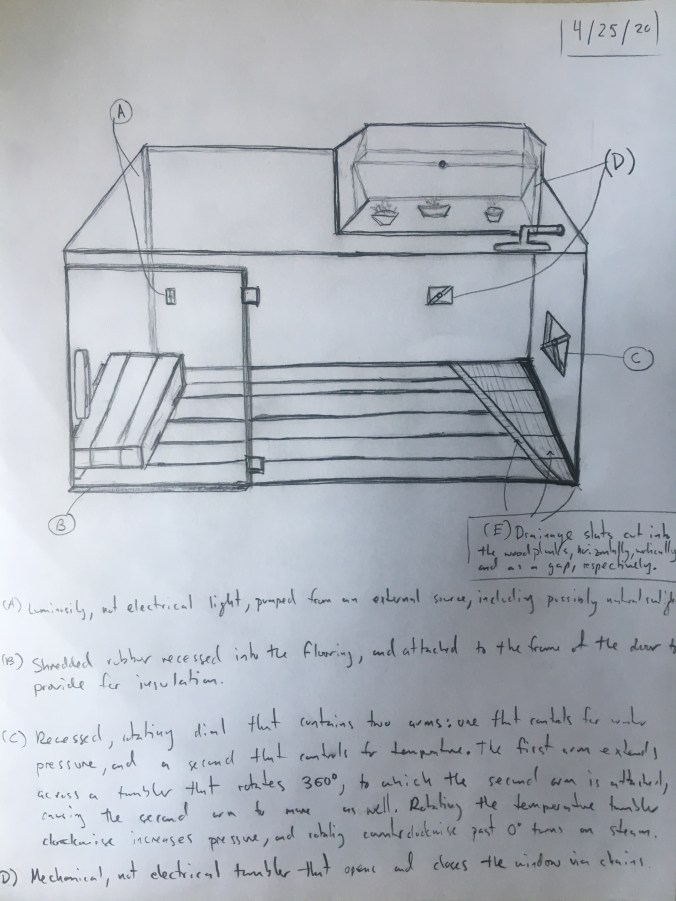
I’ve been experimenting with ideas in interior design, and though I’m not the finest artist, I have a strong intuition for engineering, and so I’d like to think the net results are pretty good, and certainly commercial quality, at least in my opinion. Specifically, I came up with a sketch this morning for a shower with some clever design components, and I was thinking about how to replicate the design on a mass scale, even though it involves some elements of artisanship, in particular the wood cutting near the drain of the shower, which I’ve assumed has been perforated, and sloped, to fasciliate drainage.

image1-4

Interior of a shower with wood plank floors.

What I’ve realized is, you could have an artisan make the original model of, e.g., the flooring, while the tools used are being monitored and recorded by a machine, effectively recording what’s taking place, to allow for accurate recording of the angles, pressures, and motions made use of by the artisan. This could allow for the mechanization, and mass production of copies, since a machine could then imitate the actions of the artisan. Obviously, this would require the artisan to make use of specialized tools that have been equipped with sensors to allow for the type of observations necessary to actually implement this, but the point being, that with sufficient data, you could probably imitate an expert artisan carpenter, e.g., and then mass produce the results, by having a machine imitate the actions of the artisan. This would probably require a large number of observations (e.g., contact pressure at a large number of points on a surface), and I’ve already written software that can efficiently manage extremely large numbers of observations. Then, perhaps finishing touches could be applied by human workers, but the point being, that an artisan could make use of A.I. to mass produce their products.

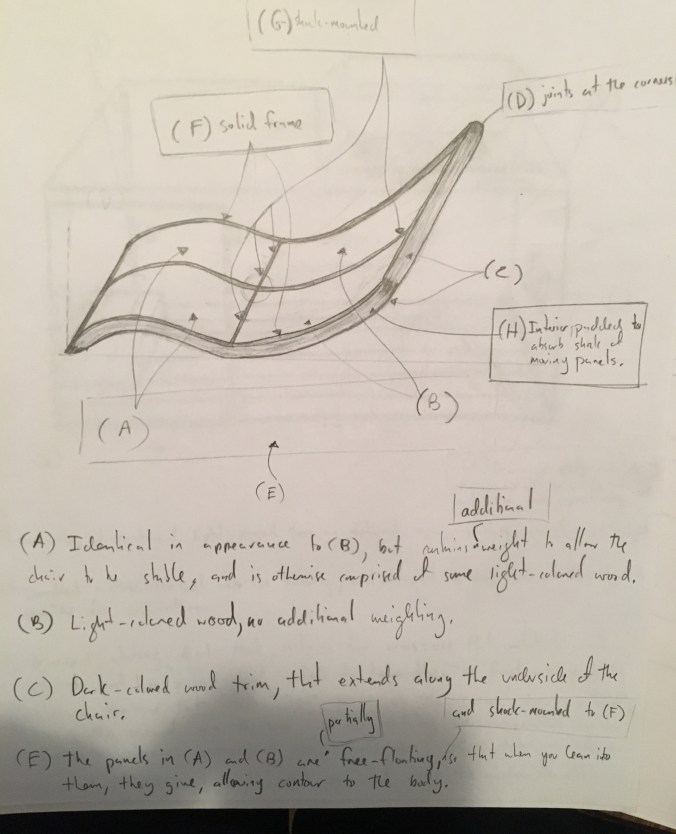
This should cause the finished products to have the same handcrafted appearance as the original, since the machine would be imitating the artisan, and you could even include software to ensure that each finished product is unique, despite being mass produced, using something like the data imitation algorithms that I’ve developed. This would lead to the mass proliferation of artisan-quality products, which would almost certainly improve standards of living, allowing ordinary people to enjoy artisan-quality craftsmanship, at prices associated with mass production. This is arguably what IKEA did for design, delivering high-end design at affordable prices, but extending this to the actual manufacturing of the product, allowing high-quality artisan construction to be enjoyed at prices that reflect the economics of mass production. Below are two related sketches using similar elements, and all are assumed to be part of the same house.

image1

A performance space with glass walls, a rug, and a cabinet.

image2-2

A living space with glass walls, a hanging art piece made of subway tiles with a faux-grass frame, a floor rug intended for seating, and a floor with a partially exposed base filled with large stones.

IMG_5460

A wooden chair with shock-mounted panels to allow for contour.

This is the color palette I imagined for the space, generally.

Screen Shot 2020-04-27 at 3.16.18 PM


Prometheus A.I. Physics Engine

It’s been a few weeks since I’ve shared any new software, which for me, is a long time, and though the disruption of the coronavirus obviously had some hand in it, the real cause is that I’ve been working on thermodynamics, coming up with new ideas and writing software that extends the algorithms and ideas that I introduced in a previous note. Specifically, I’ve actually implemented the idea of making use of compressed representations of physical systems, and have managed to reduced complex sets of observations to linear Euclidean embeddings, which allows my core machine learning algorithms to be applied.

In summary, these algorithms takes tens of millions of observations, and reduce them to reasonably short sequences of real numbers, that can then be classified using my core A.I. algorithms, which are of course radically efficient. This in turn allows for the radically efficient analysis of thermodynamic systems, and other comparably complex systems, perhaps biological systems, or actual economies (as opposed to just a single asset price).

I’m very excited about this work, so I’m going to spend a few more days ensuring that I’ve optimized the algorithms, and written an article that is deserving of the quality of work that I’ve done on the matter.

How I Think about Music Production

Music production is an art form that is distinct from the actual composition of music, and instead involves the study of how music is perceived by the listener, how it is represented in some medium, and how it is recored to that medium. Digital technology has completely revolutionized the art of music production, allowing professional quality music to be produced using inexpensive consumer devices, in turn allowing independent artists to more accurately reflect their intentions, provided they are skilled in the art of music production.

In this article, I will provide a fairly in depth introduction to the art of music production, using Apple’s Logic Pro X software, but the principles I’ll introduce are general, and can be applied to the production of music in any professional or home recording studio.

Recommended Equipment

Though you can follow along to this article with nothing at all, other than a pair of ordinary headphones, these are the components I will be using:

(1) Sony MDR Studio Monitors

These are hands down the best headphones that I’m aware of, and every recording studio has them available for artists. The clarity is unreal, and if you’ve never listened to music on professional audio equipment before, it is in my opinion a transformative experience. They typically cost about $100.

(2) Apple’s Logic Pro X

There are plenty of digital audio programs out there, but this is what I use, and it’s wonderful. The interface is intuitive, aesthetically pleasing, and the built-in devices and libraries are awesome. Logic Pro X currently costs $199.

(3) Shure SM-57 Mic

This is the workhorse of microphones, used for everything from live vocals to snare drums. This is not the best microphone, but it’s arguably the most reliable and universal, and will work just fine for everything other than studio quality vocals, though you can probably fake it after reading this article. But, if you’re looking for a microphone that is going to be used to record studio quality vocals, then you’re looking for a condenser microphone, and you won’t have any trouble finding a really high quality mic for around $100 to $200.

The Most Basic Levers of Recorded Sound

In this section, I’ll introduce two of the most basic tools that a producer can use to alter the sound of a mix, which are panning and volume. I’ll revisit each of these concepts in much more technical settings later on, but the purpose of this section is to demonstrate that even these two basic tools can completely change how a listener perceives a piece of music.

Panning

You’ve got two ears, and as a result, headphones and speakers generally have two channels, Left and Right, that correspond to your left and right ears, respectively. As a result, any recorded sound can be played back in the left channel, the right channel, or both channels. Moving a sound from one channel to the other is called panning, and it allows you to manipulate the perceived space in which a sound exists. Though there is no center channel, what panning allows you to do is create a perceived space for sound that goes from left, to center, to right, including everything in between, as you “turn the knob” from left to right.

As an example, listen to the opening percussive bells in this song by Emilie Nicolas, and try to focus on which ear you hear the sound in. You’ll notice that different notes are actually in different positions, with some in the left channel, some in the right channel, and others roughly centered (i.e., distributed evenly between the left and right channels). At the 32 second mark, there’s a man’s voice singing, which you can hear is almost entirely in the left channel. Then at the 40 second mark, the same voice appears again, except this time mostly in the right channel. This is a very simple technique that requires only turning a knob from left to right, that can create an apparent geography to a piece of music in the mind of the listener.

Screen Shot 2020-03-29 at 5.55.31 PM

A screen shot from Logic Pro X, with the blue box identifying the pan knob.

In Logic Pro X, each channel has its own pan knob, which you can simply click and rotate from L to R, which will cause the channel in question to move from 100% left to 100% right, as the knob sweeps from L to R, causing the sound to move from the left ear to the right ear. By assigning sounds different positions in a mix, you can create a perceived location for each sound, and this simple technique actually works when you have a large number of instruments, and you want to allow each instrument to be clearly perceptible to the listener.

Volume

Informally, the volume of a channel tells you how loud the channel is. Just like with panning, we can create an apparent geography using volume. So for example, if someone is shouting, but the shouting is played back at a low volume, this will create the sense that the shouting is happening far away from the listener. Similarly, if a typically quiet sound, like a whisper, is played back at a loud volume, then this will create the sense that the sound is happening near the listener (i.e., that someone is whispering in their ear).

Volume can also be used to create a sense of sparseness, or fullness, even if the individual volumes of the instruments don’t change. This is exactly what happens during a “drop”, when a song actually begins after an introduction, or a bridge section – the number of instruments typically increases quickly, creating a rush of loudness. As an example, above is a song by Skrillex, featuring Ellie Goulding, which starts with a synth line that has a roughly constant volume. There are other things going on during this introduction, like reverb, that give the intro a sense of sparseness, as if it were being played in a large open space, but the volume alone, when the beat actually comes in, completely changes the perceived sound of the song. This is because a set of instruments together have a louder volume than any of the individual instruments in isolation. So when the song actually comes in, the total volume of the mix is much higher than the isolated volume of the synthesizer line during the introduction, producing a much louder total sound. “Loudness” is actually a sport of sorts in pop music, and as a general matter, pop producers try to achieve the loudest total mix possible, which is a technical challenge we’ll discuss below.

Screen Shot 2020-03-29 at 6.28.13 PM

A screen shot from Logic Pro X, with the blue box identifying the volume fader.

In Logic Pro X, each channel has its own volume fader, which you can simply click and drag up and down, which will cause the channel in question to transition from maximum volume to completely muted, respectively.

Multi-Track Recording

Even though Logic Pro X has only two outputs, Left and Right, it is capable of recording what is effectively an unlimited number of individual tracks. You can add new tracks by simply clicking a button, and this will cause a new channel strip to appear, with its own volume fader, pan knob, and other associated controls that you can adjust. What this allows you to do is record instruments separately, but nonetheless play them back simultaneously. So you could, for example, record a guitar track, and then, separately, sing over it, recording a vocal track, and then play both simultaneously. This allows one musician to compose for an entire orchestra, and actually record it, which is nothing short of revolutionary, especially for $199.

As an example, this is a viola septet that I wrote, that also makes use of rather drastic panning during the introduction. You can clearly hear the instruments start to come in, one by one, and each of these instruments was in fact scored separately, and then mixed together into a single piece of music. Though I used Logic Pro X to actually produce the audio for this piece, the instrument sounds themselves come from a library sold by Native Instruments called Kontact, which costs about $600 to $1300. This library can then be added to Logic Pro X, and accessed through the interface relatively easily, expanding the already sizable set of instruments that are included in Logic Pro X.

Compression

One of the most important tools that a producer can make use of is compression, which allows you to compress the distribution of volumes a channel generates into a narrower band, making quiet sounds louder, and loud sounds quieter, leaving the middle relatively undisturbed. This ends up causing a track to have a tightly bounded volume, which prevents sudden jumps in volume, which is important for pop music, though it is arguably something you might want to minimize use of for other genres, where you actually want a wide range of volumes to be possible. Nonetheless, for pop music, you almost always want to make heavy use of compression, and by repeatedly compressing individual tracks, and then compressing an entire mix, you can achieve loudness, by generating a tighter average volume, and then ratcheting up that average.

But like everything else, if you overdo compression, it starts to sound unnatural, and not very good. Specifically, for vocals, using too much compression can produce a sound similar to a radio DJ’s on-air mic, which is generally not desirable. Nonetheless, if you’re producing pop music, compression is something you’ll want to use on basically every track, since you don’t want inaudible quiet sounds, nor do you want ultra loud, out of nowhere sounds – i.e., you don’t want highly random volumes that force the listener to get up every 15 seconds, and adjust the playback volume. Instead, you want music that is dynamic, that gets louder and softer, but that nonetheless has a playback volume within some manageable range.

Screen Shot 2020-03-29 at 7.39.39 PM

One of the built-in compressors from Logic Pro X.

Compression is the tool that lets you achieve this. In Logic Pro X, there are several built-in compressors, and above is the one that I typically use, because I think it produces the best results. There are a lot options on this compressor, but I’m going to focus on the basic controls, which are the threshold, the ratio, and the makeup. You can do a lot with just these three controls, but if you’re interested, you can find plenty of materials online devoted solely to compression.

The threshold is the volume at which the compressor kicks in, and starts to limit loudness. The lower the threshold is, the less upside is permitted in terms of volume. As a result, as a practical matter, if you spin the threshold all the way to the left, you’ll end up reducing the volume of the track. The ratio controls how aggressively the compressor reduces any sounds that are above the threshold. As a result, if you spin the ratio all the to the right, you will drastically reduce the volume of any sounds that are above the threshold. Finally, the make up controls the amount of gain that you add back to the signal, post compression. This is the finishing touch that lets you create a flat signal, that has a roughly constant volume. That is, the compression phase (determined by the threshold and the ratio) will reduce the volume of any sounds that breach the threshold. This will, as a practical matter, reduce the volume of the signal, since really loud sounds will get diminished. The make up gain lets you bring up the net volume of the signal, adding gain to the already compressed signal. If you’re a mechanical thinker, the compression phase puts a ceiling on the volume, and then the make up gain lifts the floor, forcing everything into a narrower band of volume.

Rather than tell you what settings to use, I think the best thing you can do for yourself as a producer of music is to try to imitate the sounds produced in the music you enjoy the most. Nonetheless, there are some benchmarks that I think you should try to understand and achieve. As an example of what I think of as ideal compression for vocals, I’d suggest a close listen to the vocals on this track by My Brightest Diamond (a.k.a. Shara Nova). This is a great example, because there’s almost no audible processing on her vocals, other than compression.

First off, notice that she’s not singing loud at all, but you can nonetheless hear every aspect of her voice, even her breath, and slight percussive elements of her pronouncing hard consonants, like C’s and T’s. In order to achieve this, you need to record a clean vocal signal in the first instance, and in this case, though I wasn’t in the studio, this vocal track is almost certainly the result of a close-mic technique, where the vocalist is positioned within inches of the microphone, separated from the mic only by a pop-screen. What this allows for is a lot of information about what’s going on, frankly, inside the singer’s mouth, which is what allows you to hear all the consonants being pronounced, and the breathing in between phrases. So overall, a close-mic technique produces a very intimate sound, as if she’s singing directly into your ear.

For a song like this, which is in large part a delicate (and quite depressing) ballad, this technique is perfect, because you want a sense of intimacy. For a stadium anthem, you do not, and so you’ll probably have to position your vocalist further back from the microphone, to allow for louder singing, since the particulars of diction and breathing aren’t as important. Compression will also play a different role in these two cases. For a close-mic setup, my personal opinion is that you’ll want to use the compression to bring out the breathing, and the diction of the singer, rather than create a flat signal. That is, you can use the compressor to actually accentuate variance in a signal, rather than crush it, by making heavy use of make up gain, and using the threshold to delicately control the overall signal. The net effect will be to produce a signal that is even more sensitive to changes in volume in the underlying vocal track, since you’ve amplified everything below the threshold, causing small bumps in volume to turn into significant jumps. This is the kind of mic placement and compression you’ll generally want for classical singing, jazz singing, and some types of hip-hop, where the vocals dominate.

In contrast, if your vocalist is going to be singing loudly, you probably need a bit of distance from the mic, and you probably don’t want to achieve intimacy, but instead, probably want to achieve a flat signal. This is the classic pop music vocal track, where the tones are clear, and the volume is roughly constant, and loud. This is achieved by bringing the compressor threshold down significantly, and then applying make up gain to recover the signal. If you’re trying to achieve a flat signal that is nonetheless loud, you’ll probably have to do this a few times, repeatedly applying compressors in series, in order to build up enough gain. In my mind, the archetypal pop vocal track is exemplified by this Britney Spears song, “Till the World Ends”, which was produced by the prolific Dr. Luke. You can hear a lot of diction, not much breathing, but most importantly, her vocals are roughly constant in volume. This is the result of repeated compression, bringing the vocal signal into an extremely narrow band, that is basically on or off, rather than dynamic. This is accentuated by the deliberate muting of the vocal track during the chorus, which is literally turned on and off by muting.

Equalization

Equalization lets you take a sound and amplify, or reduce, particular frequencies, or ranges of frequencies. Like everything else, equalization is a tool that can have many purposes, but typically, you would use equalization to amplify desirable sounds, reduce unwanted sounds, and in general, filter a track to produce the overall sound that you desire. As a practical matter, what you do with an EQ is try to get rid of all the unwanted augmentations to a signal that occur when you a record a sound. So for example, if you record an acoustic guitar with a microphone, you’re going to pick up sounds that you simply don’t typically hear when someone is actually playing guitar in front of you. This is unavoidable, because a mic is not a human ear, and there’s a lot of changes taking place between the performance, the electrical signal generated by the mic, and the digital signal recorded on your workstation.

Screen Shot 2020-03-29 at 9.02.08 PM

A screenshot of TDR Nova running in Logic Pro X.

The built-in equalizers in Logic Pro X are great, but I found what I think is an incredible equalizer program that you can download for free, called TDR Nova, that also has built-in compression. This program integrates into Logic Pro X rather seamlessly, and it also makes explaining an equalizer simple, because the frequencies are laid out from left to right, in an intuitive GUI. On the lefthand side are the low frequencies, like those generated by a bass drum, and on the righthand side are the high frequencies, like those generated by a cymbal. In reality, a bass drum has a distribution of frequencies, which will certainly include some high frequencies, but the majority will be concentrated in the low end. Similarly, a cymbal could produce some low frequencies, but the majority of the signal will be concentrated in the mid to high frequencies.

The utility of an equalizer is that it can normalize a signal to your expectations for the sounds in question. So, for example, if you record a cymbal, and there’s a ton of low frequency in the signal, then you probably don’t want to leave that in, because that’s not normal for a cymbal. That is, if you hear someone play a cymbal, there won’t be a significant amount of low end, but instead, you’ll generally hear a crashing sound, concentrated mostly in high frequencies. You can then use an EQ to reduce the volume of only the low frequencies, thereby bringing the recorded signal closer to what you’d normally hear in real life. In this case, this is done by simply moving one of the blue dots in the interface above to the frequency range that you’d like to reduce, and dragging it downward until the sound you hear matches your expectations. Again, there’s no formula for this, and you learn by doing, and by listening to what sounds good. That said, the general rule is that if you’re using equalization as a tool for normalizing a signal, then the overall purpose is to shape the frequency distribution to match what you’d typically hear in real life.

Reverb

When you’re working in a professional recording studio, you will typically record music in an acoustically insulated environment, where the floors, walls, and ceilings have all been treated to minimize the amount of echo. This is done deliberately, so that the only sounds recorded by a microphone in the space come from the source of the sound itself, and not any secondary echoes. This allows for great precision in recording the actual sound produced by an instrument, or vocalist, but it also creates an incredibly unnaturally sounding environment, where there is no echo at all. As a result, signals recorded in these types of environments require processing, to create the impression of an echo that would otherwise have been produced in a normal room. Even if you’re recording at home, you’ll probably want to insulate nearby walls to reduce echo as much as possible, absent a conscious decision to make use of the sound of the room you’re in. Given the high quality of audio software like Logic Pro X, even seriously successful artists like Billie Eilish and Mø are recording at home, using makeshift insulation.

To compensate for the lack of a “room sound” due to insulation, you can use reverb, which is really just simulated echo. Logic Pro X comes with a great reverb program called Space Designer, which I use all the time, and it has a simply enormous number of preset room sounds that you can tweak to achieve whatever sound you’re looking for. The amount of reverb that you use will probably be determined by the sound of the track in question. So for a drum kit, which is extremely noisy, I would generally use only a modest amount of reverb, because it starts to sound awful very quickly, as cymbal hits sustain too long, and kick drums sound like war drums, etc. In contrast, if you’re mixing a single, less volatile instrument, you can probably be generous with the amount of reverb that you use, because the consequences won’t be as dramatic.

As an example, this is a viola sonata that I wrote, that is unaccompanied, and uses a fairly generous amount of reverb. You can clearly hear the notes sustain, and echo, long after they’ve ended, creating the impression that the piece is being performed in a large hall. However, because the actual viola signal is quite loud in the mix, you get the sense that you’re standing near the performer. So the net perceived result is being close to a solo viola performance in a large hall.

Mixing a Track

The ultimate goal of music production is to create a finished product that allows for all of the individual tracks to be perceived clearly by the listener, yet nonetheless conveys a sense of oneness, where the individual components contribute to a single, coherent work. As a practical matter, this will require constant revision, and balancing what you’d prefer an individual track to sound like in isolation, with what it actually sounds like when the rest of the instruments are included. There is of course no algorithm that I’m aware of for doing this, but there are some general guidelines that I use as a practical matter. As an example, I’ve chosen Radiohead’s, “Paranoid Android”, since it makes use of a simply insane variety of individual track sounds. You can get an intuition for mixing by thinking about how you’d manage something like this, producing a finished product that has a balanced sound, with a dynamic, but bounded volume.

Getting Levels

The most basic question you have to answer when mixing, is how loud you want each component track to be. As a practical matter, you should have some rough sketch of what you expect the mix to sound like, which will require answering basic questions about how loud, e.g., a particular guitar track should be. As a general matter, for pop music, you want to make sure that the focus is on the vocals, absent a conscious decision to relegate them to the background.

Positioning in EQ and Panning

Simply adjusting the volumes of the tracks probably won’t be enough to achieve the mix you imagine, because there will be too much overlap in frequencies between the individual tracks. Stated differently, two tracks that have roughly the same distribution of frequencies will be hard to discern between, even if you make one louder than the other. This is because there’s a crowding out effect that occurs when you have too much sound in a particular frequency range, and as a result, you need to try and apportion both the panning spectrum and the frequency spectrum of a mix among the individual tracks.

So if you think about panning, there’s everything from hard left to hard right, and you want to position instruments somewhere in that range. This is a tool that lets you partially isolate instruments that might otherwise crowd each other out. So, if for example, you have two very similar sounding guitars, you could pan one hard left, and the other hard right. As a matter of style, you probably don’t want to do this, because it’s super cheesy, but it highlights the principle, which is that you can use panning as a means to isolate instruments that would otherwise overlap in frequency.

Similarly, you can assign certain instruments bandwidth on the EQ spectrum, but this is better suited for creating distinctions between dissimilar instruments. For example, a tom drum is going to have a lot of low frequency, whereas a flute will have a lot of high frequency. As a result, if you want to isolate these two instruments, you can reduce the high frequencies in the tom drum, and reduce the low frequencies in the flute, thereby reducing the overlap between the frequency distributions of the two instruments.

Obviously, this becomes a very complicated balancing act when you have a large number of instruments, with overlapping frequencies that perhaps aren’t even really constant. But this is why mixing is an art, and producing a listenable final product from a large set of disparate tracks is a non-trivial undertaking, that requires great patience, and a willingness to compromise.

Mastering a Track

Once you’ve mixed a track, this will produce a stereo audio file that has exactly two channels, a left channel and a right channel. You can use the parlance, and say that you “bounced” a mix down to two tracks, which means that you’ve taken some large number of tracks, that each have their own processing, like compression and reverb, and effectively printed the net result to a file that contains the sounds that you hear when you actually play your mix. This is, however, not the final product, as the next step is called mastering, which requires achieving sufficient loudness, ensuring there’s no distortion, and ensuring that the overall frequency distribution is balanced.

Loudness and Distortion

The purpose of achieving loudness is to allow for listeners to listen to your music at the loudest volume possible, with minimal amplification. This isn’t actually necessary, so long as your mix is reasonably loud, and so you can justifiably say that I’m not terribly interested in loudness, and that I’d rather preserve the dynamism of my original mix. This is something that you’ll actually hear in some recordings of classical music, in many cases making the changes in volume a bit unmanageable. In contrast, most pop songs can be set to a particular playback volume, that produces a roughly constant actual volume.

Loudness is achieved through compression and limiting. Limiting a signal is not terribly different from compressing a signal, and in fact, you can achieve limiting with a compressor, by turning down the threshold, and turning up the make up gain. However, the limiter programs within Logic Pro X are designed specifically for this purpose, making it much easier to achieve this type of compression, which is specifically geared towards making a mix loud. But just like compression can start to negatively affect quality, subjecting an entire mix to limiting can also negatively affect the quality of the entire mix, if it’s too aggressive, which will produce an undesirable, crunching sound.

You can load audio files into Logic Pro X, and use tools to analyze loudness, and I did this with Miike Snow’s song, “Black and Blue”, which achieves a simply astonishing level of loudness, despite maintaining a very high quality overall sound. The main obstacle to acheiving loudness is the crunchiness of a limiter, and actual distortion, where the signal exceeds the allotted capacity, possibly creating a cracking, or popping sound. You can search for distortion analytically, by watching the meter on the output master, which should turn red if there’s any distortion. In contrast, the sound produced by a limiter really can’t be analyzed, and so you just have to listen carefully, and make sure that you haven’t forsaken quality and clarity, in exchange for loudness in your master.

Balancing Frequencies

Unlike altering the EQ of a single track, when you’re mastering, you’re altering the frequency distribution of the entire mix, which means that you need to be very cautious in whatever changes you make, since they impact the frequency distribution over the entire mix, and not just one track. You can be a bit more precise using a program like TDR Nova, which will allow you to apply frequency specific compression. That is, you can identify a frequency range, and then apply compression to only that frequency range, rather than the entire mix. This can be useful if you’re mastering beat-heavy music, because it will allow you to take the entire low end, e.g., and normalize the volume, so that if you have a bass drum together with a bass synth in your mix, you’ll get a normalized, bounded volume for both, producing a more coherent sound, sometimes referred to as “glue compression”, because the components are compressed together in the master, whereas they’re treated separately in the mix.

Above is in my opinion a simply wonderful example of top notch electronic music production, by Ronksi Speed and Syntrobic, featuring singer Renee Stahl. It starts out as a somewhat cinematic house music track, with a fairly contained kick drum, and a layered palette of synth sounds, but then opens up at 1:03, with a beautiful piano melody that completely transforms the piece. The vocals are heavily gated, causing them to sound partially muted, producing an overall work of art that is really astonishingly original, and that’s one of the joys of electronic music, in my opinion –

Thinking carefully about this piece, you can start to appreciate the types of opportunities offered by electronic music, which really has no boundaries in terms of timbre, making the production process a real challenge, and quite fun. Though music snobs sometimes shy away from electronic music, I absolutely love it, and think that the audio production in some of the more cerebral house music like this is just amazing. And in particular, Anjunabeats is a great label if you’re interested in getting to know the best of the genre.

A Note on Uncertainty

Shannon’s equation is often used as a measure of uncertainty, and that’s not unreasonable, and he provides a mathematical argument as to why it works as a measure of uncertainty in his seminal paper on information theory.

But, I’ve introduced a different way of thinking about uncertainty rooted in partial information, that is quite elegant, since as you’re given partial information about a system, your uncertainty approaches zero as a matter of arithmetic.

However, this model doesn’t take into account the probability distribution of a system, and instead looks only to the number of states the system can be in. Your uncertainty is simply the log of the number of states of the system.

We can also take into account the distribution of the states of the system by instead calculating the expected number of states, which will be some portion of the total number of possible states.

So if a system is always stuck in some particular state, then your uncertainty is much lower than a uniform distribution of states, and so is the expected number of unique states over any number of observations. Calculating the expected number of states is trivial, and you simply calculate the portion of the total number that would have been observed given a uniform distribution, with a maximum of one, for each possible state of the system. This will always produce an expected number of states that is less than or equal to the actual total number of states. Your uncertainty is then simply the logarithm of the expected number of states of the system.

So for example, if a system can be in 10 states, and after 100 observations, State A occurred 8 times, then that state would contribute 8/10 = .8 to the total expected number of states. In contrast, if State B occurred 12 times, then that state would contribute 1 to the total, since we cap the contribution at 1. If instead all states occur an equal number of times, then each state would contribute exactly 1 to the expected number of states, for a total of 10 states. As a result, if the distribution of states is uniform, then you end up simply taking the logarithm of the number of states.

The information content of a message is measured using the same method in the previous article linked to above, which is to simply measure the change in uncertainty that results from receipt of the message.

Clarity in Repetition

Here’s another one,

Another one for Her.

I know it’s not great –

I know that they’re always the same song,

More or less –

More or less the same song.


But I find there’s clarity in repetition, that,

By repeating,

I find what I find to be most simple, and,

I find Her.

I find –

My Lady in Blue.


She’s another one.

She’s not quite the same.

I know it’s not great –

I know that they all look the same,

More or less –

More or less the same girl.


But I find there’s clarity in repetition, that,

By repeating,

I find what I find to be most simple, and,

I find Her.

I find –

My Lady in Blue.