Understanding Custom OTC Derivatives

Most OTC derivatives are highly standardized, heavily traded products that are more fairly described as unfamiliar than complex.  Nonetheless, a small corner of the market comprised of customized, or bespoke, trades has captured the imagination of both the public and the press. The descriptions put forth to date muddle the scale of the market, purportedly in the hundreds of trillions of dollars, with words like “complex” and “arcane,” all to convey a sense of simultaneous condemnation — the result of some vague concept of inherent mischief — and unholy admiration for the wizards who put these “black boxes” together. In an effort to tone down the more florid descriptions of bespoke trades, what follows is introduction to the market conditions that cause certain market participants to prefer bespoke trades to more standardized alternatives.

Pecking Order

All financial agreements involve mutual promises to deliver assets and/or cash. But some financial agreements limit the scope of assets that can be drawn upon under the agreement. That is, each party has only limited rights to the assets and/or cash flows of the other. For example, assume that A wants to enter into an interest rate swap simultaneously with the issuance of floating rate bonds.  For simplicity’s sake, we will assume that (i) the swap in question is a vanilla fixed for floating rate swap where A pays a fixed rate to A’s counterparty, swap dealer D, and D pays the floating rate on the bonds to A and (ii) the payment dates on the swap are the same as the payment dates on the bonds. This arrangement allows A to pay the bondholders a floating rate, but still manage its interest rate risk by having its payments under the bonds and the swap net out to an effective fixed rate.
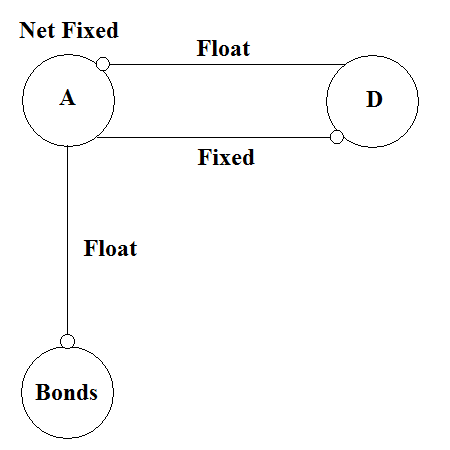
Swap Diagram

But what if the prospective bondholders want to be assured that the swap will not interfere with the credit quality of the bonds? They could insist that A’s payments on the swap be made subordinate to A’s payments on the bonds. That is, A makes payments on the bonds before it makes payments under the swap. This is a basic payment waterfall. This waterfall must be memorialized in both the bonds and the swap agreement, which means that a standardized swap will not do.

Waterfall

In practice, the credit terms of the swap could be much more complex, taking into account various agreements that A has in place, and even differentiate between certain types of payments under the swap, placing each at different levels in the payment waterfall. In short, even the most elementary swap, a fixed for floating interest rate swap, could require intense structuring simply because other agreements require it.

No Market

Another common motivation for bespoke trades is the lack of a market. That is, the risk in question is unique to the party looking to hedge it or too unusual to support a liquid hedging market. For example, assume that A is a heavy oil consumer in town X. Town X is a major delivery point for oil and so there are exchange traded oil futures that track the price of fuel delivered to X. These futures allow A to do a reasonably good job of hedging its exposure to fluctuations in the price of oil delivered to its town X operations. However, A is setting up a venture in town Y which will also consume a large quantity of oil. The price of oil delivered to Y usually tracks the price of oil delivered to X, but can deviate sharply under certain conditions. As such, A would rather not rely on futures tracking delivery to X, but would prefer a hedge that tracks the cost of delivery to Y. A could enter into a swap with dealer D where A pays a fixed rate and D pays the cost of delivery to Y. The net effect of this all-cash swap is that A has locked in a price for delivery to Y.

Further Reading

I’ve written a fair number of articles on the OTC market and related topics, but the well of financial knowledge is orders of magnitudes deeper than the information assembled by this lone wonk. But fret not, because The Qatar Financial Center has set up a simply gigantic resource, QFinance, that is fully searchable and contains information on all corners of finance. It is in essence an encyclopedic compilation of the current state of finance. It seems that most of the entries were written by high level practitioners, with others by academics and regulators. That said, it is a gigantic database, so I have reviewed only a small fraction of the entries. In any case, it is certainly worth checking out.

Asset Bubbles and Economic Activity

Also published on the Atlantic Monthly’s Business Channel.

The internet economic debate du jour is summed up nicely by economist Paul Krugman as follows here:

why [doesn’t] a housing boom — which requires shifting resources into housing — … produce the same kind of unemployment as a housing bust that shifts resources out of housing.

And here:

why … isn’t [ there ] mass unemployment when bubbles are growing as well as shrinking — why didn’t we need high unemployment elsewhere to get those people into the nail-pounding-in-Nevada business?

His point is, on balance, both booms and busts involve the reallocation of resources, yet only busts seem to produce mass unemployment. While Krugman and Arnold Kling* are wrapped up in a debate about how the question influences our understanding of government stimulus, I’d like to simply offer up an answer.

For any fixed amount of capital available for investment, an increase in the amount of capital allocated to one area implies that the amount of capital allocated to some other area must have decreased. In short, capital allocation with a fixed amount of capital is a zero sum game. The same is true of society’s capital. If the pie doesn’t grow, but stays fixed, and society shifts more of its capital into one area of economic activity, it necessarily implies that we have taken capital away from some other activity.

Asset bubbles, however, are, according to my theory of the world, able to temporarily increase the amount of capital society has available for investment because of the effect that asset bubbles have on the market’s expectation of incurring losses on investments tied to the bubble-asset. Some of the capital that society has available for investment is held back by the market in cash or cash-like investments, such as short term Treasuries, in order to cover potential losses that might arise from investments. Some entities, such as banks and insurers, are subject to regulations that dictate how much capital must be set aside to cover these potential losses. Other entities are free to estimate the amount of capital that needs to be held back in order to cover these losses. So, if we took a snap shot of all of society’s capital available for investment at a given point in time, some portion of that would be withheld as a loss reserve in cash or cash like investments. That means some portion of the capital available for investment isn’t really being allocated to “investments,” but being withheld to cover potential losses on bona fide investments.

Asset bubbles create value out of thin air. Price trends develop that deviate sharply from historical norms, and eventually a new, albeit temporary, norm is established. As a result, asset bubbles make the bubble-asset look like a much better investment than it will eventually turn out to be in the long term. As such, asset bubbles create capital available for investment out of thin air because they cause the market to underestimate the amount of capital that has to be set aside to cover potential losses arising from investments tied to the bubble-asset. This means that the effective pie, the portion that actually gets invested in non-cash assets, can be temporarily expanded, removing the zero sum accounting restriction, simply because less of society’s resources are used to cover losses.

When homes across the U.S. all started increasing in value more or less in tandem, home owners felt, and in fact were, richer than they were the day before. They could access the newly found equity in their home to purchase other goods, or double-down and purchase yet another home. As this process escalates and apparent price trends develop, banks feel more confident in making loans tied to housing and begin to compete for those loans. Mortgage lending, which was traditionally considered a “safe” lending business, got even more “safe” since the value of the collateral would surely continue to increase over the life of the loan. So even if the borrower lost his job or his legs, he could always sell the house to cover the loan: there will surely be plenty of equity between the face value of the loan and the price of the home upon sale. And so as lenders’ expectations of an upward trend in price becomes more entrenched, lenders become willing to lend greater amounts of money tied to real estate and can do so without subtracting from other lending activities by simply reserving less capital for losses on their real estate lending.

So what happens when bubbles pop? Once losses exceed expectations, the market is forced to reallocate its capital to cover those losses or face insolvency. If the price of the bubble-asset drops far enough, this could force fire sales outside the bubble-asset market as firms scramble to cover their liabilities. Once this happens, economic actors have less access to capital than they did before the bubble got started, leading to a sharp contraction in economic activity and concomitant upticks in unemployment.

One thing that still puzzles me is why bubbles pop when the bubble-asset isn’t usually expected to produce a cash flow. For example, capital invested in internet companies (e.g., internet stocks) should at some point generate the return that everyone was expecting. When internet startups don’t generate positive cash flows, those returns fail to materialize en mass, and that’s a clear signal to the market that its expectations were off. And so the bubble pops. But what sort of return were people expecting from housing? What was the signal that caused the bubble to pop? Clearly, defaults on bonds backed by real estate were the signal to the capital markets, but what caused the price plateau in the underlying housing market that got the defaults rolling? Was it that credit was extended to the maximum extent possible, and so no further appreciation was possible? Or was the cause psychological, a sort of vertigo price point at which both lenders and borrowers lose their nerve?

*Arnold Kling has proposed an alternate explanation involving the timing of bubbles, arguing that bubbles are gradual while busts are sudden, and that’s the cause. While shocks to expectations are generally bad for markets, I think that this explanation is intellectually unsatisfying because (i) it doesn’t explain why busts are sudden and (ii) it tacitly assumes that sudden changes create unemployment, which is probably true, but is merely descriptive and not explanatory.

Naked CDS: Exposed

Also published on the Atlantic Monthly’s Business Channel.

The term “naked CDS (Credit Default Swap)” has been tossed around a lot lately, with little to no examination of the etymology of the term. You may have heard of “naked short selling” of stock, and a bit of Google action will tell you that naked short selling is generally illegal. So, you’d be inclined to think that naked CDS must be similar in nature to naked short selling, and inevitably conclude that naked CDS would be illegal but for Wall Street’s tentacles. But of course, you’d be wrong.

Naked Short Selling

Naked short selling has nothing to do with being a hedonistic financier. Ordinarily, to short sell a stock, you (i) borrow the stock and then (ii) sell it to someone else. This pair of transactions leaves you with an amount of cash equal to the price of the stock at the time of the sale and an obligation to deliver the stock to the lender at some time in the future. If the price of the stock drops after the sale, you can purchase the stock in the market for less than the price you sold it for, deliver the stock to the lender, and pocket the difference. Fantastic. Naked short selling is very similar, except you never actually borrow the stock. That’s right, you sell something you don’t actually own. There are circumstances where this wouldn’t be much of a problem (e.g., I don’t own the stock right now but I will in the next couple of minutes) and we might want to allow the practice to occur. But exactly when the practice is acceptable is beyond the scope of this discussion. The key point is that naked short selling involves the sale of an asset you do not currently own.

Naked CDS

A naked CDS position is a short position that is unhedged by the underlying credit risk. For example, I have a short position on a bond through a CDS but I don’t actually own the bond. This means that I profit if the price of CDS protection on the bond increases, which usually means that the underlying bond is more likely to default than when I opened up the CDS trade. Note that I have not sold anything that I don’t own. The equivocation between naked CDS and naked short selling stems from the observation that in each case, you don’t own the thing in question. Sure, but in the case of a naked CDS position, you’re not trying to sell the thing you don’t own.  It is the sale without current ownership that makes naked short selling problematic in certain contexts. In contrast, in the case of a naked CDS position, you simply enter into a trade expressing a negative view on a credit, that is all.

Naked CDS positions are similar to unhedged puts: buying a put on a stock without actually owning the stock. A put gives you the right to exchange stock for a fixed amount of cash, called the strike price. If the market price goes below strike price, you can go and buy the stock from the market, exercise the put, and pocket the difference between the strike price and the market price. Fantastic. So the more the price of the stock falls, the more you profit. How evil. Of course, no one has a problem with unhedged puts, even though they express a negative view on an asset in almost the same way a naked CDS position does. But don’t forget, puts are not part of the “shadow banking system,” or whatever other garbage meme is being pumped this week.

Same Same But Different

Pundits also grumble because naked CDS positions are speculative, as are short positions on commodities, such as the price of fuel. But of course, the custom crafted pundit logic applies differently to different markets. For example, in the context of CDS, naked CDS speculators are bad because they magically cause the price of the underlying bond to decrease. But when it comes to commodities, pundits claim that speculators cause the price of the underlying commodity to increase. They hold this to be true despite the fact that both the CDS market and the futures markets are comprised of an equal number of long and short positions, by definition. Moreover, speculators can make money on both the long and the short end of a trade in either market, so why should we assume they consistently choose the “evil side” of the trade? Why markets with such similar characteristics yield such different criticisms is beyond me, but perhaps one day I too will wield the Möbius strip of pundit logic.

Understanding The OTC Derivatives Market

Also published on the Atlantic Monthly’s Business Channel.

In 2006, few people outside of the derivatives market had used the word “credit default swap” in casual conversation. By 2008, it had become an inescapable household term. People continue to throw around buzz words gleaned from the pink pages of the FT, but as my colleague, Daniel Indiviglio recently asked: Does anyone out there really understand what the Over-The-Counter (OTC) Derivatives market is? Since I consider myself the resident derivatives wonk at Atlantic Business, I felt compelled to respond. But rather than focus on any particular instrument or issue, I thought it would be best to focus on the overall structure of the market – who the people in the market are, what they do, and what relationships they have to each other – and leave the banker-bashing to someone else.

Market-Makers

If you were to base your understanding of financial markets on your experiences as a consumer of financial products, you would probably think that any and all types of financial products are available upon demand – all you need to do is pay for them, right? No. The reason you can purchase stocks over the internet with a few clicks of the mouse is because at the other end of that trade is someone else willing to assume the exact opposite end of the trade. If you want to buy, they’re willing to sell. If you want to sell, they’re willing to buy. The folks that do this are known as market-makers. Simply put, their willingness to both buy and sell assets creates a market in which others can trade these assets.

Liquidity risk is the risk that you won’t be able to sell an asset, or more generally unwind a trade, for an amount of cash close to its expected value at any given moment. So which assets carry the most liquidity risk? As a general rule, the greatest liquidity risk comes from assets in thinly traded markets. That is, the fewer times an asset is traded on any given day, the greater the liquidity risk. For example, stock in Coca Cola carries much less liquidity risk than a Victorian mansion for the simple reason that Coca Cola stock is heavily traded every business day all over the world. As a result, Coca Cola stock trades can be executed quickly through intermediaries who are willing to buy it from or sell it to you, since these intermediaries know that at some point in the near future, someone else will show up at their door asking to buy or sell some more. So these market-makers must be the greatest people on the Earth, willing to devote their time to make markets liquid, all for the greater good of humanity, right? No.  You bought your lunch, even if you don’t remember paying for it. In exchange for providing liquidity, market-makers get to pocket the difference between the prices at which they buy and sell.

A swap is a very common type of OTC derivative, which includes that destroyer of economies, the credit default swap (CDS). While industry folk commonly speak of a buy-side and a sell-side to the swap market, you can’t really buy or sell a swap in the classic sense, since a swap is an instrument in which both sides have obligations to perform in the future. That is, if the underlying rate moves against either party, that party will have to pay up, much like a future or forward contract. This is in contrast to an option from the perspective of its holder. An option grants the right, not the obligation, to the option holder to buy a particular asset; and creates an obligation on the part of the option writer to sell that asset. You can sell a right and assume an obligation. You cannot sell an obligation. Well, there are probably a few bozos out there. But in any case, both parties to a swap could end up having an obligation to pay at some point in the future.

The Sell-Side

Swap dealers are market-makers for swaps: the sell-side of the market. But how do they create markets when you can’t really buy or sell a swap? At all times except execution, swaps have positive value to one of the parties to the swap and negative value to the other. At execution, the market value of the swap to each side of the swap is zero.  This is because the price of the swap will be based upon the value of some rate at execution. One party will be long on the rate (benefiting if the rate goes up) and the other will be short on the rate (benefiting if the rate goes down). After execution, that rate will move, up or down, which will create value to one of the parties. What swap dealers do to net their positions is offset their long positions with short positions; and offset their short positions with long positions. In reality, this process is not so simple. The face value of each trade, known as the notional amount, is not likely to match up so perfectly with the other trades, despite being executed by masters of the universe. As a result, they have to work pretty hard to make all of their trades match up.

The Buy-Side

So who is out there using these swaps aside from those evil useless bankers? Well, I’m sorry to disappoint you, but pretty much everyone: corporations of every variety, particularly heavy consumers of energy products, municipalities of every variety, and of course, hedge funds. There are others, like insurers, who have played a now infamous role in the OTC derivatives market, but the preceding list, while not exhaustive, at least provides some insight into the broad variety of market participants out there using these weapons of mass financial destruction.

So why do these firms voluntarily use these evil, destructive, terrible things which will inevitably cause them to suffer? Well, it’s not original sin. It’s because firms that engage in various types of economic activities have natural exposure to various types of risk. And swaps get traded on pretty much every type of rate you can think of. There are the typical and fairly well known swaps like credit default swaps, which are priced against credit spreads; interest rate swaps, which are priced against interest rate spreads; FX and currency swaps, which are priced against currency spreads; and then there are less well known swaps such as energy, weather, and catastrophe swaps, each priced against their own respective spreads. Liquidity varies across these different categories, for the same reasons outlined above: some are less commonly traded than others. Some swaps, known as bespoke swaps, are never traded at all. They are custom tailored trades designed to hedge the risks of specific parties.

So how do these rates correspond to risk? Taking a position on a given rate, long or short, allows you to assume the risk that the rate will move. If you’re naturally exposed to increasing energy prices, taking a long position on a swap keyed to some energy rate, say the price of oil, will allow you to cash in when the price of oil moves up. Because your business loses money when oil prices go up, the net effect of your business losses and your swap gains are zero, if it’s done right. And what if the price of oil goes down? Then your business does well and your swap does not. Again, if that’s done right, your net position is zero with respect to the price of oil. This lets you forget about the price of oil and focus on your business activities. So who takes up the other end of the trade? Even if a dealer takes on the short position in our example, the dealer will usually find someone else who wants to take the short position of the trade and pass the exposure onto them. So why would this other party want to short the price of oil? There are a number of reasons. They could have the exact opposite business problem that you have, and lose money when the price of oil goes down. Or, they could be one of those evil speculators. Yes, speculators serve a bona fide economic function and actually help make markets more liquid.  Again, sorry to disappoint.

Inter-dealer Trading

Dealers rely on each other to supply liquidity to the OTC market. That is, as mentioned above, it is unlikely that any one dealer’s clients will demand a perfectly balanced set of products. As a result, dealers rely heavily on their ability to trade with each other, and smooth over any imbalances in their books. And because of this heavy inter-dealer trading, swap markets have a lot of inter-dealer credit risk, which means that dealers are exposed to the risk that another dealer will default. In general, counterparty risk, which is the risk that the party you’re trading with won’t pay as promised, is of paramount concern in the swap market. The general market practice is and has been to require your counterparty to post collateral based on daily mark-to-market valuation against the relevant spread. But dealers are so important to the market and their positions are so large that even well-collateralized positions that fail to payout in full can have disruptive, even devastating effects. As a result, a central counterparty (CCP) has been set up, which acts as a heavily capitalized hub through which trades are channeled, and most importantly, netted against each other. Right now, there is only one CCP and it is dedicated to a subset of the CDS market. Other CCPs may very well follow. For more on CCPs, go here.

The image below, which does not take into account any CCP, provides an overall graphical representation of the OTC swap market, with dealers performing the classic bank-style role of intermediary between end-users of financial products.

Market Structure

One thing you should notice about the image above is that the swap market connects otherwise disparate parties in the financial system. This has the beneficial effect of providing each with the risk profiles they desire. But it also has the effect of causing the entire system to assume the credit worthiness of the entire system. In other words, as I mentioned above, swaps create exposure to counterparty risk, which is in essence credit risk. One of the obvious-in-hindsight lessons of this crisis is that counterparty risk is highly correlated to macroeconomic credit risk. That sounds fancy and deep, but really it’s just restating the obvious: counterparty risk is a type of credit risk, and so, as the overall risk of default rises, so does the risk of counterparty default. This means that CDS protection sellers are least likely to payout at the very moment they’re obligated to: upon someone else’s default. That said, the OTC derivatives market – the CDS market in particular – has done a simply incredible job of maintaining functionality through even the worst parts of this crisis and has adapted quickly to increase liquidity and administrative efficiency. While those outside the industry seem convinced there’s some kind of trillion-dollar ruse going on, that is certainly not the case. The OTC derivatives market is an invaluable and remarkably sophisticated market that adds real value to the financial markets and the world’s economies. Without it, our lunch will get a lot more expensive.

Understanding Obama’s Financial Overhaul

Also published on the Atlantic Monthly’s Business Channel.

Joe Nocera has said his peace with respect to Obama’s proposed overhaul of the financial system. And in doing so, he expressed disappointment with several aspects of the proposal. In particular, he is displeased that the proposal “doesn’t attempt to diminish the use of … bespoke derivatives.” That certainly sounds ominous. But it’s also not true.

The proposal calls for increased capital charges on bespoke trades, which is a strong incentive away from them. But frankly, I’m sick of writing about the proposal. So rather than regurgitate and parse the administration’s plans for financial regulation, I’d like to take a moment to get familiar with some of the key concepts at play in the proposal, so that you can read it and come to your own conclusions. The two core areas I focus on here are derivatives and regulatory capital. With an understanding of these two areas, you should be able to get a grasp on what the administration is thinking and what effects the proposal will have in practice.

OTC Derivatives

I write about OTC derivatives pretty often, so rather than reinvent the wheel, I’ll shamelessly reuse a piece of introductory text I have handy:

A derivative is a contract that derives its value by reference to “something else.” That something else can be pretty much anything that can be objectively observed and measured. That said, when people talk about derivatives, the “something else” is usually an index, rate, or security. For example, an option to purchase common stock is a fairly well-known and ubiquitous derivative. So are futures for commodities such as pork belly and oil. However, these are not the kind of derivatives that [the proposal] is talking about. [The proposal] is talking about OTC derivatives, or “over the counter” derivatives. This category of derivatives includes the much maligned “credit default swap” market, as well as other larger but apparently less notorious markets, such as the interest rate and foreign exchange derivatives markets. The key defining characteristic of an OTC derivative is that it is entered into directly between the parties. This is in contrast to exchange-traded derivatives, such as options to purchase common stock. Highly bespoke OTC derivatives are often negotiated at length between the parties and involve a great deal of collaboration between bankers, lawyers, and other consultants. For other, more standardized OTC contracts, commonly referred to as “plain vanilla trades”, contracts can be entered into on a much more rapid and informal basis, e.g., via email.

For the limited purpose of wrapping your head around the world of derivatives, think of all derivatives as being in one of three broad categories: (1) exchange-traded derivatives (e.g., options on common stock and futures on pork belly); (2) standardized OTC contracts (e.g., your basic credit default swap); and (3) bespoke OTC contracts (transaction specific, often more complex instruments).

In fairness to Nocera, he’s not the only one weary of the third category of bespoke derivatives. But that doesn’t make his fears justified. So why do firms use custom made derivatives instead of just settling for an exchange traded derivative or a standardized swap? Despite uninformed opinions to the contrary, there are a lot of legitimate reasons for using custom derivatives. The most basic reason is what’s known as basis risk. The term refers to the risk that the difference between two rates will change. In the context of OTC derivatives, it usually refers to the risk that a hedge is imperfect. For example, a commodity user, like an airline, would like to lock in the price of jet fuel delivered to a terminal near an airport in northern California. However, the only exchange traded futures contracts available track the price of delivery to the Gulf Coast.  While we would expect these two rates – the price of delivery to CA and the price of delivery to the Gulf Coast – to be correlated, there are all kinds of events, e.g., supply disruptions, that can affect one price without affecting the other. As such, using an exchange traded future would expose the airline to basis risk. By using a customized product, the airline can more perfectly hedge its exposure to the price of local fuel.

At this point, most of the bozo pundits would say, “just move all the customized trades onto an exchange!” That’s a fine idea, but it has the unfortunate feature of being impossible. In order to have an exchange, you need a lot of liquidity, or simply put, a lot of people trading perfectly fungible assets. The reason you need perfectly fungible assets is that it allows buyers and sellers to be matched on a rapid basis without any communication between them.  Without a lot of people trading perfectly fungible assets, you don’t have a market where you can easily buy a new position or sell your current position, and therefore, you cannot have an exchange. Because bespoke derivatives are often one-off deals, hedging extremely specific risks, there is no market where they can be traded, for the simple reason that they are all unique and only useful to the parties to the original transaction. And so, bespoke derivatives are useful products that cannot always be substituted with exchange traded or standardized OTC products.

What Is Regulatory Capital?

There’s a lot of talk about regulatory capital in Obama’s proposal. So what is regulatory capital? In short, it has to do with how banks finance their operations. Banks are businesses. And like all businesses, they have investors that contribute money to the business. In the parlance of banking regulation, the money that investors contribute is called capital.  This capital can come in various forms, despite the fact that it’s all cash. The form of the capital is determined by what the investor expects in return for his capital contribution. For example, equity capital comes from investors who expect to share in the profits of the bank. That is, after all of the bank’s expenses and debts are paid, the equity investors get their share of what, if anything, is left over. Capital could also come in the form of debt. The bank’s debt investors, commonly referred to as creditors, expect regular payments in return for their investment, regardless of whether or not the bank generates a profit. As such, they get paid before any of the equity investors get paid. Because of this, we say that debt is higher in the capital structure of a bank than equity. But of course, life is a lot more complicated than simple debt and equity. And so, banks make use of a broad range of financing that falls in different places along a continuum from pure senior debt (the top of the capital structure) to pure subordinated equity. As money gets generated by the bank’s activities, that money gets pushed down the bank’s capital structure, paying investors off in order of seniority.

In the magical world of academia, capital structure isn’t supposed to matter much. But as Michael Milken reminds us, in the real world, capital structure matters, a lot. Firms that finance their activities with a lot of debt will have high fixed obligations, since creditors don’t care if you make a profit or not. They invested on terms that assured them payment, come hell or high water. And while they might not be as intimidating as the Goodfellas, creditors have a lot of power over firms that fail to pay their debts. These powers range from seizing assets pledged as collateral to forcing bankruptcy upon the firm. Obviously, these kinds of events are disruptive to a firm’s business activities. And as this crisis has taught us, the business activities of banks are pretty important. Fully aware of this, the world developed what are known as regulatory capital requirements. What these requirements do is place restrictions on the capital structure of banks based on the riskiness of the bank’s activities. As you would expect, the rules that implement these restrictions are very complicated. But the general idea is fairly intuitive: as the riskiness of the bank’s activities increases, the bulk of the bank’s financing should move down the capital structure, towards equity. This makes sense, since a bank that is running a high risk operation shouldn’t be promising too many people regular income, since by definition, their cash flows are unstable. As such, a high risk bank should make greater use of equity, since equity investors only expect their share of the profits, if and when they appear.

Most of the developed world has adopted some version of the bank capital regulations known as the Basel Accords, written by the Bank For International Settlements. Under the Basel rules, assets are assigned a weight, which is determined by the asset’s riskiness. “No risk” assets, such as short term U.S. Treasuries, are assigned a weight of 0%. High risk assets can have weights over 100%. The rules then look to the capital of the bank and break it up into three Tiers: Tier 1, Tier 2, and Tier 3. Tier 1 is comprised of pure equity and retained earnings, the absolute bottom of the capital structure; Tier 2 is comprised of financing that’s almost equity, or just above Tier 1 in the capital structure; and Tier 3 is comprised of short term subordinated debt, or the lowest part of the capital structure that can be fairly characterized as debt. Anything above Tier 3 doesn’t count as capital for the purposes of the rules.

When a bank buys an asset, they are generally required to assign a capital charge to that asset equal to 8% of the value of the asset multiplied by its risk weight. Half of the capital they set aside must come from Tier 1. So for a $100 loan with a risk weight of 50%, the bank that issued or bought the loan would need to set aside 8% x 50% x $100 = 8% x $50 = $4 worth of regulatory capital, at least half of which must come from Tier 1.

So regulatory capital requirements are a matching game between a firm’s assets and its capital structure. The more capital a firm has to set aside to purchase an asset, the fewer assets it can purchase. This means that heightened regulatory capital requirements will restrict a firm’s ability to generate returns on its capital. Well aware of this, Obama’s proposal uses regulatory capital as a tool to push firms away from certain practices. For example, as mentioned above, the proposal calls for increasing the capital charge for bespoke trades. It also threatens firms that are “too big to fail” with the spectre of overall heightened capital requirements. While Nocera thinks this is an empty threat, not everyone is so confident. But in any case, go read it yourself, at least the summary, and come to your own conclusions.