Information, Morphology, and DNA

Introduction

When I originally started my work in DNA, I was astonished to find that superficially distinct people (e.g., Nigerians and Norwegians), were 99% matches on their maternal line, as measured by mtDNA. See, A New Model of Computational Genomics [1], generally. That is, 99% of their bases are exactly the same. I mulled through the intuitive suspicions like slavery, but that line of reasoning started to fade quickly, as populations all over the world were again 99% matches, with absolutely no known history to explain it. For example, the people of Thailand and Japan (where there’s no significant history of slavery), are 99% matches with some people in Scandinavia and Africa. Moreover, many people in Scandinavia are 99% matches to a 4,000 year old Ancient Egyptian genome. Slavery simply cannot explain these outcomes, and I am not aware of any history that does. The conclusion I came to is that the world was global a very long time ago, due simply to sailing –

This makes perfect sense, and of course the history could be lost if it’s sufficiently ancient, which it seems to be. Consistent with this hypothesis, there is at least some academic support for a very early migration out of Africa, to Asia, and back to Africa [2], around 70,000 years ago, which could on its own explain these results, without sailing until much later (e.g., allowing for the eventual peopling of Japan and other Pacific islands, which plainly requires sophisticated sailing).

However, I also recently realized that it must be the case that mtDNA carries information about paternal lineage. This follows from the fact that mtDNA alone can be used to predict ethnicity with roughly 80% accuracy, over a dataset of 36 global ethnicities. See Section 5 of [1]. Chance implies an accuracy of \frac{1}{36} \approx 3\%. This accuracy is simply too high, unless mtDNA carries information about paternal lineage as well. This is distinct from being able to determine who a given person’s father is, and is instead, information about the paternal line of the person in general, which in turn allows you to predict ethnicity.

We are then confronted with the problem of morphologically distinct people, with the same maternal and paternal lineages. That is, two populations that have very similar distributions of maternal lines, probably have similar distributions of paternal lines as well. My work shows unambiguously that there’s a set of global populations that are 99% matches on the maternal line, which in turn implies that they are probably highly similar on the paternal line as well. However, these populations include Africans, Europeans, and Asians, who are obviously morphologically distinct people. How could this be if they are so genetically similar?

Complexity, Selection, and Competition

I think the answer comes from complexity theory. Specifically, coding for color (e.g., skin or eyes), texture (e.g., hair), and quantity (e.g., size or height), requires very little information compared to coding for structure. Human beings are all structurally the same, and as a consequence, there shouldn’t be much variation in the genetics that codes for overall morphology. Similarly, because color, texture, and quantity are low-information variables, the portion of the genome that codes for these properties will be small relative to the size of the human genome as a whole. In contrast, the brain, nervous system, and sensory organs (e.g., the eye) are incredibly complex systems. As a consequence, they must require significantly more bases to code for than e.g., skin color. Said in simple terms, you can encode variables like size using integers, whereas coding for structure requires information about position and function, which is far more complex, especially for a system as complex as the brain. Keep in mind, the human brain is, as far as we know, the most complex system in the Universe.

You can then ask, why would Nature use efficient codes? And the answer there is that Nature is the most ruthless enforcer of efficiency, and probably why human beings even considered efficient coding in the first instance (i.e., it is the result of competition). Specifically, posit two otherwise identical species A and B. Species A uses a small portion of its genome to code for simple systems in the body, whereas species B uses a large portion of its genome to code for simple systems in the body. The larger the portion of the genome that codes for a given system, the greater the multiplicity of outcomes (i.e., the greater the number of variations that are possible for that system).

This is the case because there are a greater number of sequences that follow from a longer sequence of bases. Note that the number of possible sequences of length N is 4^N, and as a consequence, the number of possible sequences grows exponentially as a function sequence length. It follows that species A will reserve a larger portion of its genome for more complex systems, thereby allowing for exponentially greater multiplicity in complex systems. This in turn implies that species A will be more diverse with respect to complex systems like, e.g., the brain, than species B. That is, you have an exponentially larger number of possible brains in species A than you do in species B. For the same reason, species B will allow for greater multiplicity in less complex systems, but this is obviously a waste. Therefore, species A will create more opportunities for selection on the basis of complex systems like the brain, and in the long run, species A will plainly outperform species B.

Genetic Similarity, Morphological Distinction

The logical conclusion is that the reason you have high genetic similarity among morphologically distinct populations is that they have similar brains, sensory organs, nervous systems, and complex systems generally, which should produce similar preferences. The portion of the genome that causes them to appear physically different is likely minuscule when compared to the total genome size. This could explain how e.g., an African person and Asian person, or Northern European person, could all be 99% matches, and as a general matter, share a significant portion of their total genome. More generally, the visible portion of the human body is plainly not the most complex part, nor is it the bulk by mass – the inside is. This implies a question for empirical testing, that is now possible to answer, specifically, whether whole-genomes follow mtDNA. If this is the case, which I suspect it is, given the fact that mtDNA alone can reliably predict ethnicity, at the level of a modern sovereign boundary, then the story of humanity needs to be rewritten, which will in turn change our understanding of not only the present, but history as well. That is, it’s impossible that these genetic connections arose spontaneously, and so there must be a history that brought them to fruition, which implies a very early, and very diverse world.

Historical Implications

As a consequence, our understanding of history is almost certainly wrong, based upon genetics, and also just common sense observation. One glaring example is the Ancient Egyptians, who were visibly Asian people, that seem to have straight hair and somewhat almond eyes, and I suspect based upon genetics and common sense, that they come from Nepal, since they are a 99% match to many modern Nepalese people. And there are other modern day Africans that look very similar, e.g., the Khoisan people, who are also in many cases part of the same global group of people that are mutual 99% matches to each other. If I had to wager, I’d say that we don’t have a good understanding of very early Ancient Egyptian history (i.e., beginning around 10,000 BC), and that the Egyptians initially came from Nepal, and might have been seafaring people for a very long time, prior to forming what we now know as Ancient Egypt. Again, this is consistent with [2], that argues for a migration back to Africa from Asia, around 70,000 years ago.

Menkaure and Queen Khamerernebty II, courtesy of MFA Boston.

Whole-Genome Sequencing

Some of this plainly doesn’t come across in traditional genetic research, which focuses on genes, and other signatures in genomes that are statistically common in populations. However, I did reach many of the same conclusions as researchers using traditional techniques (e.g., a migration back to Africa from Asia). Therefore, at the risk of being immodest, because my results are consistent with, but more precise than, traditional genetics, I think it’s fair to conclude the methods introduced in [1] are in general superior. Now, that said, being able to sequence entire genomes is relatively new, and so there is a practical explanation for this, which is that you have limited time and resources, and so you focus on a portion of what is in all honesty a gigantic mathematical object (i.e., the entire human genome). However, my work allows for whole-genome comparison and analysis in polynomial time, and was conceived of after the advent of whole-genome sequencing. As a result, we can now compare entire genomes, even on consumer devices, and therefore, ask questions about whole-genomes.
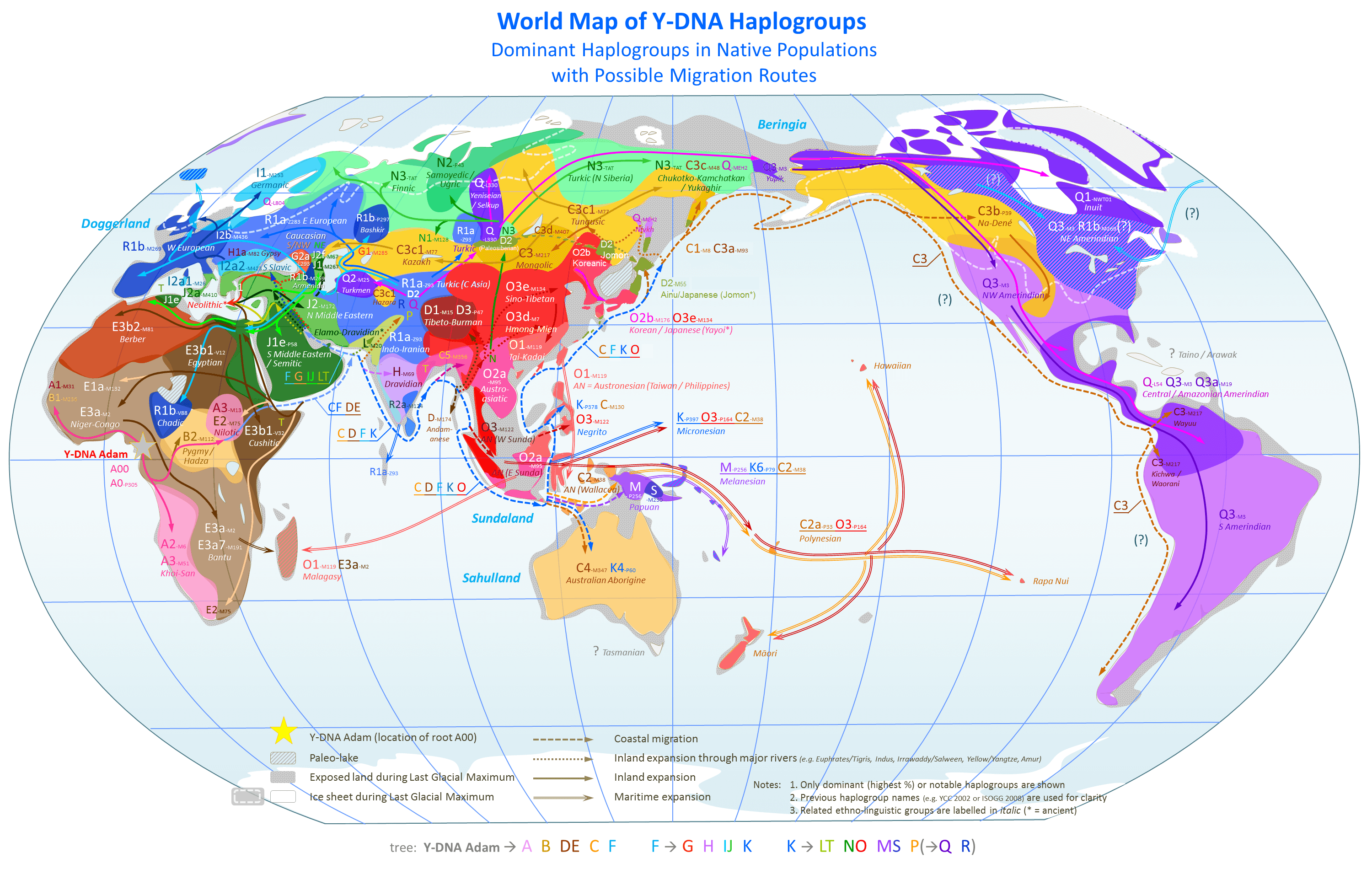
Image courtesy of Wikipedia

Moreover, there’s simply no way that traditional genetic research using Haplogroups will produce the kinds of accuracies my work produces. You can see this in the map above, which shows the global distribution of different Haplogroups, which plainly span large geographic areas. In contrast, my software is able to, e.g., distinguish between Norwegians, Swedes, and Finns, again with 80% accuracy, given a dataset that includes 36 global ethnicities. You can see that it is impossible to do this using Haplogroups alone, because it’s sloppy, and breaches national boundaries. If you want to understand exactly why my methods work better, read [1], but for an intuition, you’re starting with a gigantic mathematical object, a genome expressed as a vector of labels, that is potentially millions of characters long. Then, you’re searching for individual, presumably sequential signals that are common to a population. First off, the better signals might not be sequential, and my research suggests instead the best signals are randomly spread over a genome. See Section 7 of [1]. Secondly, even if the best signals are sequential (which is probably not true), there are an enormous and certainly intractable number of sequences to consider, because you have to subdivide populations, because every population is heterogenous (i.e., there are multiple bloodlines in every population). Therefore, you are basically guaranteed to miss some signals that are common to a population, producing the imprecise results above. 

Application to Data

Attached is code that allows you to A/B test populations, and identify where on the genome their bases differ. It also outputs the average number of matching bases. As an example of the theories above, I compared a single Mongolian genome to a single Thai genome, and the number of matching bases is 5,028. Keep in mind that chance implies a match count of one quarter of the genome, which is 4,144 bases. As such, the Mongolian genome and Thai genome have little more than chance in common. I then compared 4 Thai genomes, to the full dataset of ethnicities, and the results are plotted below. The x-axis shows the population acronym (e.g., MN is Mongolian). The full table of acronyms can be found at the end of [1]. If a given Thai genome is a 99% match to e.g., a Norwegian genome, a counter is incremented. The y-axis shows the value of that counter for a given population as a percentage of its maximum. For example, there are 4 Thai genomes, and 20 Norwegian genomes in the attached dataset. As a consequence, the counter for the Norwegian population has a maximum of 80 (i.e., 20 x 4).  The chart below shows the value of this percentage for each population on the y-axis, and in the case of the Norwegian population, it is exactly 13.75%. As you can see, there’s a very weak connection between the Thai genomes and the Mongolian genomes, of which there are 19, with a percentage of 2.63%. The plain implication is that despite superficial similarities, Thai people are much closer to Norwegian people, than they are to Mongolians.

In addition, there is a single Saqqaq genome in the dataset, and so 50% of the Thai genomes are a 99% match to that single Saqqaq genome. The Saqqaq were indigenous people that lived in Greenland from around 2,500 BCE to 800 BCE. Greenland is plainly geographically remote from Thailand, and moreover, requires a boat to get to – you simply cannot credibly claim that people can swim through the frozen waters around Greenland, in appreciable numbers. As a consequence, it must be the case that at least some seafaring capabilities existed in indigenous peoples during antiquity, suggesting at least the possibility of sophisticated seafaring people elsewhere. Moreover, the Ancient Egyptians were obviously very sophisticated people, and so they’re a decent candidate for the peopling of the Pacific, which obviously required sophisticated boats, and probably telescopes.
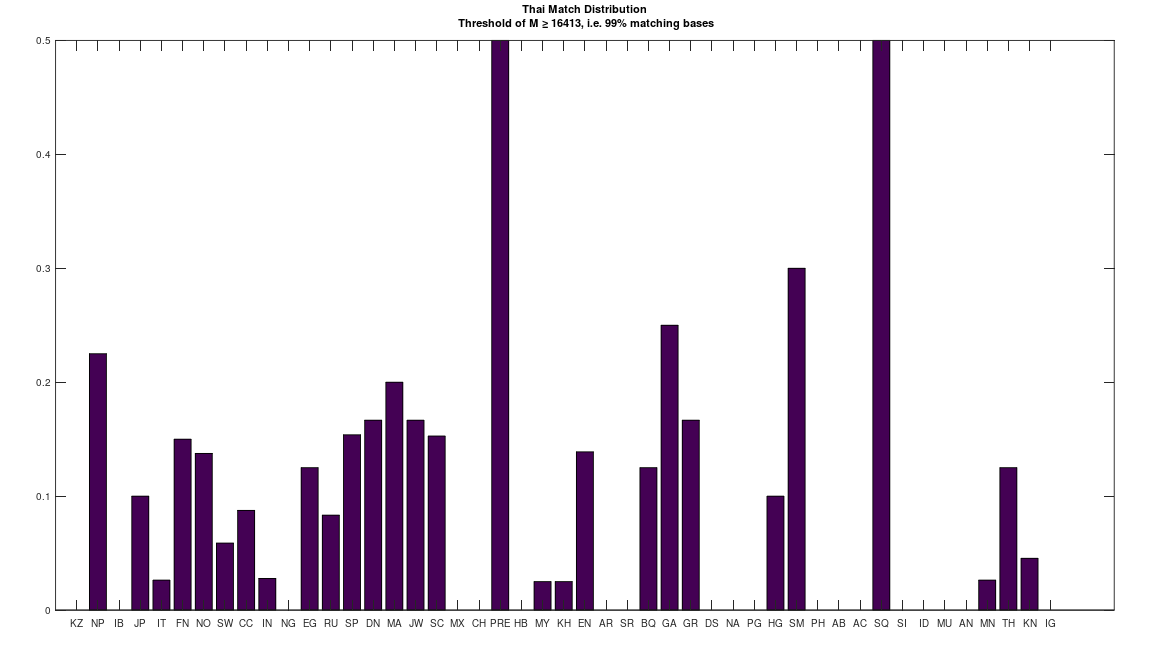
The distribution of match count percentages for the Thai population

Again, as you can plainly see, many Norwegians are a nearly perfect match to the Thai people. In fact, the maximum match percentage between Norwegians and Thais, is 99.76% of the full genome. This could explain why there are plainly Asian-inspired structures in Norway (and some other parts of Europe) known as Stave Churches, that obviously resemble Thai temples. Note that this is also consistent with the hypothesis that genetically similar people should prefer the same aesthetics, since they have similar brains and sense organs. The conclusion being that despite dissimilar appearances, the Thai and Norwegians are very closely related, whereas the Mongolians and Thai are not closely related. This is contrary to what are plainly racist, unscientific categorizations of people, revealing instead real, and deep genetic connections between superficially dissimilar populations.


The Origins of Diversity and Humanity

I recently noted that it’s basically impossible for random mutations to persist, unless they occur on a mass scale in a given population. I posited that contagious microorganisms are the cause, specifically that microorganisms spread in a given population and cause similar mutations to that population. If those mutations are beneficial, selection will cause them to persist. This is also consistent with a common origin of multiple hominin species out of Africa, since otherwise, there’s really no good explanation for multiple similar hominin species to emerge from the same place. Mathematically, having the same significant random mutation occur twice has a probability of roughly zero, since the probabilities are governed by the Binomial Distribution, which means we should have at most one species of hominin, and there are instead many. In fact, there should have been at most one original human, who would be therefore incapable of reproducing. This idea is obviously wrong. The idea that they should all come from the same place without cause is therefore totally absurd.

If you instead posit the existence of microorganisms somewhere in Africa that cause great apes to mutate into hominins, then you can easily explain the emergence of hominins. This would also explain why e.g., Mongolians, some of whom are closely related to Heidelbergensis, look very similar to other Asians, who are not related at all to Heidelbergensis (e.g., the Thai people). That is, the microorganisms in Asia cause the relevant mutations that change morphology. The work above implies that a very small portion of the genome is responsible for appearance, and it is therefore perfectly plausible that the same mutation occurs to totally distinct people, on a mass scale, causing them to develop a similar appearance, while otherwise having very little in common genetically. However, the portion of the genome separating humanity from the great apes is presumably significant, and as a consequence, it should not occur as often. That is, it should occur more often than chance, because it has a cause (i.e., microorganisms in Africa), but it should occur less often than the mutations that change appearance in Asia, because the portion of the genome involved in appearance is presumably much smaller than the portion involved in transitioning from great ape to hominin.

If less than all of the mutations required to transition from great ape to hominin are effected, then I would wager the organism in question ends up with a genetic disease, and dies off. Similarly, if less than all of the mutations required to transition into an Asian morphology are effected, I would again wager the individual in question ends up with a genetic disease, and dies off. Because there are fewer genes involved in transitioning to an Asian morphology than there are in transitioning from great ape to hominin, the probability of a fatal error should be lower, since the number of mutations is much smaller (i.e., each mutation carries some probability of error, and so the total error is a function of the number of mutations). As a consequence, Asians should look roughly the same, and they do, since it is a “safer” mutation than transitioning from great ape to hominin. Note that I am plainly not considering e.g., Indians in this discussion, and there are of course other populations in Asia that are morphologically distinct, but this is not inconsistent with this hypothesis. In fact, it supports the hypothesis, because it shouldn’t happen all the time, just more often than great apes that transition into hominins, and greater than chance, which is plainly the case, given that a simply enormous number of Asian people have very similar morphology. This, despite the fact that they are plainly not all closely related as a matter of overall genetics.

Here’s the code:

https://www.dropbox.com/s/7477c8hj314bgsw/Genetic_AB_Test.m?dl=0

Here’s the dataset:

https://www.dropbox.com/s/zwt1bcqqmqkleca/mtDNA.zip?dl=0

Any missing code is linked to in my paper, A New Model of Computation Genomics.

Williams Syndrome, Schizophrenia, and Parallel Computing

I was introduced to Williams Syndrome through my research on genetics, and it is rare among genetic diseases in the sense that it’s not all depressing, and in fact, people with Williams Syndrome are incredibly charming, emotive, and in some cases articulate people. The disease is the result of deletions on Chromosome 7, and Chromosome 7 is believed to be connected to language skills, and possibly socialization itself. Amazingly, people with Williams Syndrome are simply incredibly kind people, and some are brilliant musicians. As a general matter, people with Williams Syndrome have a great affinity for music, even if they are not themselves musicians, plainly suggesting a connection between musical aptitude and Chromosome 7. I didn’t look too far into the particulars, but I did come upon a video interview with a simply charming woman named Alexandra, who has Williams Syndrome. Williams Syndrome is at times associated with cognitive difficulties, but simply watching Alexandra, you can tell that she has basically none, and is instead, quite articulate, and moreover, she has a high level of self-awareness, and can describe her emotional state in detail, despite her disabilities. In particular, she said something that stuck with me, which is that she loves looking in the mirror, and I do as well, though not because I think I’m the most handsome man in the world, but because of an innate sense of not being alone as a consequence of simply looking in the mirror. And in fact, whenever I brainstorm, I always look in the mirror, as if I’m having a conversation.

Schizophrenics often have hallucinations that cause them to dislocate their consciousness, and assign it to a part of their body that makes no sense. So e.g., they might think their consciousness lives in a book across the room. This is obvious literally insane, and cannot possibly be physically true. However, I think it is the result of what are literally multiple functioning consciousnesses in one brain. This is not metaphysical, and instead, I think the brain of a person with Schizophrenia is literally subdivided, into two consciousnesses. This does not mean two brains, or two copies of the entire brain, but instead, multiple instances of the portion of the brain responsible for consciousness itself, not the rest of the brain. Because consciousness is physically real, there must be a cause for it, presumably in the brain, and as this mechanism develops, presumably during childhood, it could splinter into multiple instances, creating multiple consciousnesses in one brain.

This would allow for literal, self-awareness, in the sense that one region of the brain responsible for consciousness observes another region responsible for consciousness. This is in essence parallel computing, with communication between the UTMs, which can be accomplished simply through a single shared memory, which is obviously critical for any functioning human being. In fact, that could be one of the things that goes wrong with Schizophrenia, leading to proper multiple personalities, due to memory unique to one portion of the brain.

It would also allow for arbitrary scaling of consciousness, which in this view would scale the potential for literally parallel thoughts, and therefore faster more efficient thinking. This could explain how some people solve seemingly non-computable problems, through potentially arbitrarily large arrays of consciousness that are going to be difficult to describe in words, because by definition, you have multiple independent sequences of thoughts. If the mechanism of consciousness is in the brain, but driven and perhaps even housed in a field (e.g., the electrostatic fields in the brain generate a magnetic field literally separate from the body), then you could even have infinite independent consciousnesses in one brain. This sounds far out, but it’s not, because the shape of the field determines the number, and if the shape of the field is infinitely divisible, then you could have a shape with an infinite number of discrete components. Such a mind would be strictly superior to a UTM, which is obviously the case for some people.

Returning to Williams Syndrome, I think Alexandra experiences exactly that, i.e., another person in her mind when she looks in the mirror, albeit in a manner that is not destructive to her psyche, suggesting a connection between Williams Syndrome and Schizophrenia, and therefore Chromosome 7. This could explain why musicians (and Alexandra) really are unusually happy, energetic people:

They’re literally never alone.

And although it is only anecdotal, at the same time, it’s clear there’s a connection between creativity and madness, in that Quincy Jones’ mother was schizophrenic, and he is of course himself, plainly a brilliant musician, and Paul Erdös, Sir Isaac Newton, John Nash, John Nash’s son John Charles Nash (again implying heredity), Erik Satie, and Caravaggio all suffered at times from mental illness, possibly Schizophrenia. Caravaggio actually murdered a man, over a tennis game, indicating that he was plainly insane, despite the fact that he was a genius. This comes across from Alexandra, who cannot stand being alone, experiencing anxiety as a consequence. The net point being, there seems to be a connection between self-awareness, which comes across as emotional intelligence in the case of Alexandra, and Chromosome 7, and in turn, a connection between self-awareness and parallel computation, which could explain the nature of genius, and its lamentable connections to madness. Expressing this mechanically, the deletions on Chromosome 7 associated with Williams Syndrome, and musical and creative aptitude generally, and perhaps Schizophrenia, cause multiple instances of the mechanism responsible for consciousness in the brain to develop, causing the individual to literally think differently than normal people.

My list of crazy people is plainly anecdotal, but I thought it was worth noting that Erik Satie is the only musician on the list. This caused me to consider potential causes, under the assumption that musicians are less likely to be mentally ill than other geniuses. This is obviously counter to the popular perception of musicians as degenerates, but those people are popular musicians, and they are degenerates. In contrast, to knowledge, none of Mozart, Brahms, Bach, Liszt, Prokofiev, Chopin, Faure, Chausson, Debussy, and Ravel suffered from any mental illness at all, and in fact, they were all really well-adjusted, productive people. This led me to the primary difference between music and all other art forms, which is that music requires physical discipline over time, to play a note only at the exact right moment, in the exact right place, in the exact right manner. This plainly requires a regulatory function in the brain that prevents impulses from translating into errors. As a consequence, I think it makes perfect sense that musicians would be among the most well-adjusted geniuses, for the simple reason that they by definition have a high degree of physical discipline, which will prevent them from, e.g., stabbing a man over a tennis match. At the same time, because music is quantitative, I don’t think it’s any less challenging at the highest levels, than mathematics. And so, fine art musicians would be primary targets for genocide by people seeking to damage demographics, since they plainly posses high intellect, but are not degenerates.

Evolution and Microorganisms

Posit a species A, of population size N. Now imagine there’s exactly one member of the population that develops an inheritable, beneficial trait, through mutation. That person will have some number of offspring M, and if the ratio \frac{M}{N} is not significant, that trait will not persist, because even if it’s dominant, it will be bred out to extinction in a few generations. This presents the fundamental insight for a hypothesis I just came up with, which is that microorganisms, particularly contagious microorganisms, could drive our evolution. Now imagine instead that a virus spreads through population A, causing a significant percentage of that population to develop the same mutation. In this case, it’s at least possible for the trait to persist, since a significant number of individuals all experience the same mutation at roughly the same time, due to an exogenous factor, in this case a virus. Then, selection can takeover, and if the trait is beneficial, it will persist, and if it is deleterious or deadly, it will die off. Finally, it is simply not credible to assume that the same random mutation will occur repeatedly in a population. Genomes are gigantic systems, with enormous numbers of possible mutations, and so the probability of the same random mutation occurring even twice, is so low that it’s not meaningful. 
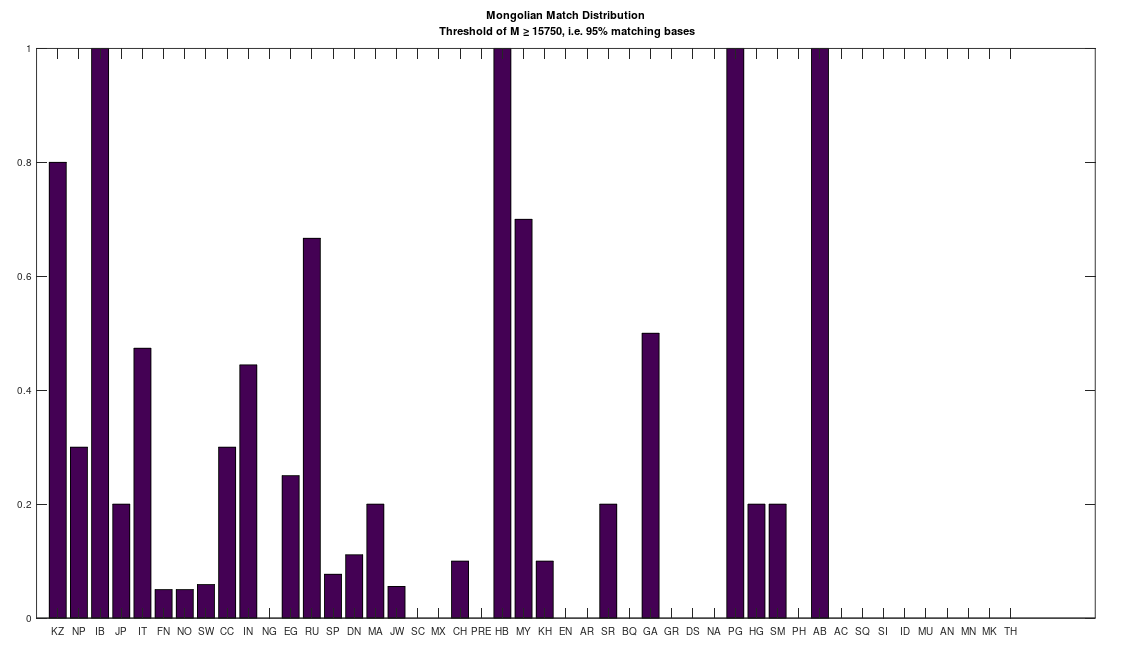
As for the mechanics of this process, I noted in a previous article that it seems reasonable to assume that significant mutations are the result of already assembled strands of DNA being inserted into a sequence during replication. That is, during replication, there’s a free-floating, already complete strand of DNA that is inserted (presumably at the beginning or end of a genome). The intuition is that a healthy organism should not produce a significant number of erroneous insertions, and so it makes more sense to assume that an entire strand is inserted all at once, erroneously, which is technically a single error. This also explains the existence of the D-loop, since insertions would all occur at the “end”, causing a heterogenous portion of the genome to develop over time.


Returning to the relevance of microorganisms, I hypothesize that the source of these insertions (i.e., the strands that get appended) is the microorganisms in a given environment, which plainly interact with other organisms. As evidence for this claim, I realized that the Mongolians and some Chinese are from completely distinct heritages, with Mongolians plainly descended from Heidelbergensis (see the chart above and note HB stands for Heidelbergensis). Many Chinese are simply not related to Heidelbergensis in any meaningful way (though some are). Nonetheless, they are both plainly morphologically similar people. How could it be that two completely different heritages produce extremely similar morphologies? One explanation consistent with the facts is the hypothesis that microorganisms in the environment slowly change the morphology of people that live there long enough through mutations. The same is true of the Ancient Romans, who obviously look European, and are somehow not related to any living group of people, including Europeans. Both of these populations are evidence for the claim that environment impacts morphology, which sounds obvious, but the interesting part is the hypothesis that it’s due to microorganisms that drive specific mutations, on a sufficiently large scale to persist.

This could even explain the origin of humanity itself, specifically, the fact that it seems all species of hominin come from Africa. Why would this be the case? There’s no obvious explanation for it, though if microorganisms play a role, then similar mutations could occur in the same great apes, independently, at different points in history, producing distinct species of hominin, in the same locations. Specifically, e.g., the same or similar strands of DNA from the same or similar viruses end up appended to the same locations in the genome of an ape, which then kicks of selection, and so on.

Follow up on Roman mtDNA

I noted previously that literally no one was a perfect match for Ancient Roman mtDNA, other than other Ancient Romans. The dataset I used at the time had about 400 global genomes, so this is already surprising, and indicative of a people that were systematically annihilated, as opposed to a society that collapsed. For contrast, plenty of people today globally are perfect matches for the Ancient Egyptians, who lived 4,000 years ago, roughly 2,000 years before the Ancient Roman genome samples. As such, it’s not as if people simply disappear, even if their civilizations collapse, it’s just not true.

Just out of curiosity, I ran a BLAST Search on this complete Ancient Roman mtDNA genome. There are zero perfect matches outside of other Ancient Roman mtDNA genomes. This proves conclusively that the Ancient Romans were literally exterminated, which must have taken centuries, possibly longer. This in turn implies that their extermination was deliberate. As a consequence of their annihilation, there are basically no people related to the first Christians alive today. Have a look around the world, and ask yourself whether or not religious people are in trouble again. This is despite the popular narrative the media presents, which is that religious people are belligerent –

Just ask the millions of Muslims held in cages by the PRC (an explicitly atheist regime), who’s really under threat.

As a general matter, the world population seems to be divided into three groups, one descended from the Denisovans (some Finns and some Ashkenazi Jews, with small pockets everywhere), one descended from Heidelbergensis (Iberian Roma, Mongolians, Papuans, and Andaman Indians, again with small pockets everywhere), and apparently everyone else, which includes a giant population that spans the entire world from the Greenland to Hawaii, moving East.

Now consider how many people do research in genetics, and no one ever mentions this glaring, obvious fact. It is simply not normal for an entire civilization’s bloodline to vanish. Egypt was much smaller than Ancient Rome, and yet, there are no Romans left, none, in a dataset that, from what I understand, contains about 100,000 genomes. Keep in mind, mtDNA barely changes at all, even over enormous periods of time, which is why you find plenty of matches to the Ancient Egyptians, Phoenicians, Mayans, Chachapoyas, and others. Literally perfect matches, to truly ancient civilizations, all over the world, in modern populations. Not a single Roman left, none, nowhere in the world, despite the fact it was an empire that spanned continents. They were plainly exterminated, there’s no argument to the contrary, and I’d wager some of the same people are planning to exterminate the Uyghurs, and probably others right now. This obviously does not imply that the PRC is responsible for the annihilation of the Ancient Romans. I would wager instead that the Catholic Church took care of that, but you never know. I am instead suggesting that some people instinctively hate religious people, and that it is probably genetic.

Transactions, Savings, and Income

Posit two economies A and B that begin with exactly the same structure, specifically, the same distribution of preferences, cash, and other assets among the individuals in the population. So for an individual A_i, there is some other individual B_i, with exactly the same preferences, cash supply, and other assets. As a consequence, A_i and B_i are identical for economic purposes. Therefore, if we begin at time t_1, where economies A and B are equal, and assume deterministic progression, economies A and B will proceed through exactly the same sets of transactions over time.

Now assume that the pace at which this happens as a function of time for economy A is much faster than that of economy B. It follows that the income generated during any period of time by economy A will be greater than that of economy B. That is, the GDP of economy A categorically exceeds that of economy B, simply because it progresses faster through what is nonetheless an identical sequence of states and transactions. All other things being equal, it follows that economies that have a higher rate of transaction over time will have higher GDP, than those that have a lower rate of transaction over time.

Now posit that A and B are identical, except that in economy B, savings are held in real assets (e.g., land), whereas in economy A, savings are held in financial assets (e.g., bank deposits). Assume again they begin completely identical, and so it must be the case that there are no savings outside of cash in both economies. Again consider the economies as a function of time. All of economy B‘s savings will go to real assets, and therefore, the cash associated with those purchases simply moves on to the seller, in exchange for the asset. This produces no net change in GDP, but it can improve utility, assuming voluntary transactions (i.e., the seller wants cash, the buyer wants an asset). In contrast, in economy A, savings will go to financial assets (including e.g., bank deposits).

If the bank deposits are backed by fractional reserves, then every dollar deposited will in turn generate a multiple of the number of dollars actually deposited. So in that case, the money supply increases, which should increase GDP as that new money is paid out into the economy. If instead the cash goes to equity in a company, then the company is seeking to raise capital for investment. It follows that new income generating assets will be produced by the company (assuming it is successful) using that capital, thereby increasing GDP. In contrast, simply purchasing an existing asset for cash does not produce any new income, even if that asset already generates income (e.g., through rents on land). It follows that, all other things being equal, economies that have savings in financial assets will have higher GDP than economies that have savings in real assets.

Abstracting, we see that if savings are deposited in banks with fractional reserves, that then lend in the form of debt, the money supply increases. If instead, savings are contributed to companies in exchange for equity, then the supply of income producing assets increases. In both cases, GDP should increase. In contrast, the purchase of an existing real asset cannot increase GDP. This could explain the wealth disparities between economies with comparable populations, specifically, the prevalence of financial assets. Moreover, financial assets require law and order, whereas real assets can be defended by individuals. It follows that a reliable legal system is required in order to maximize the GDP of an economy. Therefore, we should find that countries with more reliable legal systems are generally wealthier than those with less reliable legal systems.

Generating Gravity

All of this talk of UFOs lately led me to an article on previously secret Navy tech that is being touted as a likely source for the truly inexplicable UFO sightings that Navy pilots have been making. It looks like these more recent sightings are not the real thing, otherwise we wouldn’t be shooting them down so easily, but the article mentions a patent for a device capable of generating a “gravitational wave”. I obviously have no idea what the device actually does, but my model of gravity allows for gravity to be generated, at least in theory, because I posit a cause of gravity, in a mechanical sense, that I suppose in theory could be fabricated.

It dawned on me, that if you can actually generate gravity, then you probably don’t need electricity, at least not to generate locomotion, since you can simply accelerate a mass using gravity directly. Moreover, you can generate visible light using ambient low frequency light, blue-shift it into the visible spectrum, and do so using a heterogeneous set of frequencies, which will create white light. The net point being, that the ability to generate gravity could completely liberate humanity economically from the shackles of limited energy.

The Equity Value of a Contract

It just dawned on me, that every contract should have a net value, and therefore, some equity value. Specifically, posit a contract between parties A and B. Even if there are no payments or other financial deliveries, if the contract is economically meaningful, it will provide for rights and obligations. If the contract is voluntary, then the value of the contract to each party should be greater than zero on day one, otherwise they wouldn’t have entered into it. This is already a deep fact of economics, since it necessarily implies value creation. That is, the parties are by definition better off than they were without the contract. And this is something I discuss at great length in my book VeGA, which is that crime is literally a net economic loser for society, since it undermines voluntary transactions, thereby creating suboptimal outcomes, and probably outright losses.

There is however a separate point, that can be thought of as a function of secondary markets. Specifically, it is possible for either of A or B to assign their rights in the contract, or have someone else assume their obligations. As a consequence, there should be a market price for all four of those components. Specifically, there should be a market price for (i) the rights of A and B and (ii) the obligations of A and B. As a practical matter, secondary markets exist only for financial contracts, but there’s no reason why such a secondary market should be limited to financial contracts. As a general matter, if party A is e.g., unable to perform its obligations, there should be a market where A can offload its obligations. This is a generalized version of a futures contract.

This could be achieved through standardization of service contracts, and a legal system that allows people to substitute fungible services. Block Chain platforms are probably a decent candidate. There are of course cases where you would not want to allow substitution in this manner. For example, if you’re buying a bespoke suit, or other product of fine art or artisanship, you simply don’t want a substitute. If however, you’re having your apartment painted, and two vendors are certified as fungible, it’s at least possible that the superficial uncertainty of having an unknown third-party paint your home, would be offset by a robust secondary market, that would potentially create superior pricing.

You could even allow for speculators in these types of markets, if you e.g., have cash penalties for failure to deliver services. Just imagine having a contract to have your house painted, and that contract was issued by a speculator that has no ability to actually paint your house, and instead assumed they would be able to offload the obligation to some certified third party painter. If they fail to find a painter in time, they’re hit with a cash fine that is paid to you, and is adequate to make up for the inconvenience. Will everyone want to participate in such a market? Maybe not, but you can already see that it will create competition on price, because of speculation. At the same time, speculation can cause all kinds of other problems. The net point being, that careful consideration of the economy could identify potentially useful applications of this type of generalized futures contract. If I had to bet, I would say food delivery services (including commercial scale production), home appliance delivery, and other already-fungible goods and services will probably work.

Corporate events alone would probably create a market in big cities, since you don’t care about the particular foods served, you care about the delivery date, the quality, and the number of people it can feed. This will allow for “cheapest to deliver” concepts, which you find in fixed income markets, which will certainly create opportunities for speculators to make money. In the worst case, you have to “fail to deliver”, the other side of the contract again gets charged some penalty rate, which is paid to you, which in a big city, will allow you to order food for delivery right away.

Runtime Complexity in Bits

It just dawned on me, we can express an analog of the Kolmogorov Complexity that measures the runtime complexity of an algorithm. Specifically, let F_1 and F_2 be equivalent functions run on the same UTM U, in that U(F_1(x)) = U(F_2(x)), for all x. During the operation of the functions, the tape of the UTM will change. Simply count the number of changes to the tape, which has units bits, which will allow us to compare the runtimes of the functions in the same units as the Kolmogorov Complexity. As a general matter, we can define a measure of runtime complexity, R_K(F(x)), given by the number of bits changed during the runtime of F as applied to x.

Interestingly, my model of physics implies an equivalence between energy and information, and so a change in the information content of a system must be the result of acceleration. See Equation 10 of, A Computational Model of Time-Dilation. This connects computation with forces applied to systems, which are obviously related, since you need to apply a force to change the state of a tape in a UTM. Note there’s a bit of pedantry to this, since a changed bit is not necessarily the same as the units of bits themselves, but in any case, it nonetheless measures runtime complexity in some form of bits.

Measuring the Information Content of a Function

It just dawned on me that my paper, Information, Knowledge, and Uncertainty [1], seems to allow us to measure the amount of information a predictive function provides about a variable. Specifically, assume F: \mathbb{R}^K \rightarrow S \subset \mathbb{R}. Quantize S so that it creates M uniform intervals. It follows any sequence of N predictions can produce any one of M^N possible outcomes. Now assume that the predictions generated by F produce exactly one error out of N predictions. Because this system is perfect but for one prediction, there is only one unknown prediction, and it can be in any one of M states (i.e., all other predictions are fixed as correct). Therefore,

U = \log(M).

As a general matter, our Knowledge, given E errors over N predictions, is given by,

K = I - U = (N - E) \log(M).

If we treat \log(M) as a constant, and ignore it, we arrive at N - E. This is simply the equation for accuracy, multiplied by the number of predictions. However, the number of predictions is relevant, since a small number of predictions doesn’t really tell you much. As a consequence, this is an arguably superior measure of accuracy, that is rooted in information theory. For the same reasons, it captures the intuitive connection between ordinary accuracy and uncertainty.

