Evolution and Microorganisms

Posit a species A, of population size N. Now imagine there’s exactly one member of the population that develops an inheritable, beneficial trait, through mutation. That person will have some number of offspring M, and if the ratio \frac{M}{N} is not significant, that trait will not persist, because even if it’s dominant, it will be bred out to extinction in a few generations. This presents the fundamental insight for a hypothesis I just came up with, which is that microorganisms, particularly contagious microorganisms, could drive our evolution. Now imagine instead that a virus spreads through population A, causing a significant percentage of that population to develop the same mutation. In this case, it’s at least possible for the trait to persist, since a significant number of individuals all experience the same mutation at roughly the same time, due to an exogenous factor, in this case a virus. Then, selection can takeover, and if the trait is beneficial, it will persist, and if it is deleterious or deadly, it will die off. Finally, it is simply not credible to assume that the same random mutation will occur repeatedly in a population. Genomes are gigantic systems, with enormous numbers of possible mutations, and so the probability of the same random mutation occurring even twice, is so low that it’s not meaningful. 

As for the mechanics of this process, I noted in a previous article that it seems reasonable to assume that significant mutations are the result of already assembled strands of DNA being inserted into a sequence during replication. That is, during replication, there’s a free-floating, already complete strand of DNA that is inserted (presumably at the beginning or end of a genome). The intuition is that a healthy organism should not produce a significant number of erroneous insertions, and so it makes more sense to assume that an entire strand is inserted all at once, erroneously, which is technically a single error. This also explains the existence of the D-loop, since insertions would all occur at the “end”, causing a heterogenous portion of the genome to develop over time.
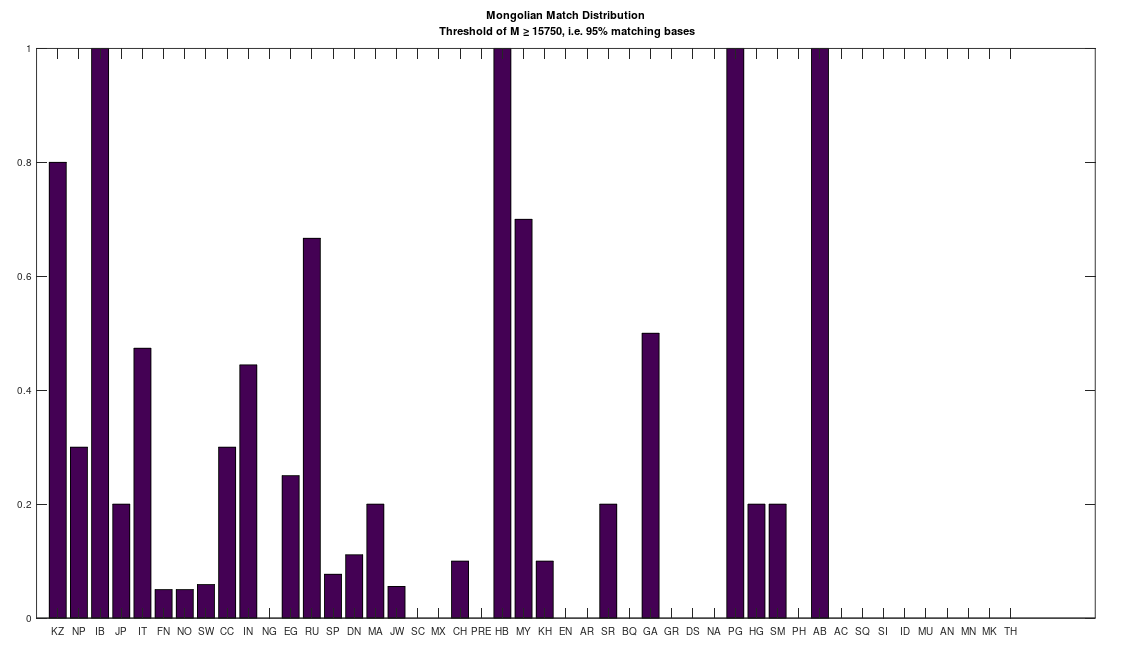
 

Returning to the relevance of microorganisms, I hypothesize that the source of these insertions (i.e., the strands that get appended) is the microorganisms in a given environment, which plainly interact with other organisms. As evidence for this claim, I realized that the Mongolians and some Chinese are from completely distinct heritages, with Mongolians plainly descended from Heidelbergensis (see the chart above and note HB stands for Heidelbergensis). Many Chinese are simply not related to Heidelbergensis in any meaningful way (though some are). Nonetheless, they are both plainly morphologically similar people. How could it be that two completely different heritages produce extremely similar morphologies? One explanation consistent with the facts is the hypothesis that microorganisms in the environment slowly change the morphology of people that live there long enough through mutations. The same is true of the Ancient Romans, who obviously look European, and are somehow not related to any living group of people, including Europeans. Both of these populations are evidence for the claim that environment impacts morphology, which sounds obvious, but the interesting part is the hypothesis that it’s due to microorganisms that drive specific mutations, on a sufficiently large scale to persist.

This could even explain the origin of humanity itself, specifically, the fact that it seems all species of hominin come from Africa. Why would this be the case? There’s no obvious explanation for it, though if microorganisms play a role, then similar mutations could occur in the same great apes, independently, at different points in history, producing distinct species of hominin, in the same locations. Specifically, e.g., the same or similar strands of DNA from the same or similar viruses end up appended to the same locations in the genome of an ape, which then kicks of selection, and so on.

Follow up on Roman mtDNA

I noted previously that literally no one was a perfect match for Ancient Roman mtDNA, other than other Ancient Romans. The dataset I used at the time had about 400 global genomes, so this is already surprising, and indicative of a people that were systematically annihilated, as opposed to a society that collapsed. For contrast, plenty of people today globally are perfect matches for the Ancient Egyptians, who lived 4,000 years ago, roughly 2,000 years before the Ancient Roman genome samples. As such, it’s not as if people simply disappear, even if their civilizations collapse, it’s just not true.

Just out of curiosity, I ran a BLAST Search on this complete Ancient Roman mtDNA genome. There are zero perfect matches outside of other Ancient Roman mtDNA genomes. This proves conclusively that the Ancient Romans were literally exterminated, which must have taken centuries, possibly longer. This in turn implies that their extermination was deliberate. As a consequence of their annihilation, there are basically no people related to the first Christians alive today. Have a look around the world, and ask yourself whether or not religious people are in trouble again. This is despite the popular narrative the media presents, which is that religious people are belligerent –

Just ask the millions of Muslims held in cages by the PRC (an explicitly atheist regime), who’s really under threat.

As a general matter, the world population seems to be divided into three groups, one descended from the Denisovans (some Finns and some Ashkenazi Jews, with small pockets everywhere), one descended from Heidelbergensis (Iberian Roma, Mongolians, Papuans, and Andaman Indians, again with small pockets everywhere), and apparently everyone else, which includes a giant population that spans the entire world from the Greenland to Hawaii, moving East.

Now consider how many people do research in genetics, and no one ever mentions this glaring, obvious fact. It is simply not normal for an entire civilization’s bloodline to vanish. Egypt was much smaller than Ancient Rome, and yet, there are no Romans left, none, in a dataset that, from what I understand, contains about 100,000 genomes. Keep in mind, mtDNA barely changes at all, even over enormous periods of time, which is why you find plenty of matches to the Ancient Egyptians, Phoenicians, Mayans, Chachapoyas, and others. Literally perfect matches, to truly ancient civilizations, all over the world, in modern populations. Not a single Roman left, none, nowhere in the world, despite the fact it was an empire that spanned continents. They were plainly exterminated, there’s no argument to the contrary, and I’d wager some of the same people are planning to exterminate the Uyghurs, and probably others right now. This obviously does not imply that the PRC is responsible for the annihilation of the Ancient Romans. I would wager instead that the Catholic Church took care of that, but you never know. I am instead suggesting that some people instinctively hate religious people, and that it is probably genetic.

Transactions, Savings, and Income

Posit two economies A and B that begin with exactly the same structure, specifically, the same distribution of preferences, cash, and other assets among the individuals in the population. So for an individual A_i, there is some other individual B_i, with exactly the same preferences, cash supply, and other assets. As a consequence, A_i and B_i are identical for economic purposes. Therefore, if we begin at time t_1, where economies A and B are equal, and assume deterministic progression, economies A and B will proceed through exactly the same sets of transactions over time.

Now assume that the pace at which this happens as a function of time for economy A is much faster than that of economy B. It follows that the income generated during any period of time by economy A will be greater than that of economy B. That is, the GDP of economy A categorically exceeds that of economy B, simply because it progresses faster through what is nonetheless an identical sequence of states and transactions. All other things being equal, it follows that economies that have a higher rate of transaction over time will have higher GDP, than those that have a lower rate of transaction over time.

Now posit that A and B are identical, except that in economy B, savings are held in real assets (e.g., land), whereas in economy A, savings are held in financial assets (e.g., bank deposits). Assume again they begin completely identical, and so it must be the case that there are no savings outside of cash in both economies. Again consider the economies as a function of time. All of economy B‘s savings will go to real assets, and therefore, the cash associated with those purchases simply moves on to the seller, in exchange for the asset. This produces no net change in GDP, but it can improve utility, assuming voluntary transactions (i.e., the seller wants cash, the buyer wants an asset). In contrast, in economy A, savings will go to financial assets (including e.g., bank deposits).

If the bank deposits are backed by fractional reserves, then every dollar deposited will in turn generate a multiple of the number of dollars actually deposited. So in that case, the money supply increases, which should increase GDP as that new money is paid out into the economy. If instead the cash goes to equity in a company, then the company is seeking to raise capital for investment. It follows that new income generating assets will be produced by the company (assuming it is successful) using that capital, thereby increasing GDP. In contrast, simply purchasing an existing asset for cash does not produce any new income, even if that asset already generates income (e.g., through rents on land). It follows that, all other things being equal, economies that have savings in financial assets will have higher GDP than economies that have savings in real assets.

Abstracting, we see that if savings are deposited in banks with fractional reserves, that then lend in the form of debt, the money supply increases. If instead, savings are contributed to companies in exchange for equity, then the supply of income producing assets increases. In both cases, GDP should increase. In contrast, the purchase of an existing real asset cannot increase GDP. This could explain the wealth disparities between economies with comparable populations, specifically, the prevalence of financial assets. Moreover, financial assets require law and order, whereas real assets can be defended by individuals. It follows that a reliable legal system is required in order to maximize the GDP of an economy. Therefore, we should find that countries with more reliable legal systems are generally wealthier than those with less reliable legal systems.

Generating Gravity

All of this talk of UFOs lately led me to an article on previously secret Navy tech that is being touted as a likely source for the truly inexplicable UFO sightings that Navy pilots have been making. It looks like these more recent sightings are not the real thing, otherwise we wouldn’t be shooting them down so easily, but the article mentions a patent for a device capable of generating a “gravitational wave”. I obviously have no idea what the device actually does, but my model of gravity allows for gravity to be generated, at least in theory, because I posit a cause of gravity, in a mechanical sense, that I suppose in theory could be fabricated.

It dawned on me, that if you can actually generate gravity, then you probably don’t need electricity, at least not to generate locomotion, since you can simply accelerate a mass using gravity directly. Moreover, you can generate visible light using ambient low frequency light, blue-shift it into the visible spectrum, and do so using a heterogeneous set of frequencies, which will create white light. The net point being, that the ability to generate gravity could completely liberate humanity economically from the shackles of limited energy.

The Equity Value of a Contract

It just dawned on me, that every contract should have a net value, and therefore, some equity value. Specifically, posit a contract between parties A and B. Even if there are no payments or other financial deliveries, if the contract is economically meaningful, it will provide for rights and obligations. If the contract is voluntary, then the value of the contract to each party should be greater than zero on day one, otherwise they wouldn’t have entered into it. This is already a deep fact of economics, since it necessarily implies value creation. That is, the parties are by definition better off than they were without the contract. And this is something I discuss at great length in my book VeGA, which is that crime is literally a net economic loser for society, since it undermines voluntary transactions, thereby creating suboptimal outcomes, and probably outright losses.

There is however a separate point, that can be thought of as a function of secondary markets. Specifically, it is possible for either of A or B to assign their rights in the contract, or have someone else assume their obligations. As a consequence, there should be a market price for all four of those components. Specifically, there should be a market price for (i) the rights of A and B and (ii) the obligations of A and B. As a practical matter, secondary markets exist only for financial contracts, but there’s no reason why such a secondary market should be limited to financial contracts. As a general matter, if party A is e.g., unable to perform its obligations, there should be a market where A can offload its obligations. This is a generalized version of a futures contract.

This could be achieved through standardization of service contracts, and a legal system that allows people to substitute fungible services. Block Chain platforms are probably a decent candidate. There are of course cases where you would not want to allow substitution in this manner. For example, if you’re buying a bespoke suit, or other product of fine art or artisanship, you simply don’t want a substitute. If however, you’re having your apartment painted, and two vendors are certified as fungible, it’s at least possible that the superficial uncertainty of having an unknown third-party paint your home, would be offset by a robust secondary market, that would potentially create superior pricing.

You could even allow for speculators in these types of markets, if you e.g., have cash penalties for failure to deliver services. Just imagine having a contract to have your house painted, and that contract was issued by a speculator that has no ability to actually paint your house, and instead assumed they would be able to offload the obligation to some certified third party painter. If they fail to find a painter in time, they’re hit with a cash fine that is paid to you, and is adequate to make up for the inconvenience. Will everyone want to participate in such a market? Maybe not, but you can already see that it will create competition on price, because of speculation. At the same time, speculation can cause all kinds of other problems. The net point being, that careful consideration of the economy could identify potentially useful applications of this type of generalized futures contract. If I had to bet, I would say food delivery services (including commercial scale production), home appliance delivery, and other already-fungible goods and services will probably work.

Corporate events alone would probably create a market in big cities, since you don’t care about the particular foods served, you care about the delivery date, the quality, and the number of people it can feed. This will allow for “cheapest to deliver” concepts, which you find in fixed income markets, which will certainly create opportunities for speculators to make money. In the worst case, you have to “fail to deliver”, the other side of the contract again gets charged some penalty rate, which is paid to you, which in a big city, will allow you to order food for delivery right away.