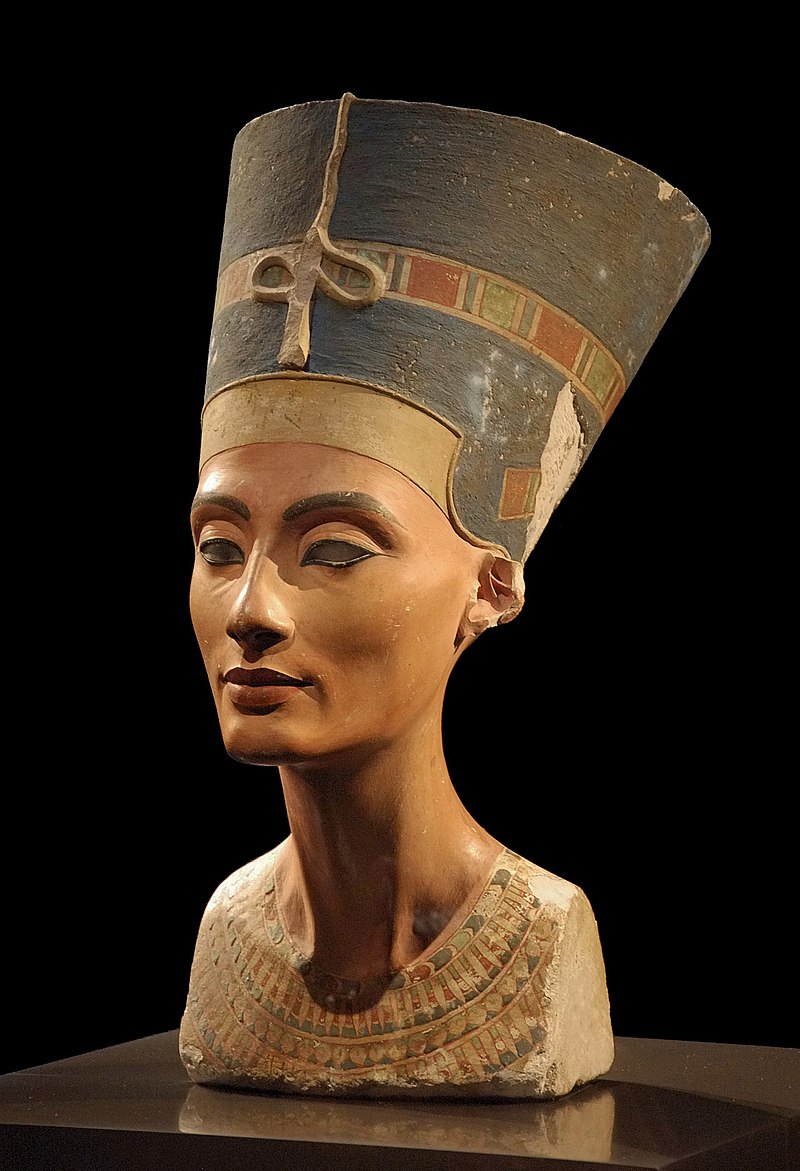
I’ve always had two Ancient Egyptian genomes in my dataset, though I was only interested in the older of the two, which is from about 4,000 years ago, primarily because this is prior to Rome, and also because of the obvious morphological differences between Egyptian Royalty before and after Rome. Specifically, prior to Rome, the Egyptians looked Asian, and are in fact genetically related to Asian people, whereas afterwards, they looked European. On the left is Menkaure and Queen Khamerernebty II (c. 2,530 BCE), courtesy of MFA Boston, in the center is Nefertiti (c. 1,370 BCE), courtesy of Wikipedia, and on the right is Cleopatra (c. 50 BC), courtesy of Wikipedia, who plainly looks nothing like the rest of them. Moreover, the aesthetic is also completely different, plainly closer to that of Rome and Greece, and I would wager that the skills that led to earlier Egyptian art were lost, together with the bloodline, which explains the change in the people themselves, and their art.


I just tested the newer of the two genomes, which is from around 120 AD, and there are significant differences. Below is a plot of the differences between the two populations, with the newer Egyptian genome distribution subtracted from the older Egyptian genome distribution, and so a positive number in a given column implies the population in question is closer to the older Egyptian genome than the newer Egyptian genome, and vice versa. The minimum match count is set to 70% of the total genome. There were 105 other genomes that matched to the older Egyptian genome, and 87 other genomes that matched to the newer Egyptian genome. There is apparently no overlap between the two genomes, and together, 192 people are related to one or the other. There are a total of 484 genomes in the dataset, and so rough justice says about 40% of the world’s current population is related to the Ancient Egyptians, though this is not precise, because there are a significant number of other ancient genomes in the dataset. The net point is, especially because there are only two genomes, a large number of people alive today are related to the Ancient Egyptians, all over the world, and you can see that below.

Because these are single genomes, and because mtDNA is so stable, even over thousands of years, you can’t be certain that the differences between the two genomes are the result of time. Specifically, it could just be that these are two different families that are both from Ancient Egypt, and that both bloodlines were extant throughout Ancient Egypt. If this is the case, then it’s just chance that caused them to appear in this particular order. Note that I’m not referring to the order of their actual discovery (i.e., the date someone dug them up), and instead, the point in time at which the actual people lived. That said, the older of the two genomes is plainly significantly closer to ancient civilizations, specifically the Phoenicians and the Saqqaq. They are also significantly closer to the Thai people, which is consistent with the obvious fact that the Ancient Egyptians were visibly Asian people, prior to Rome. The newer genome is instead closer to the Swedes, Igbo (of Nigeria), the Icelandic, and the Munda (of India), who are all closely related to each other. This is again consistent with a migration-back to Africa hypothesis, which I’m now convinced of. If you’re interested in a more detailed analysis of these issues, and the underlying software, see my paper, A New Model of Computational Genomics.
All that said, the net takeaway is that a large portion of the world’s current population seems to have been a part of a very large group of people that lived literally all over the world, in antiquity. This suggests unambiguously, that ethnically diverse, and almost certainly interracial people, have existed for thousands of years, possibly longer, and the Pre-Roman Egyptians are themselves obvious evidence of this. Yet again, given the fact most modern people are far too stupid and lazy to build pyramids, anatomically correct yet innovative sculptures, and navigate the world in a small boat, the obvious conclusion is that these people were just better than you, but that’s not so hard, is it?
Discover more from Information Overload
Subscribe to get the latest posts sent to your email.
 Information Overload