Data Classification
Black Tree brings the power of parallel computing, together with data compression, producing runtimes that are simply incomparable to other Deep Learning techniques. For a high-level academic summary of the underlying algorithms, see Vectorized Deep Learning. Download a Free Version of Black Tree from www.blacktreeautoml.com.
The results below were generated using Black Tree’s “Supervised Delta Classification” algorithm. This algorithm is included in the Free Version of Black Tree, so you can download the datasets below and see for yourself, that there is simply no contest between Black Tree and other Deep Learning techniques. All runtimes were generated on a MacBook Air 1.3 GHz.
| Dataset | Classification Accuracy | Total Runtime (Pro) | Total Runtime (Massive) |
|---|---|---|---|
| UCI Credit 25,500 Training Rows 4,500 Testing Rows |
83.33% | 1,467 seconds | 223.7 seconds |
| UCI Ionosphere 298 Training Rows 53 Testing Rows |
94.11% | 0.755 seconds | 0.201 seconds |
| UCI Iris 127 Training Rows 23 Testing Rows |
95.65% | 0.237 seconds | 0.086 seconds |
| UCI Parksinsons 165 Training Rows 30 Testing Rows |
90.90% | 0.379 seconds | 0.083 seconds |
| UCI Sonar 176 Training Rows 32 Testing Rows |
95.65% | 0.513 seconds | 0.108 seconds |
| UCI Wine 151 Training Rows 27 Testing Rows |
96.70% | 0.310 seconds | 0.082 seconds |
Image Classification
Black Tree’s image compression algorithms allow Image Classification tasks, including medical imaging classification, to be accomplished in roughly the same amount of time as Data Classification tasks, again producing simply unparalleled runtimes. Black Tree Pro and Black Tree Massive use the exact same image processing and classification algorithms. The Free Version of Black Tree includes the exact same algorithms, with a hard limit of 2,500 images. Accuracies and runtimes for the MNIST Numerical and MNIST Fashion Datasets are 99.95% and 286.09 seconds (5,000 Training Rows and 5,000 Testing Rows), and 92.85% and 15.90 seconds (1,000 Training Rows and 1,000 Testing Rows), respectively.
Black Tree Runs in a GUI
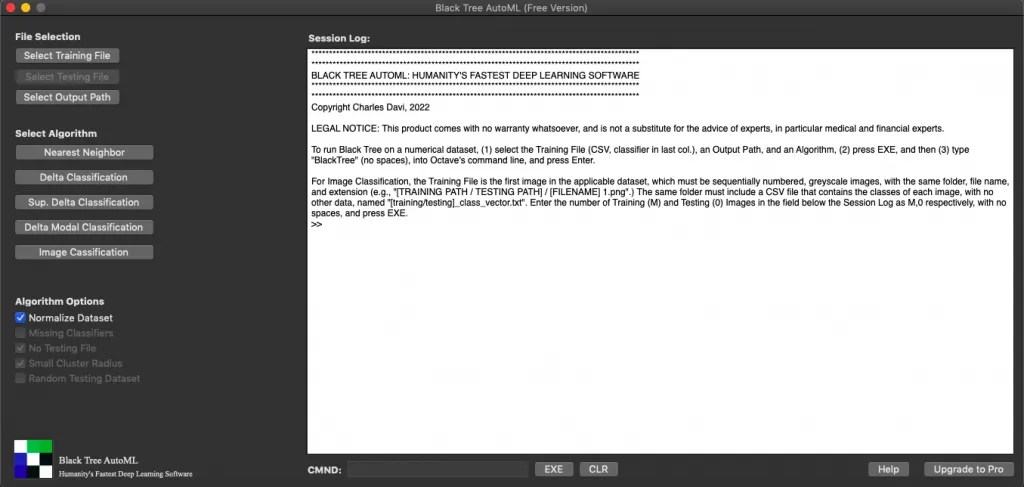
The front-end for Black Tree runs in an easy-to-use interface, reducing Deep Learning to a task that can be accomplished by an admin or assistant, thereby allowing for radical reductions to costs and headcount associated with Deep Learning. For the same reasons, Black Tree allows firms and individuals to spend a small sum of money (see pricing below) to test the question of whether investing in Deep Learning is worthwhile. For some users, this question can likely be answered by the Free Version of Black Tree.
Pricing
Download the Free Version of Black Tree, which includes (i) data classification and clustering, and (ii) image classification (grayscale only), up to exactly 2,500 rows / images (non-commercial license), or select from the commercial licenses below.
NOTICE: All sales are final, no refunds available. For technical support, see Contact Information.
A lifetime commercial license for one user, which includes (i) data classification and clustering, and (ii) image classification and clustering (grayscale only), up to around 25,000 rows.
A lifetime commercial license for one user, which includes (i) all of the algorithms included in Black Tree Pro, (ii) a significantly faster Supervised Delta Classification algorithm, (iii) a significantly faster normalization algorithm, together with (iv) Massive Algorithms that can classify 500,000 rows in approximately ten minutes, and (v) confidence metrics that allow for precise classification.
Black Tree Osmium (Coming Soon)
A lifetime commercial license for one user, which includes (i) preprocessing, compression, analysis, and anomaly detection algorithms that can be applied to data, image, video, and 3D and higher dimensional data and video (i.e., high-dimensional time-series), (ii) image and video classification algorithms, (iii) 3D object detection, tracking, and classification algorithms, (iv) high-dimensional time-series prediction and interpolation, (v) algorithms that can detect periodicity and stable average values in time-series data, and (vi) N-dimensional optimization.
Discover more from Information Overload
Subscribe to get the latest posts sent to your email.
 Information Overload