I noted in my paper, A New Model of Computational Genomics [1], that many living human beings are very closely related to both Denisovans and Heidelbergensis. This likely doesn’t come across in standard genome comparison, because it seems current standard methods make use of local alignments, that effectively ignore insertions and deletions. This causes basically all living people to seem roughly similarly related to archaic humans. If you instead don’t use local alignment, you see drastic differences in match counts, with only some modern humans closely related to Heidelbergensis and Denisovans. First off, insertions and deletions are obviously very significant, since they produce diseases like Downs Syndrome and Williams Syndrome. Secondly, my methods are plainly more precise than using haplogroups (see [1] generally), and I use a single global alignment method. The net conclusion being, that local alignment produces imprecision because it ignores insertions and deletions, which are obviously significant. For example, run a BLAST search on this genome, and you’ll see “gaps” in the reports, which plainly artificially inflate the match percentage. In contrast, my work is able to predict ethnicity with roughly 80% accuracy, even between e.g., Swedes and Norwegians. This is simply not possible using local alignments, because everyone will end up a nearly perfect match to everyone else, which is obviously not true.
I’ve since updated the human mtDNA dataset that is the subject of [1], to include another 7 Denisovan genomes, and a population of 11 modern Kenyan genomes, as well as others. The dataset now contains a total of 452 complete human mtDNA genomes, over 47 global populations, including many ancient, and archaic humans. All genomes come from the NIH, and the dataset includes a provenance file with links to the NIH Database for each genome. All genomes have been diligenced to ensure that the person in question is e.g., ethnically Chinese, as opposed to someone simply located in China. See Section 1.4 of [1].
When running the same analysis I’ve always run, comparing the Denisovan population to the entire dataset, I found many Kenyans were a match. See the chart below, and see the end of [1] for a table with acronym names (e.g., KN is Kenyan). This is quite significant, since Southern Denisovan fossils have yet to be found, and if all hominins come from Africa, then there should be evidence of Denisovans in Africa. Unlike some of the surprising genetic relationships I’ve found, this could unfortunately be explained by slavery, for the simple reason that many Europeans are also matches to Denisovans. If Europeans related to Denisovans enslaved Kenyans, they could have reproduced with those Kenyans, which would have altered the maternal lineage of Kenyan people generally.
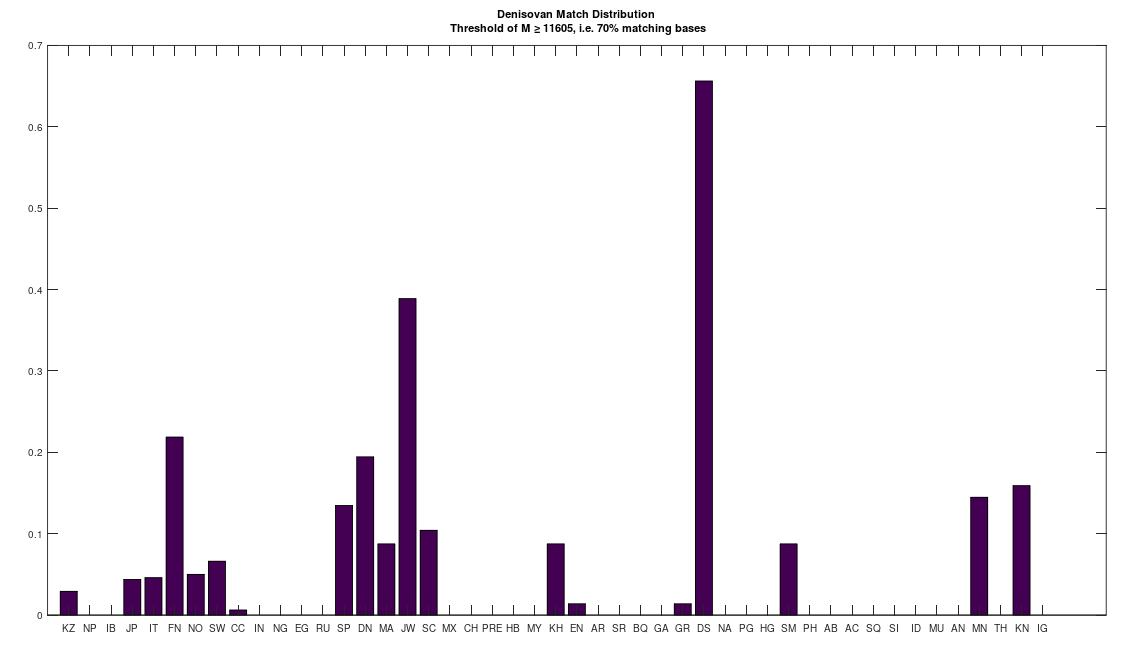
However, my work also allows us to determine whether a given genome A is the ancestor of another pair of genomes B and C. If modern day Kenyans are the genetic ancestors of the ancient Denisovan genomes collected in Asia, then this would eliminate slavery as a possibility, at least with respect to those ancestor genomes, and instead provide evidence for the claim that the Denisovans originated in Africa, and that at least some modern day Africans are the ancestors of the Denisovan fossils found in Asia. This is apparently the case, and moreover, the same is true of other Kenyans, with respect to Heidelbergensis. That is, some modern day Kenyans appear to be the ancestors of Denisovans, and others the ancestors of Heidelbergensis. The net conclusion is that all hominins could have come from Africa, and you can read this article for an explanation as to how this could happen, mechanically. This is obviously consistent with the popular narrative, but these things are not obvious, and there is both doubt and multiplicity in the academic community, though no one seems to think we come from America, so that point seems settled.
For an intuition as to how the ancestry test works, posit 3 genomes A, B, and C. Now assume B and C have more in common than A and B. A cannot be the ancestor of B and C, since that would imply that B and C both started out basically identical to A (since A is the ancestor of both B and C), and then both B and C randomly mutated to have more in common with each other than they do with A. This is basically impossible as a matter of probability, since it’s analogous to two people flipping independent coins ten thousand times, and ending up with nearly the same sequence of heads and tails. This is obviously wrong, but for a fulsome discussion, see Section 6.1 of [1].
The attached code applies exactly this test to two populations, treating one as ancestor (A), one as a descendent (B), and then attempts to find a genome C for which AB > BC and AC > BC, where AB, BC, and AC, are the match counts between genomes A, B, and C, respectively. If this inequality is satisfied, then it is at least possible for genome A to be the ancestor of genomes B and C. As noted, 2 Kenyan genomes out of 11 satisfy this test for the ancient Denisovan genomes, all of which were collected from ancient sites in Asia. Further, this inequality is also satisfied for 3 Kenyan genomes for the single Heidelbergensis genome included in the dataset. This seems to be unique to Kenyans, suggesting some Kenyans are truly ancient people. Specifically, 0 out of the 9 Nigerian genomes satisfied either test, and only 1 Khoisan genome out of the 10 Khoisan genomes satisfied the test for Denisovan, and only 1 Khoisan genome (a different genome) satisfied the test for Heidelbergensis. Note that the Khoisan are believed to be ancient people themselves. Further, 0 Egyptian genomes satisfied the test for Denisovan, however 5 Egyptian genomes satisfied the test for Heidelbergensis. The net point is again, all hominins seem to come from Africa, and a significant percentage of Kenyans (about 45%) seem to be truly ancient people.
Here’s the dataset:
https://www.dropbox.com/s/zwt1bcqqmqkleca/mtDNA.zip?dl=0
Here’s the code:
https://www.dropbox.com/s/tk2c9fsnwrtaspo/Southern_Denisovans_CMNDLINE.m?dl=0
I’ve also attached some extra code, that allows you to find descendent populations from a given population. You’ll note that all of you have committed atrocities against your own ancestors, I’m guessing because intelligence is not yet too common in the overall human population.
Extra code:
https://www.dropbox.com/s/v2n070ki0acwwgv/Ancestry_Analysis_CMDNLINE.m?dl=0
Any code not included above is linked to in my paper, A New Model of Computational Genomics.
Discover more from Information Overload
Subscribe to get the latest posts sent to your email.
 Information Overload