Posit a species 


As for the mechanics of this process, I noted in a previous article that it seems reasonable to assume that significant mutations are the result of already assembled strands of DNA being inserted into a sequence during replication. That is, during replication, there’s a free-floating, already complete strand of DNA that is inserted (presumably at the beginning or end of a genome). The intuition is that a healthy organism should not produce a significant number of erroneous insertions, and so it makes more sense to assume that an entire strand is inserted all at once, erroneously, which is technically a single error. This also explains the existence of the D-loop, since insertions would all occur at the “end”, causing a heterogenous portion of the genome to develop over time.
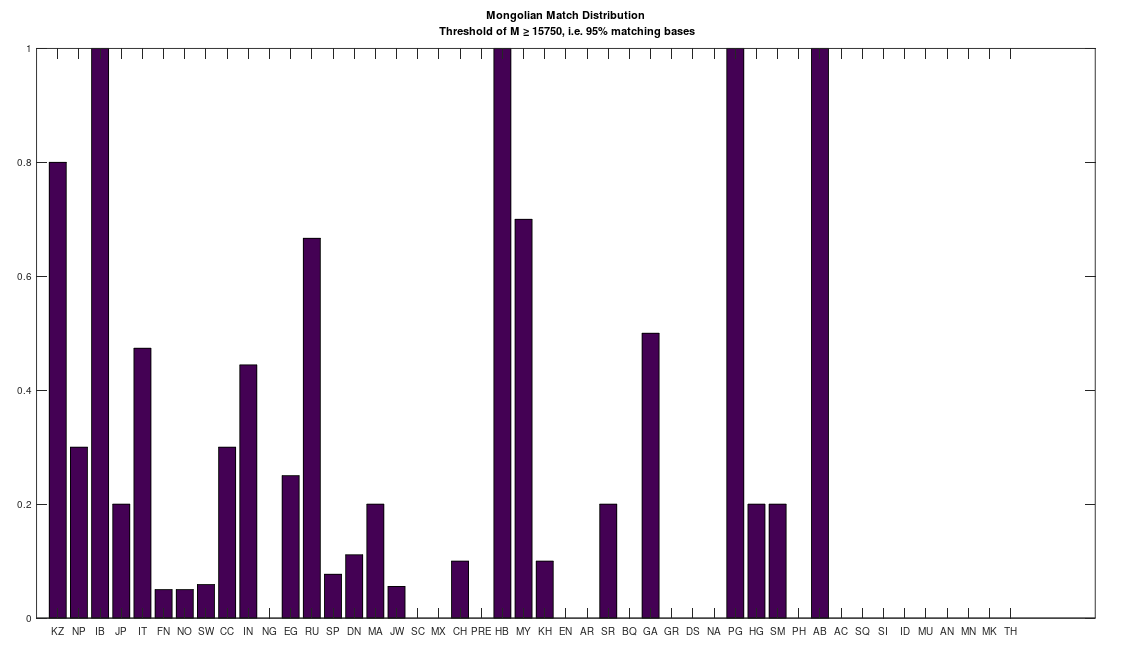
Returning to the relevance of microorganisms, I hypothesize that the source of these insertions (i.e., the strands that get appended) is the microorganisms in a given environment, which plainly interact with other organisms. As evidence for this claim, I realized that the Mongolians and some Chinese are from completely distinct heritages, with Mongolians plainly descended from Heidelbergensis (see the chart above and note HB stands for Heidelbergensis). Many Chinese are simply not related to Heidelbergensis in any meaningful way (though some are). Nonetheless, they are both plainly morphologically similar people. How could it be that two completely different heritages produce extremely similar morphologies? One explanation consistent with the facts is the hypothesis that microorganisms in the environment slowly change the morphology of people that live there long enough through mutations. The same is true of the Ancient Romans, who obviously look European, and are somehow not related to any living group of people, including Europeans. Both of these populations are evidence for the claim that environment impacts morphology, which sounds obvious, but the interesting part is the hypothesis that it’s due to microorganisms that drive specific mutations, on a sufficiently large scale to persist.
This could even explain the origin of humanity itself, specifically, the fact that it seems all species of hominin come from Africa. Why would this be the case? There’s no obvious explanation for it, though if microorganisms play a role, then similar mutations could occur in the same great apes, independently, at different points in history, producing distinct species of hominin, in the same locations. Specifically, e.g., the same or similar strands of DNA from the same or similar viruses end up appended to the same locations in the genome of an ape, which then kicks of selection, and so on.
Discover more from Information Overload
Subscribe to get the latest posts sent to your email.
 Information Overload