I think I’m finally done with my work on mtDNA, which I’ve summarized in my paper, A New Model of Computational Genomics, though I spent some time today thinking about how it is that significant mutations occur. Specifically, if you run a BLAST Search on a human mtDNA genome, and you compare that to a gorilla, you’ll see that there’s a 577 base sequence that humans have, that gorilla’s do not, suggesting that humans are the result of a 577 base insertion into the mtDNA of a gorilla. You get a similar result with chimps and other similar species. Here’s a screen shot of a BLAST Search I ran comparing this human mtDNA genome to a gorilla’s, and you can see the Query genome (i.e., the human genome) begins at index 577, and the Subject genome (i.e. the gorilla genome) begins at index 1, suggesting that the human genome contains 577 bases that are simply absent from the gorilla genome.
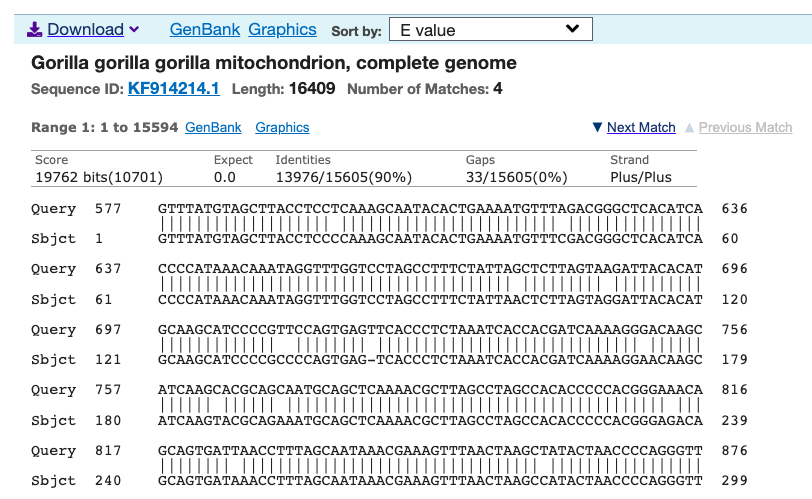
This isn’t necessarily the case, but the result is consistent with the assumption that a significant insertion into a gorilla’s mtDNA, produced human mtDNA. This is obviously also consistent with evolution, but the question is, how could such a massive error occur in a healthy species? I think the answer is that it’s not a normal insertion, and instead, an already assembled, yet free-floating segment of DNA ends up attached to the end of a strand that is being assembled. That is, there’s some detritus floating around, that is an already formed strand of DNA, that ends up attached to one of the ends of another strand that is in the process of being assembled. This shouldn’t occur often either, but if it did, it wouldn’t imply that the genetic machinery is broken, which would almost certainly be the case given an insertion that is 577 bases long. That is, if it just happened to be the case that some left over strand ends up attached to another strand in the midst of being assembled, then that’s just a low probability event that is not indicative of anything wrong. In contrast, if there’s an inadvertent 577 base insertion, then the genetic machinery is broken, and will almost certainly produce lethal diseases in short order.
That said, this exogenous insertion must also not be deleterious, in order for it to persist. This is of course perfectly consistent with evolution, and at the same time, consistent with a modern understanding of genetic replication, where small errors often produce disastrous and even lethal diseases. The net result would be, a healthy species just happened to experience an unlikely event that caused a piece of stray DNA to become attached to another piece during replication, and this exogenous insertion turned out to be either benign or beneficial. This would allow for significant mutations, possibly allowing for one species to mutate into another.
Discover more from Information Overload
Subscribe to get the latest posts sent to your email.
 Information Overload