I’ve noted countless times that Nature seems to select for beauty, and more generally, symmetry. Specifically, it’s astonishing that any species has integer symmetry. Consider the chain of events that lead to e.g., human beings having exactly two eyes, and five fingers on each hand. It’s simply extraordinary. To formalize this, consider a set of points in the plane. For every axis of symmetry in the shape, the probability of randomly generating that shape in the plane is reduced, for the simple reason that one point by definition defines yet another point under that axis of symmetry. If for example, there’s left-right symmetry, and we limit our considerations to a square with sides of length 1, and place the origin at its center, then every point with a negative x-value has a corresponding point with a positive and equal x-value. As a consequence, as you increase the number of axes of symmetry that is defined for a given set of points in the plane, you reduce the probability of randomly generating that set of points.
Returning to Nature, by selecting for highly symmetric morphologies, under the assumption that genetics controls morphology, which it obviously does, Nature therefore selects beauty presumably because it selects for highly unlikely genetic sequences, thereby reducing the probability that a mate has a trait generated by chance, which is associated with disease. More formally, if the mechanics that govern the replication of DNA, and protein production, of a given organism, can produce a highly symmetric and complex morphology, then it is reasonable that they can also control for the avoidance of random mutations, which are again associated with disease. This is consistent with the fact that people perceived as beautiful are actually healthier in general.
This also provides a theory of art rooted in natural selection, where again, an organism capable of producing complex and highly symmetrical objects can also likely control not only their behavior, but their faculties and bodily functions, again ultimately implying a genetic makeup capable of avoiding random mutations, that are again, associated with disease. In this view, art, and likely intellectualism generally, is a signal of genetic fitness, for the simply reason that the probability of randomly generating highly symmetrical and complex objects and ideas, is basically zero. Ironically, this brings us right back to DNA itself, since the probability of generating a DNA sequence that will actually produce a living organism is basically zero.
Modern societies create a feedback loop, because intellectualism also has economic value, in that inventions increase productivity, and at times make the previously impossible a reality. This suggests that societies that foster free and open creativity will likely outperform those that don’t, not just in terms of economic output, but also health, and reality is in accordance with this hypothesis. It also suggests that those that are hostile to the development of the arts, which is a real phenomenon historically, are for the same reasons, therefore instinctively hostile to the development of the awareness and production of highly complex yet structured artifacts, which could serve to train other human beings to recognize those aspects in others, presumably allowing them to select more fit mates. This suggests those that oppose the open expression of the arts, and intellectualism generally, are in this view a competing subspecies, with a possibly distinct criteria for reproduction, that is in all honesty not obviously prevalent in Nature, given the prevalence of symmetry.
Returning to the mathematics, and abstracting a bit, basically all strings are Kolmogorov random. If you’re not familiar with the Kolmogorov Complexity, you should read this note. Applying this to Nature, Kolmogorov random morphologies do not exist, since there is always symmetry, in even DNA itself, which is highly structured and symmetrical. At the same time, you don’t find trivial symmetries either, suggesting that you will not find organisms with morphologies that have a low complexity compared to their scale. Instead, what you see is highly complex morphologies that nonetheless have macroscopic symmetries, and then further symmetries at even smaller scales of observations. The classic example is a Nautilus Shell.
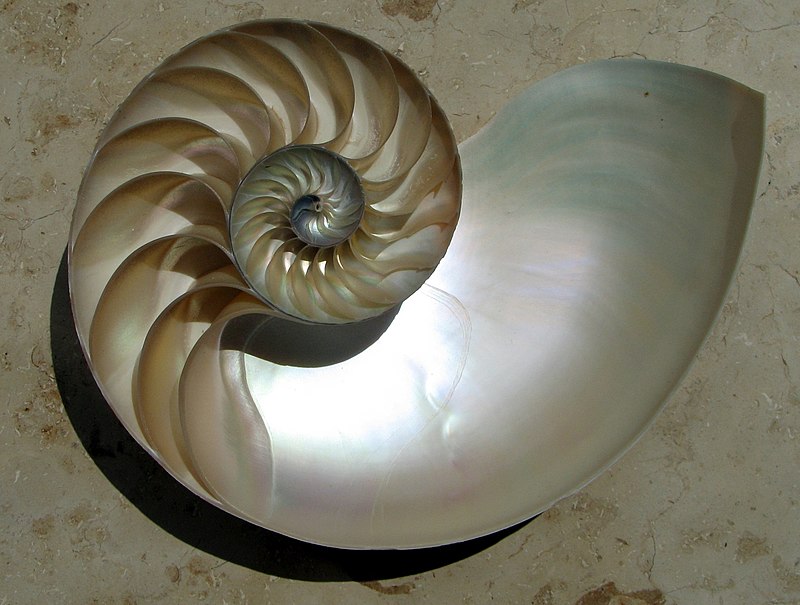
A Nautilus Shell, courtesy of Wikipedia.
In fact, a Nautilus Shell forms a spiral, that can of course be modeled approximately by closed form equations, which is simply astonishing, suggesting again that Nature selects for morphologies that are certainly not Kolmogorov random, but at the same time, not trivial in terms of their complexity. This is echoed in art, where truly complex artifacts are sort of annoying, and generally relegated to aficionados, whereas at the same time, mundane pieces are rejected as simplistic. It is instead the combination of complexity and approachability that typically maximizes the appeal of a work. Just another example, trees are not symmetrical, though they have to be either balanced, or strong enough to withstand the asymmetry of the distribution of mass. However, they don’t have sensory organs, and have no obvious means of selection on the basis of aesthetics. However, leaves are symmetrical, suggesting some likely exogenous factor, perhaps again other species that select trees on the basis of appearance, by instinct, e.g., birds, or maybe even some bugs, that might spend more time in more symmetrical trees by instinct, thereby spreading the seeds and pollen of more symmetrical species. This should be testable, by simply presenting birds or bugs with two trees, one being highly asymmetrical or (perhaps simply unappealing) and the other more symmetrical (or perhaps simply more appealing). If there’s any clear bias, this could explain the symmetry of leaves and other plants that are too ancient for human beings to have selected. For intuition, imagine you’re on a date, and you have to choose between two trees, one that’s a mangy dilapidated mess, the other a fine and beautiful flowering cherry blossom. Human beings are capable of selection on sympathy, a sort of Charlie Brown syndrome, but most animals are not, if you haven’t noticed yet –
You don’t get perfect cross-sections from sympathy, at least not immediately, and Nature, what it is, seems to have little in the way of patience for its immediate endeavors.
Discover more from Information Overload
Subscribe to get the latest posts sent to your email.
 Information Overload