Spatial Entropy
I noted on Twitter that I came up with a really efficient way of calculating spatial entropy, and though I plan on writing something more formal on the topic, as it’s related to information theory generally, I wanted to at least write a brief note on the method, which is as follows:
Let 


So for example, if you have 
You could do the same with a set of curves, but you’d need a comparison operator to first sort the curves and then compare their distances, and for this, you can use the operators I used in Section 1.3 of my A.I. summary (the “Expanding Gas Dataset”).
This allows for the measurement of the the entropy of an arbitrary dataset of vectors.
Information, Knowledge, and Uncertainty
The fundamental observation I’ve made regarding uncertainty, is that what you know about a system plus what you don’t, is all there is to know about the system. This sounds tautological, but so is the founding equation of accounting, which was also founded by an Italian mathematician, which it seems clear people are trying to forget.
Expressed symbolically, the equation states that:

Where 

Because we can now measure spatial entropy, we can measure the entropy of a dataset, which would also be the information content,
My prediction algorithms return a set of vectors given an input vector, and it allows for blank entries in the input vector. So if you observe the first 50 out of 1,000 states of a system, you’ll get a set of vectors that reflect the information you have, and of course, that set winnows down in size as the number of observations increases (see Section 3.1 of A New Model of Artificial Intelligence).
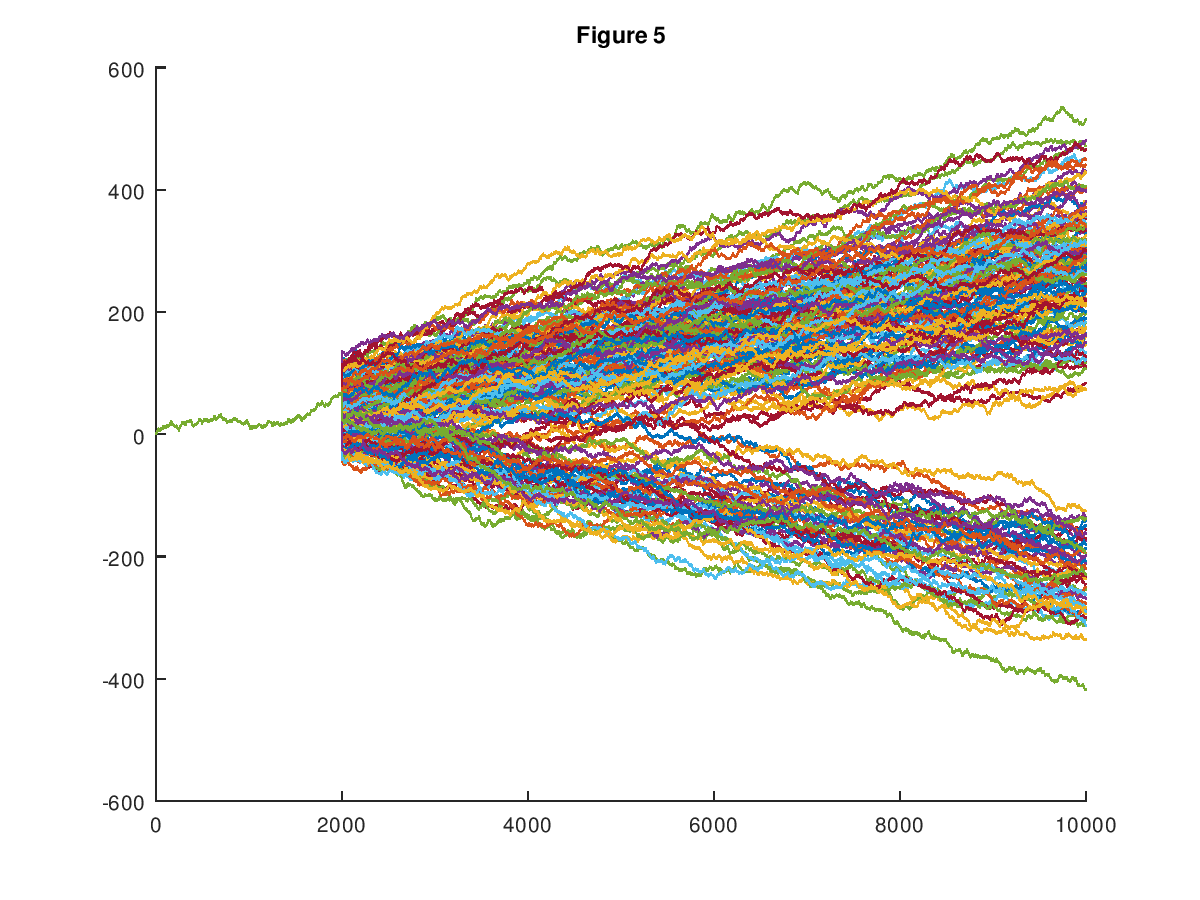
Here’s a representative chart (from that paper) that shows how the set of possible paths of a random walk starts to tilt in favor of an upward path as data becomes available. In this case, 2,000 observations are available out of 10,000, and the input vector is in fact an upward tilting path.
We can also measure the entropy of this set of returned set of predictions, using the same method described above, which would in my opinion represent your uncertainty with respect to your prediction. This makes sense, because in the worst case, you get back the full training dataset, which would set your uncertainty equal to the information content of the dataset. Expressed symbolically,

This implies that your knowledge with respect to your prediction is zero, which is correct. That is, if your prediction algorithm says, my prediction is, the entire training dataset, then it doesn’t know anything at all. As observations become available, the set of returned predictions will shrink in size, which will reduce the entropy of the returned prediction set, implying non-zero knowledge. Eventually, you could be left with a single prediction, which would imply perfect knowledge, and no uncertainty, in the context of your training dataset, which is all you ever know about a given problem.
Discover more from Information Overload
Subscribe to get the latest posts sent to your email.
 Information Overload