Carl Jung had a big influence on me when I was in college, and though these days I stick to more practical psychological considerations for application to A.I., when I was 20 years old, I was willing to entertain some radical thinking. And this is not to suggest that Jung’s ideas on psychology aren’t practical, in fact quite the opposite – personally, I believe that species memory, archetypal thinking, and a “shadow” animal nature are all very real aspects of the human condition. But Jung was unafraid to explore mystical thinking, in a manner and on a scale that is arguably unfashionable for a storied, and relatively contemporary figure in the history of Western thought. In particular, he had this idea of “synchronicity”, which I think I’ve reduced to mathematics, but I’ve called it coincidence, to dress it down a bit:
If I had to define coincidence, I would say it has two components: (a) a low probability, and (b) contextual relevance.
One of the examples of coincidence I gave in the article is the following:
Imagine walking out of a store having just purchased a bright orange hat, when suddenly, someone throws an orange at you. Both events are low probability in the ordinary course, and the latter event of getting hit by an orange is relevant, because it intersects in property with the item you just purchased. And you would be completely certain the event was deliberate, even if it seemed superficially impossible for that to be the case.
In that article, I discuss some practical explanations for why human beings are drawn to coincidence, and how information theory can help us make sense of that behavior. In short, if an event has a low probability, then it should carry a lot of information, and if our brains process signals efficiently, the proximate occurrence of two, contextually related, low probability events (i.e., a coincidence) should get a lot of attention, since it carries a lot of information, and therefore, requires a significant amount of brain power to fully process. The overall point being that even though coincidence is associated with superstition, the underlying mechanic driving the resultant behavior of being drawn to coincidence makes perfect sense in light of information theory.
So, I think I’ve explained why some people are superstitious, and why coincidence is inherently interesting to human beings, but this still leaves open the question how coincidence materializes in the physical world, which really shouldn’t have a good explanation. Though I won’t succumb to pseudoscience and claim to have an answer, I will discuss how thinking differently about the nature of time and causation can actually make sense of coincidence in a mathematically rigorous manner, which I find fascinating, and might even be a testable hypothesis, but in any case, it nonetheless presents a beautiful model of reality rooted in the theory of sets, and gives me a great excuse to discuss a bunch of art in the context of mathematics and physics, so, I’m not going to pass up that opportunity.
Expectations and Information
As a practical matter, the human brain probably operates like a modern computer, on a macroscopic level, in that there’s probably something akin to RAM that is populated with information gleaned from recent experiences. So, for example, if you buy a cup of coffee and a bagel, and see an advertisement featuring American supermodel Amber Valletta, there will be some window of time during which the notions of coffee, bagel, and Amber Valletta will be on your mind. I’ve spent most of my life in New York City, so the probabilities of observing a coffee, or a bagel, are pretty high, meaning that neither item is likely to be the subject of a coincidence, at least as I’ve defined it above. Even if, e.g., someone throws a bagel at you, immediately after buying a bagel, you wouldn’t say it was a coincidence, because bagels are everywhere in New York, and as a result, it’s sensible to assume that someone just doesn’t like you, and threw a bagel at you, because you’re near a bagel store.
However, the probability of observing someone that looks like Amber Valletta is quite low, and that’s part of the reason she’s famous – she’s extremely good looking, and it is therefore, unlikely to observe someone that looks like her. So, returning to the example, if you had just purchased a coffee and a bagel, and saw an ad featuring Amber Valletta, and then suddenly, you see Amber Valletta walking down the street, wearing a t-shirt with an image of a coffee and a bagel on it, you’d be astonished, because the probability of seeing Amber Valletta is already extremely low, and the added conditional of a t-shirt featuring the items you just purchased brings the probability of the entire circumstance into the absurd.
This is a deliberately absurd example that highlights the nature of coincidence, which is the apparent transmission of information without causation. In this case, it seems as though Amber Valletta knew you would buy a coffee and bagel where and when you did, and knowing this, she purchased a t-shirt memorializing this information, and showed up to convey her understanding. That would probably be the impression generated by that set of facts, though it is of course possible that it just happened, without any deliberate action at all. As a practical matter, as the probability of the circumstance drops, and the intersection with your present expectation increases, you’ll become increasingly suspicious that it was in fact the result of deliberate action. To highlight this mechanic, imagine that your face was also featured on the t-shirt, so that the ultimate result is that you see Amber Valletta wearing a t-shirt with your face on it, and the items you just purchased, and are now holding in your hands. If that happened, you would probably refuse to believe that it was not deliberate.
Now, let’s be a bit more careful in addressing what’s happening: the most basic aspect of this set of facts is the occurrence of events that have extremely low probabilities. However, coincidence can be distinguished from the unexpected, in that coincidence has an additional element of relevance, where the events in question are not only extraordinarily unlikely, but also have something in common with your present set of expectations. In this case, the low probability event is seeing Amber Valletta, but the aspect that takes it from the merely unlikely, to coincidence, is the additional information memorialized on her t-shirt, which intersects with your present expectations. This is in contrast to, e.g., seeing a dead whale on Park Avenue, which is bizarre, but unless you just engaged in some whale-related activity, doesn’t rise to the level of coincidence, because it doesn’t intersect in property with your expectations.
When you think about coincidence in this manner, it highlights how truly strange it is, because the events in question must intersect with your expectations. But if the events intersect with your expectations, then how could they be low probability, since they’re already included in the aspects you’ve incorporated into your present expectations of the world? One solution, is to take those expectations, and paint a low probability event with some of them. So returning to the dead whale, imagine being a woman wearing a blue dress, and seeing a giant dead whale on Park Avenue with a similar, cleanly pressed, blue dress inexplicably draped over the whale’s head. This would take an already absurd scene, and paint it with the personal, since the event is not only extremely unlikely, but also conveys information that intersects with your present expectations. This thinking also highlights the psychological impact of coincidence, which is to take the familiar, and make it absurd, by associating it with an extremely unlikely event.
Note that the definition of coincidence I’ve defined above has two prongs, and therefore, two levers to pull in constructing a coincidence: one is the probability of the event, and the other is the scale of intersection with someone’s present expectations. We can, therefore, construct a pseudo-metric that measures the scale of coincidence itself, which (x) increases as the probability of the event decreases, and (y) increases as the intersection with someone’s expectations increases.
Returning to the example above, Amber Valletta is the low probability event, so that aspect of the hypothetical is essentially fixed. We can, however, adjust the scale of intersection, to increase the overall scale of coincidence. Imagine, for example, walking out of the bagel store, and seeing Amber Valletta wearing the exact same outfit as you, but for a large, ostentatious top hat, with a picture of your face on it, while holding a bagel and coffee. If this actually occurred, you would be justifiably convinced that this was deliberate, and that she somehow had access to information about you.
Coincidence as Indicative of Sentience
Before I get into the mathematics, I want to discuss what motivated this article in the first instance, which is the repeated and inexplicable coincidences I’ve noticed in the arts, and in my life generally. Again, I’m pushing the boundaries here on purpose, because the final result will be what I think is interesting mathematics that presents a totally new way of thinking about information and time. The fodder I’ll use to get there is admittedly a bit flimsy, since I’m calling upon coincidence to get the ball the rolling, but the end result will be real mathematics that models all the weird things I’ll describe.
My life has been pretty strange, to say the least, so there’s no shortage of examples, but the example I’ll lead with is a photo of a black hole that I downloaded to my phone sometime in September of 2017. I don’t know exactly what date I downloaded the picture, because the file itself is dated December 21, 2016, and as a result, the date displayed is the file date, not the date of download. However, it is between two other photos, one taken on September 11, 2017, at 1:49 PM, and another taken on September 29, 2017, at 10:27 AM. So, I must have downloaded the black hole picture sometime in between those two dates.
Here are the three photos, with the black hole photo in the middle:


The photo on the left is the first real break I had in physics, where I got very close to Einstein’s equations for time-dilation using information theory (here’s the end result of that work, where I rewrote all of special relativity and some of general relativity, using objective time: “A Computational Model of Time-Dilation“). The photo in the middle is of a black hole, that I suppose came from the internet, but I don’t remember what prompted me to download it, and the last image is a screen shot of an Andrew Bayer song that I’m guessing I liked, and didn’t want to forget, or perhaps I planned to send it to someone. Note that I’m not suggesting that I don’t like Andrew Bayer, because I do, I just don’t remember why I took the screenshot.
In sequence from left to right, what we have is a bunch of equations related to the nature of time, an image of a black hole, and a song that is apparently about memories from a prior existence. Now you can say I did this on purpose, which is fine, but I didn’t, but you don’t have to believe me, and it’s not relevant, because the point is, if you take the intersection over the set of ideas associated with the images, what you’ll end up with is fairly construed as a set of images related to the nature of time. I’m currently working on a paper and related software that actually models human association, meaning, and understanding in exactly this manner, by taking the intersection or union over associations, but for now, the point is, it’s fair to say that these three pictures together convey an impression about a topic that is related to the nature of time.
About two months later, on February 21, 2018, it was anomalously hot in New York City, reaching 79 degrees. This date, expressed using an American calendar, is 2/21, and removing the delimiter we have 221. Though presumably unrelated, the date of the black hole photo above is 12/21, and removing the delimiter we have 1221. This type of observation is justifiably dismissed as horribly unscientific, because there is no causal connection between a photo of a black hole, and an anomalously hot day a few months later. Expressed in terms of information theory, the date of the black hole photo provides no information whatsoever about the weather in New York City. But that misses the point, which is that if you want to a convey a message, you don’t need a causal relationship – all you need is a coincidence to get someone’s attention.
The point is not that the photo caused the hot day. The point is, that if the hot day was a signal, then one way to get the recipient’s attention would be to have some aspect of the hot day intersect in property with information from the recipient’s life. I’m obviously not saying that this is what happened, but rather, pointing out that conveying a message to a recipient that isn’t expecting a message can be done effectively using coincidence, the fruits of which are generally considered unscientific. So the net point is, not only is coincidence often the first step to a bona fide scientific insight, it’s also an incredibly useful way to get someone’s attention. This doesn’t mean you should run around looking for coincidences, but rather, the point is that there is real mathematics that we can develop around coincidence that allows us to discern between deliberate action, and the merely unlikely. That is, unpacking these types of fact patterns carefully allows you to develop mathematics that can measure the difference between a deliberate message, and a freak accident.
Returning to the example above, simply seeing Amber Valletta is unlikely, but not a coincidence. Seeing Amber Valletta dressed exactly like you, wearing a giant top hat with your face on it is a coincidence, the scale of which is so extreme, that it is almost certainly the result of deliberate action, and not the result of the undisturbed machinations of the universe. So, by considering an unfashionable topic carefully, we have developed rigorous mathematics that can distinguish between sentient action, and happenstance.
Finally, I’ll note that Amber Valletta’s initials are A.V., or 1.22., in the numerical order of the English alphabet, and yes, that’s why I selected her – it was in fact a coincidence, in this case, deliberate. I initially selected Charlize Theron, whose name intersects with mine, but I thought this was better for this particular purpose, since it requires converting a name to numbers, which I often do for fun. To make things a bit more bizarre, I’ll note that I was fortunate enough to have drinks on 2/21/2016 with a woman that has a strong resemblance to Amber Valletta, which I suppose you could say was a “hot date”.
Coincidence in the Arts
Because an artifact of the arts can generally be experienced at any given time, we’ll need to revisit the original definition of coincidence above, which requires only contextual relevance. That is, you can generally listen to a song whenever you’d like, so we want our notion of coincidence to cover those cases where the relevance doesn’t depend upon something that just happened. In the examples above, I used the notion of present expectations to determine the set of items that should be considered when determining the scale of intersection associated with an event. This is because considering the sum total of someone’s life will always generate some intersection with essentially every event, which muddles the analysis. As a result, I’ve deliberately limited the examples above to exogenous facts that intersect with someone’s recent, subjective experiences. But that might not always be appropriate.
For example, if a total stranger shows up to a bar you’re in, with your full, exact birthday written on their forehead, then whether or not you were thinking about your birthday, that experience obviously constitutes a coincidence, and would prompt a reasonable person to wonder exactly how that came to be. Similarly, if it is in fact your birthday, and a total stranger passes by with your full, exact birthday written on their forehead, this would, again, most certainly constitute a coincidence. The point is, however, that what is relevant is not always what is proximate in space or time, though what is proximate in space or time is, generally, fairly considered relevant, because that’s how people operate.
In contrast, if someone shows up to a bar with a bagel tattooed on their forehead, we might regard this as a curiosity, and certainly unlikely, but it does not satisfy the definition of coincidence above, because bagels do not intersect in relevance with the life of an ordinary person. If you work at a bagel store, or at a bagel company, then perhaps you could claim contextual relevance, but the point being, that for an ordinary person, in the ordinary course, bagels will not be contextually relevant, outside of proximate experience. As a result, this example highlights how we can objectively discern absolute, contextual relevance, outside of proximate experience, by considering only those items and ideas that are fairly considered unique to a given individual.
With this is mind, we can now evaluate coincidence in the mind of an observer of an artifact of art. Because I’m writing this article, the observer is going to be me, and because I think she’s a wonderful artist that is resetting American pop in the right direction, I’m going to discuss Halsey. It also turns out that there are a number of seriously bizarre coincidences between her work and mine, that will serve as excellent fact patterns for analysis.
To begin with, let’s consider the video for her song, “Graveyard”.
The first thing I’ll note is that the video is a time-lapse video, which is an expression of quantized time, which is a fundamental component of my research in physics. I think it’s fair to say that in the context of pop music videos, a time-lapse video is low probability, but of course, not entirely unheard of. Nonetheless, the point being, that to someone that spends a significant amount of time working on quantized time, seeing a pop video that makes use of quantized time garners attention.
At the time I listened to it, I remember thinking it was strange that she says, “let that sink in” at the 00:12 second mark, because I had just said the following on Twitter, a few days prior to the video’s release date:
I said that once, and I do have a superficial resemblance to classical representations of Satan, so, let that sink in …
This would constitute an intersection in relevance, because I just used the phrase a few days before listening to the song, but because it’s not a terribly uncommon phrase, I wouldn’t say that the two elements of coincidence outlined so far are compelling. But, it’s obviously enough to get your attention when you first hear a song that you enjoy. Also note that L is the 12th character in the English alphabet, and also the leading sound and letter of the phrase, “let that sink in”, which she says at the 12th second of the song. Further, the date of the black hole photo above is 12/21, which can be permuted slightly to form the sequence 1212, or “LL”, which, as I’ll explain below, is a variation on a moniker I’ve made only private use of, that basically no one knows about.
The next thing I noticed is a long, loud, conspicuous breath she takes at the 2:37 mark, which is simply not normal for a pop song. Ordinarily, pop artists go through considerable efforts, using noise gates and pop screens, to get rid of breathing sounds, but she decided to not only leave it in, but to also make a point of it, which is certainly low probability. It turns out, I did the exact same thing at the end of a song called, “Vega”, that I wrote one year ago, which was inspired by the story of Joan of Arc.
This is not something I would ordinarily do, since my background in audio production is mostly in pop and hip-hop, where you don’t want breathing noises, as a stylistic matter. But, I’m an independent artist, so I can do whatever I want. In contrast, Halsey is a commercial artist, that is making songs that need to sell, so her decision to break a norm is a commercial decision, which definitely caught me off guard, and I had trouble dismissing it, especially given the more subtle coincidences described above.
After listening to the song a few times, I noticed the subject of her painting, which includes a conspicuously, anomalously colored eye, and I realized that exactly one week prior to the release date of the video, I shared an image processing algorithm that produced the following image, when given a photo of myself that I took as input. The eye on the left is unnaturally dark, and the eye on the right is basically non-existent, none of which was deliberate – I simply applied the algorithm to the image, and this was the result. Moreover, even if I wanted to do this on purpose, I could not have known about the subject of the video, because it wasn’t released yet.
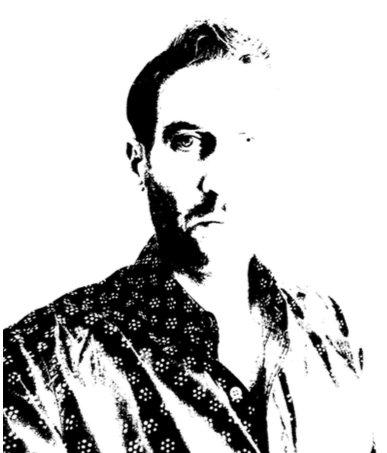
As a result of these coincidences, and the fact that I really liked her music, I decided to look into her music a bit more, and the weirdness just continued. It turns out that she wrote an absolutely beautiful song called, “Sorry”, explicitly about an “unknown lover”.
Five years ago, I also wrote a song explicitly about an “unknown” lover, which I haven’t thought about much since then. It was, regrettably, misinterpreted as a love song for the person I was dating at the time, despite what I thought were fairly explicit statements that the person in question is, “an unknown, in an unknown place”. But in any case, it is most certainly not about any particular person, and that was intended to be part of the charm of the song. Now, it is simply not the case that, eventually, every artist writes a song about an unknown lover. In fact, after a lifetime of playing, recording, writing, and listening to music, these are the only two examples of songs about unknown lovers that I’m aware of.
To be clear, these are not songs about secretly loving someone that is unaware of your affections, of which there are obviously plenty, since unrequited love is a classic topic. But rather, both of these songs are about love with respect to someone with an unknown identity – both of these songs are about missing information. To make things even more peculiar, Halsey suggests she has partial information about the person in question, saying that she knows the person’s birthday, and their mother’s favorite song, but otherwise knows nothing else about them. I wrote my song partly as a joke, as a clever way of saying that I’m not exactly married, which is a mean thing to do in retrospect, because I was dating someone at the time. In contrast, Halsey’s song is quite serious, and is saying explicitly that hers is a song about missing information, which is weird, considering that I’m an information theorist, that also happens to have a background in music production. Moreover, she’s saying in the song that she is in fact mean, and thoughtless, which is strange, because she seems quite nice, and I am certainly not nice, and certainly thoughtless, at least sometimes. Finally, her song was released on 2/2/2018, and “22”, read “deuce deuce“, is a really obscure moniker of mine, that only a few people know about, given to me by a guy whose name is also Charles, when I was 13 years old at summer camp, presumably so others could distinguish between us, though it is also a reference to a song called, “Hip Hop Ride“.
While I think I’m a handsome, brilliant man, I’m quite sure Halsey is not consciously writing love songs riddled with details from my life, as nice as that would be, or consciously conjuring my artistic concepts and bad personality traits. Rather, I think, either, this is the result of a ludicrously elaborate prank, or, in my opinion, more likely, real artists are truly weird people that might not operate the same way normal people do, which is a thesis I’ve repeated (see Section 4 of, “A New Model of Artificial Intelligence“), that, if true, could explain why creative people solve problems that appear to be superficially non-computable – musicians in particular. And while we’re on the subject of looks, though she is, thankfully for her sake, obviously far more attractive than I am, I’ll add that, after a simulated car accident, she looks a bit like I did around her age.

Handsome, brilliant math dude (2005).
But there’s more: she has a song called, “New Americana“, and I wrote a viola sonata called, “Song for a New America“. Again, these are not normal titles for songs, especially for a viola sonata.
And there’s still more: Halsey’s first actual photo on Instagram was posted on 5/6/19, which is my birthday, in the European calendar. You could say, “so what”, but Halsey’s first EP came out in 2014, and it’s a bit weird for a pop artist to start a social media account years into her career. The video for the song, “Ghost“, from her first EP, “Room 93“, was released on 6/11, which was my apartment number at the time, in Williamsburg, Brooklyn (i.e., my room number). And I’ll close with the observation that, the numerical string “93” translates into the alphanumeric string “ic”, which I interpreted as the product of i (the complex number), and c (the velocity of light in a vacuum). This is because I previously made the observation that, algebraically, our velocity in time is probably best thought of as the complex velocity, v = ic (see, footnote 7). When I first conceived of time as a complex number, I was living in Williamsburg, Brooklyn, and maybe two days after I originally conceived of the idea, a gigantic painting by an artist named Ron Agam was hanging in Whole Foods, called “Complex Universe”, that looked like a Frank Stella painting from the future. His last name is also “MAGA” backwards, which, I suppose, sucks for him.
So, do I think these coincidences rise to the level that indicates deliberate action? Not really, generally speaking, but sometimes I do, because they’re an effective way of identifying someone working on stuff you’d prefer they didn’t – just imagine using A.I. to not only make all these observations, but also plow through social media and other data to find the people that check all the boxes. This will give you a short list. But they are, in any case, super weird coincidences, whether or not Amazon or someone is paying Halsey to ID the dude doing the math stuff that might make their whole server business thingy go broke, and model consumer preferences more efficiently, which, I guess, they probably wouldn’t like either.
I don’t think she is doing this, but the point is, it’s possible, and that’s not good news.
But, back to science, in the next article, I’ll present an admittedly theoretical mathematical model of how information could be exchanged through time, that would, if true, explain all of this in a manner that doesn’t require malicious intent, but nonetheless allow for causation and the ordinary progression of the laws of physics to generally persist as usual.
So, do I think artists actually make use of these processes, exchanging information through time? Yes, and I know that makes me sound crazy, but I don’t care, because I’m right about so many things in science, particularly A.I., which is testable on a laptop anywhere in the world, that I’m not worried about my reputation anymore. I think that just as ordinary light bounces off a mirror, there’s another type of momentum that can be exchanged through time, allowing for information to bounce back from likely futures. I think gravity is an example of this (see, my rant on Twitter).
I think this is how mathematicians and some artists solve non-computable problems – by having access to information that most people don’t. Separately, I also think intelligence is quantized, but not like an IQ test, but rather, like the jump from one infinite cardinal to the next. And I think IQ measures deductive problem solving, which has declining marginal utility, which is why people that score in the top 1% to 5% on standardized tests are just as intelligent as people that have a freakishly high IQ. In contrast, I think creative people are producers of new information, which cannot be the product of deduction (see Section 4 of, “A New Model of Artificial Intelligence“), so you can’t measure that by asking questions that have deductive answers. You can only look at the volume, and complexity, of original output produced by the person in question. So as a practical example, Mozart would probably do just fine on an IQ test, but that’s not why he’s a genius – he’s a genius because he wrote so much complex music, it’s hard to believe he did anything else: by the time he was nine years old, he had already written five symphonies. You can’t test for that, other than to ask a kid to write five symphonies, which you’ll just have to wait for.
Discover more from Information Overload
Subscribe to get the latest posts sent to your email.
 Information Overload