The Sorry State Of The Dismal Science

Also published on the Atlantic Monthly’s Business Channel.

John Authers’ recent interview with University of Chicago professor Richard Thaler is a fine example of what I hope are broader trends in economic thought. To some, it might seem like just another interview. But Authers undoubtedly recognizes its significance. Thaler is a professor at the University of Chicago, which is the birth place of the Efficient Market Hypothesis, and Authers is a well-respected columnist for the Financial Times, which is arguably the voice of the free market in the press. And yet, there they are, casting doubt upon the very theories underpinning a generation of thought that have made the University of Chicago the epicenter of free market ideology. In the language of soda-pop-economics, this interview is a “black swan.”

It seems Authers is leaning ever closer towards a world view informed by behavioral economics. While I haven’t done any empirical research into Authers’ work, I do read his column, The Short View, religiously (personally, I recommend you do the same). And as the recent downturn developed, I noticed several articles that suggest he’s come to question at least some of the assumptions underlying the old free market dogmas, particularly the Efficient Market Hypothesis. In my opinion, this is a welcomed development. And I sincerely hope it is part of a broader trend away from grandiose theories about how humans make decisions and towards precise theories which are supported by real-world observations.

Those that have toiled through my writing in the past know that I am a big fan of free markets. Yet, I am not a big fan of the EMH. And in general, I find a lot of economic theory, particularly macroeconomic theory, to be little more than hand-waving. There’s an almost priestly air about it that makes me deeply suspicious of its validity. In gentler terms, Economics lacks a rigorous epistemological theory. That is, economists have no robust system of determining which statements about economics are true, and which are not. This is in stark contrast to say, mathematics. A statement about an alleged mathematical truth is verifiable (putting Gödel and Turing aside for the moment). If you tell me that you have discovered a new mathematical truth, you can sit down and in a finite number of words, provide a logical path from assumptions we both agree are true to your new found conclusions that I must accept as true, else I reject either the assumptions or logic itself. Now, I understand that economics can never be a purely deductive sport, since it is complicated by the nuance and uncertainty of, well, reality. But that doesn’t mean we can’t do better than simply assuming away all of human ridiculousness.

The economics that assumes rational behavior on the part of humanity is, in my opinion, dead. It is simply at odds with everyday experience. It’s arguable that the desire for wealth is itself an inherently irrational impulse for most of the developed world, given that our needs would likely be satisfied on public assistance. That said, those who are able to control their behavior and act rationally do a much better job at generating and accumulating wealth. But once they get the money, they go and do something absurd with it, like buy a fleet of planes. So while reason and deferred consumption might be the means by which we accumulate wealth, the end goal of accumulating wealth seems to be driven by a need to express dominance, or at least an antisocial impulse to be free of society’s constraints. This view finds support in popular culture, which often equates wealth with conspicuous consumption, sexuality, and control. All of this suggests that somewhere buried under all of those pinstripes is a real brute.

If I am correct, and there is a sea change taking place in how economists view human behavior and the markets humans create, then there may be a lot of quackery in the short term. That is, during the intellectual power vacuum that will follow the demise of the old Chicago School, a few crackpots might temporarily seize power as we trace our way from the four humors to phlogiston. But when we finally get our Lavoisier, this time let’s remember to keep his head on, despite our penchant for the irrational.

Credit Default Swaps and Control Rights, Redux

Also published on the Atlantic Monthly’s Business Channel.

Felix Salmon and I are usually on the same side of the jury box when it comes to the trial of credit default swaps. However, it appears we have reached an impasse concerning creditor control rights in the context of restructurings and bankruptcies. While that sounds like an awfully narrow issue to quibble about, the policy implications of this seemingly obscure issue are far reaching and call into question both the orderly functioning of the debt markets and the soundness of the current bankruptcy regime.

Let’s begin by outlining the issue at hand. In my previous article, I wrote:

Suppose that ABC Co. is on the verge of bankruptcy, but wants to avoid bankruptcy by restructuring its debt (renegotiating interest rates, maturity, etc.) with its bondholders. Further, assume that bondholder B has fully hedged his ABC bonds using CDS, or over-hedged to the point where B would profit from ABC’s bankruptcy. The problem seems obvious: B either doesn’t care if ABC does or actually wants ABC to file for bankruptcy, and so he will do anything he can to stop ABC from restructuring and force ABC into ruin.

In fairness to Felix, here’s his added qualification of the issue from his response to my article:

The problem is a bit more subtle than that, and is simply that bondholders who have bought CDS protection have much less incentive to participate in restructuring negotiations.

The key to understanding why we shouldn’t expect this change in incentives to lead to any material change in the restructuring process is rooted in the distinction between incentive to act and power to act. Clearly, anyone who expects to profit more from option A than B will choose A given the chance. And so, a bondholder who expects to receive a larger payout from CDS than from a restructuring will choose the CDS payout given the chance. But does that bondholder have any power to bring this result about? As a general matter, probably not.

One Is the Loneliest Number

Restructurings generally take place across the entire capital structure of firm. A firm could have multiple issuances of bonds, loans, and may even have other hybrid debt-equity financing. Each class of creditors has holders with certain control rights. While this complicates the restructuring efforts for the firm, since the firm will have to coordinate with various classes of creditors which may have competing incentives, it also mitigates the influence that any individual creditor/creditor-class can exert on the restructuring process. In addition, it usually means that the firm will require different thresholds of creditor approval from each class. For example, ABC concludes for a given restructuring plan that it needs the approval of 75% of class A holders, 60% of class B holders, etc. The actual threshold will be determined in large part by two main drivers: (i) the agreements that determine the rights of each creditor class (ii) and the number of on-board creditors needed to make the deal economically feasible.

So, even acknowledging the clear incentive on the part of those who stand to gain more from a bankruptcy than a restructuring, their impact on the success of the restructuring will be determined by their ability to affect the firm’s ability to achieve the required thresholds. Thus, their impact will be determined by their ownership stake in the debt. And so, in order for Felix’s argument to be taken as a serious point of concern, we must posit the existence of a class of hedged creditors who stand to gain more in bankruptcy than restructuring that is so large and well coordinated that it is able to obstruct the restructuring efforts of the firm and those creditors that stand to gain more from restructuring than bankruptcy. While not impossible in a nominal sense, this strikes me as a rather fortuitous state of affairs.

Bankruptcy Is Not A Sure Bet

In analyzing the incentives of the participants, Felix assumes that bankruptcy is certain in the case that a restructuring fails. This is not necessarily the case. He wrote:

I might end up with just 45 cents on the dollar — $450,000 — if I agree to the company’s [restructuring] plan. If I just let it go bust, on the other hand, I get $600,000 [from CDS]. And so I have an incentive to opt for the more economically-destructive option.

Every filing for involuntary bankruptcy is reviewed by a judge and can be contested by the debtor. And CDS don’t payout until judgment is entered against the debtor. That means payout under a CDS as it relates to bankruptcy is an uncertain event. That means that your expected payout should be discounted by the probability that the event will occur. So in the example above, the expected payout should be some fraction of $600,000, which could easily bring it below the $450,000 indifference point.  What’s worse, that probability might be impossible to calculate for your average bondholder, which holds its bonds passively and is not likely to have access to up to the minute progress reports on the firm’s financial condition or the restructuring process.

Review by a judge also means that only meritorious claims for bankruptcy will survive. And so, again, we run into the distinction between the incentive to act and the power to act. That is, whether or not someone would like a firm to go into bankruptcy, its ability to cause that to occur is restricted to only those circumstances where it would have been permissible anyway.

Covenant Thy Lender

In the previous article, I suggested that if companies were truly concerned about their creditors stocking up on CDS and fouling up restructurings, they could require the bondholders to promise to not hedge beyond a certain threshold. Felix responded with the following:

And Charles Davi’s idea that companies could somehow constrain their creditors from buying credit protection is even sillier — and probably illegal. The whole point of issuing bonds is that they’re tradable, fungible, and anonymously held. You can’t covenant up bondholders in the same way you can with bank lenders.

First, loans are covenant-heavy for the borrower, not the lender. That’s why companies like issuing bonds in the capital markets, as opposed to taking on loans. Second, without commenting directly on the legality of the scheme (though I’ll note that Felix cites no authority for his claim), it is common place in the MBS market for large, wrapped deals to condition voting rights on bona fide economic exposure. In a wrapped deal, there’s an insurer that guarantees payment on the bonds. If the bonds don’t pay, the insurer does. In these types of deals, the insurer controls all of the bondholders’ voting rights, unless the insurer defaults or goes belly up. So, what bondholders have in these deals are bonds whose voting rights are contingent upon their exposure to risk.

If CDS were truly a problem in the context of restructuring, I would expect companies to issue bonds with voting rights contingent upon maintaining bona fide economic exposure, in a manner analogous to what is done in the MBS market. That said, I wouldn’t expect them to be very popular with bondholders.

Note that this voting restriction would not affect tradability or fungibility at all. The bonds would still be identical and therefore completely fungible.

The “Restructuring” Credit Event

Finally, Felix misstates the requirements for recovering under a restructuring. He wrote:

[A]ny restructuring as drastic as the one I described would count as an event of default — so owners of credit protection would get paid out either way.

That is simply incorrect. First, an “Event of Default” is distinct from a “Credit Event.” A Credit Event is caused by the issuer referenced in the CDS. An Event of Default is caused by one of the two parties to the CDS. The former triggers a payout under the CDS. The latter triggers a payout for damages, in essence for breach of contract. For example, if X and Y enter into a CDS naming ABC Co. as the reference entity, any failure by ABC to make a payment on its bonds would be a “Credit Event” and would trigger a payout, let’s say from X to Y. Any failure by X or Y to make a payment required under their CDS would be an “Event of Default.” The two concepts are completely distinct.

More importantly, Felix misstates the circumstances under which payout occurs. At the outset of a CDS trade, the parties will agree which Credit Events will cause a payout. And indeed, Restructuring is one type of Credit Event. However, only those parties who specifically elect Restructuring as a Credit Event will be entitled to payout upon the occurrence of a restructuring. As such, his analysis of the incentives of participants, which assumes that all trades include Restructuring as a Credit Event, is flawed.

Most importantly, if someone is using CDS to truly hedge against credit risk, they will elect to have Restructuring as a Credit Event. Assuming that this is the case, Felix’s entire argument is out the window, since in that case, the hedged creditor is either indifferent towards or, in the case he’s over-hedged, has an incentive to see the Restructuring succeed.

Credit Default Swaps and Control Rights

Also published on the Atlantic Monthly’s Business Channel.

Megan McArdle asks, “Do We Hate Credit Default Swaps for The Wrong Reasons?” As Megan notes, blaming credit default swaps for all kinds of things is quite fashionable these days, since simply uttering the term makes commentators feel sophisticated. While this is itself a topic worthy of discussion, the more interesting point in Megan’s article concerns how credit default swaps affect the incentives of bondholders in the context of restructurings.

The basic argument is as follows: Suppose that ABC Co. is on the verge of bankruptcy, but wants to avoid bankruptcy by restructuring its debt (renegotiating interest rates, maturity, etc.) with its bondholders. Further, assume that bondholder B has fully hedged his ABC bonds using CDS, or over-hedged to the point where B would profit from ABC’s bankruptcy. The problem seems obvious: B either doesn’t care if ABC does or actually wants ABC to file for bankruptcy, and so he will do anything he can to stop ABC from restructuring and force ABC into ruin.

At first blush, this looks like a serious loophole and a nice way to make some fast cash. Sadly, there are several reasons why this is not the case. The key factor to understanding why we shouldn’t expect this to be a major problem is to appreciate that there is no CDS vending machine. You cannot go to the market and demand credit protection on all of your bonds at your whim. You have to find someone willing to take the exact opposite position that you are taking. That is, if you bet heads they bet tails, by definition. As a result, if everyone knows the next toss is coming up heads, you probably won’t find someone to take the opposite side of that bet.

As discussed above, when you buy protection, you (the protection buyer) buy it from someone else (the protection seller) who will end up paying out if a bankruptcy does indeed occur. These protection sellers are very interested in making money, and so, as the probability of default increases, the price of protection or “spread” widens, making it more expensive to purchase protection. So, as firms get closer to a restructuring or bankruptcy, the cost of buying CDS protection on soon-to-be-junk bonds skyrockets. And not only does the cost of protection go up, liquidity, or your ability to enter into CDS trades, on distressed entities dries up. There’s a fine reason for this too. As the probability of default edges closer to certainty, fewer people are willing to take the other side of the trade. They’re just as convinced as you are that ABC will fail, and they’ll tell you to go sell your bridge to someone else.

This means that in order to take advantage of the restructuring-sabotage-strategy, you have to either (i) guess which companies are doomed for failure well in advance of any real trouble; or (ii) wait for trouble and then lay out a ton of cash and find someone stupid enough to take the obviously wrong side of a bet with you. Neither scenario seems likely to occur often, since (i) requires some fairly remarkable foresight and (ii) requires remarkably stupid counterparties. Moreover, in the case of (i), if you’re truly convinced that ABC is headed for restructuring or bankruptcy, you can buy protection with “Restructuring” as a credit event, which means that if ABC does restructure, you’ll get paid. So, in that case, you don’t have to sabotage anything. You can just sit back and wait for an ABC restructuring or ABC bankruptcy, since you’ll get paid in either case.

Moreover, rather than waste all that time and effort trying to sabotage a restructuring, you can cash in before a bankruptcy ever occurs. As the spread widens beyond the point at which you bought in, your end of the trade is “in the money,” and so it already has intrinsic value that you can realize in a variety of ways. For example, assume that when you bought protection on ABC, the spread was 150 bps. When rumors abound that ABC is entering talks with its bondholders, you can be sure that the spread will be well above 150 bps. Let’s say that the spread widened to 1000 bps. As a protection buyer, your side of the trade has economic value that you can realize by entering into another trade in which you sell protection to someone else. (The CDS market has recently begun changing the way CDS spreads are paid, but we’ll assume we’re operating under the old system where the protection buyer pays the spread in quarterly installments). That is, you sell protection at 1000 bps, pay for protection at 150 bps, and keep the remaining 850 bps for yourself. Sure, you could go for the gold and sabotage a restructuring, but that’s a lot more involved than simply entering into an offsetting trade and pocketing the juice.

In addition to the market based reasons above, there are corporate governance reasons why we shouldn’t coddle these kinds of claims. When a company issues bonds, it includes terms that it and its bondholders must live up to. That is, each bondholder could be asked to swear on a stack of bibles that, “I will not go out and buy CDS protection to the hilt and ruin you.” If a company were truly concerned about the risk of restructuring-sabotage, it would include such terms.

The Regulatory Pendulum And Electoral Guillatine

Also published on the Atlantic Monthly’s Business Channel.

The conventional wisdom is that market regulation goes through booms and busts as the public oscillates through its love-hate relationship with the capitalist ethos. When all is well, high-earning executives are the embodiment of capitalism’s well-oiled wealth distribution machine at work. When all is not well, they are the embodiment of the structural deficiencies inherent in a capitalist society that favor those on top. Moving in sympathy with public sentiment, the regulatory pendulum swings from what some consider under-regulation to what others consider over-regulation, blowing past the inevitable resting point, and pausing only at the extremes.

This phenomenon has a simple, albeit unscientific explanation that would surely disappoint Galileo. During booms, deregulation is less contentious since the public is punch-drunk on the boons of capitalism’s bounty. And so, during booms, politicians can garner campaign funding from and scratch backs with those that have an interest in deregulation, all without taking much of a public flogging. During busts, regulation is politically advantageous since the public will be eager to blame someone for the economic malaise. Those who benefited the most during the preceding boom make easy targets, and so politicians can earn points with the electorate by appearing outraged at the conduct of under-regulated, overpaid executives. My sources tell me that this is to go on, back and forth, in perpetuity, leaving reason and prudence by the wayside.

Getting What You Want

Some might say that this process is inefficient, since the market swings back and forth from poindexter to cowboy, missing opportunities in the former case and betting the farm in the latter. I agree. However, there’s also an argument to be made that this behavior pattern is preference maximizing, at least at the time it occurs. Simply put, during booms, the public is wide-eyed and wants to believe that one day they too will have a CEO haircut and a Learjet. During these times, the public wants to see business at work, unfettered by those pansy leftists who just want to choke the life out of the American Dream. During busts, people are frightened, crave security, stability, and most importantly, someone to blame. The public will quickly abandon its love of well-oiled hairdos and private jets, and demand an accounting for the harm that’s been done. In each case, our elected representatives give us want we want at the time, and so we are satisfied at each juncture. If we add in the assumption that people make decisions based on short-term expectations (some modified version of a preference for present consumption), we have a reasonable theory as to why the phenomenon persists.

Given the opportunity to choose a different overall strategy from a neutral perspective,  something akin to Rawls’ “viel of ignorance,” we would, hopefully, chose a regulatory structure that maximizes our preferences over the long run. But assuming that human decision making is dominated by short term expectations, we will continue to prefer extremes and our representatives will continue to take extreme actions.

And so goes the hapless and headless story of the free world.

How To Speak “Structured Finance”

Also published on the Atlantic Monthly’s Business Channel.

With all the accusations of excessive speculation on Wall Street, the media has certainly done its fair share of speculation as to what goes on in the structured finance market. And given all the public outrage, this is information the press should should get straight before they report.

Like every trade, the world of structured finance has developed its own little language describing the things that people in the market do. The first step to understanding that language is building a vocabulary. I would say that most folks in the media have developed to the point where they can identify, point at, and grunt towards objects in the structured finance space. But it’s not just the media that doesn’t understand structured finance. It’s economists, pundits, and perhaps most ironic, financiers!  Even that giant of finance, George Soros has loused up explanations of how credit default swaps work. I’ve called out economists in the past for their mumblings on credit default swaps and the like, and so has Megan McArdle. This is a serious problem because economists, finance giants, and the like command a level of authority that my local TV news anchor does not.

Continuing in the tradition of misinformation, it appears Hernando De Soto has joined the ranks of economists who demonstrate a complete lack of understanding of the subject area. But rather than devote an entire article to bashing an intelligent man, I’ve decided to use the errors in his opinion piece in The Wall Street Journal as the first step in exploring the world of structured finance for those (lucky) folks who have hitherto had little exposure to the area.

Speaking Structured Finance

Speaking “Structured Finance” is not as hard as those around you suggest. Sure, these are not ideas and terms you’ve grown up around. But with a bit of reading and thinking, you’ll be the star of your next wine and cheese night. In this article, I provide topical treatment of a wide range of subjects, but provide links for those brave souls who really want to dive in and impress their cheese-eating friends.

First, Mortgage Backed Securities are not derivatives. To my fellow finance wonks, this may be a trivial observation. But apparently Mr. De Soto was not aware of this distinction:

[A]ggressive financiers have manufactured what the Bank for International Settlements estimates to be $1 quadrillion worth of new derivatives (mortgage-backed securities, collateralized debt obligations, and credit default swaps) that have flooded the market.

A Mortgage Backed Security (MBS) is just that, a security and not a derivative. Investors that own MBSs receive regular income from these securities. What distinguishes them from traditional securities, such as corporate bonds, is that the MBS is backed by a pool of mortgages. That is, investors buy MBSs, and as a result, they have a right to the cash flows produced by that pool of mortgages. As the homeowners whose mortgages are in the pool pay off their mortgages, the money gets funneled to and split up among the MBS holders. In effect, MBSs offer investors the opportunity to finance a portion of each mortgage in the pool and receive a portion of the returns on the pool.  For more on MBS, go here.

Similarly, a Collateralized Debt Obligation (CDO) is not a derivative, but a security. It is similar in concept to an MBS, except the pool is not made up of mortgages, but rather various debt instruments, such as corporate bonds.  The pool underlying the CDO could be made up of loans, in which case it’s referred to as a Collateralized Loan Obligation (CLO). In general, a CDO has a pool of assets that generate cash. As that cash is generated, it gets funneled to and split up among the investors. For more on CDOs, go here and here.

A Credit Default Swap (CDS) is a derivative. So De Soto got 1 out of 3. Well then, what’s a derivative? A “derivative” is a bilateral contract where the value of the contract is derived from some other security, derivative, index, or measurable event. For example, a call option to buy common stock is a fairly well known and common derivative. A call option grants the option holder the right (they can do it) but not the obligation to buy common stock at a predetermined price. The person who sold the option has the obligation (they must do it) and not the right to sell common stock at that predetermined price. So the value of a call option that entitles the holder to buy 100 shares of ABC Co. at $10 per share would depend on the current price of ABC’s stock. If ABC is trading above $10, it would be worth something to the holder, a.k.a., “in the money.” If it’s trading below $10, it would be “out of the money.”

So what are OTC Derivatives? The term “OTC” means “over the counter.” The spirit of the term comes from the fact that OTC Derivatives are not traded on an exchange, but entered into directly between the two parties. “Swaps” are a type of OTC Derivative. And the Interest Rate Swap market is by far the largest corner of the OTC Swap market, despite media protestations as to the size of the CDS market. For more an Interest Rate Swaps, go here.

Despite the fact that the Interest Rate Swap market is an order of magnitude larger than the CDS market, we will succumb to media pressure and skip right past Interest Rate Swaps and onto the most senselessly notorious OTC Derivative of all: the Credit Default Swap.

What Did You Just Agree To?

Under a typical CDS, the protection buyer, B, agrees to make regular payments, usually quarterly, to the protection seller, D. The amount of the quarterly payments, called the swap fee, will be a percentage of the notional amount of their agreement. The term notional amount is simply a label for an amount agreed upon by the parties, the significance of which will become clear as we move on. So what does B get in return for his generosity? That depends on the type of CDS, but for now we will assume that we are dealing with what is called physical delivery. Under physical delivery, if the reference entity defaults, D agrees to (i) accept delivery of certain bonds issued by the reference entity named in the CDS and (ii) pay the notional amount in cash to B. After a default, the agreement terminates and no one makes any more payments. If default never occurs, the agreement terminates on some scheduled date. The reference entity could be any entity that has debt obligations.

Now let’s fill in some concrete facts to make things less abstract. Let’s assume the reference entity is ABC. And let’s assume that the notional amount is $100 million and that the swap fee is at a rate of 8% per annum, or $2,000,000 per quarter. Finally, assume that B and D executed their agreement on January 1, 2009 and that B made its first payment on April 1, 2009.  When July 1, 2009 rolls along, B will make another $2,000,000 payment. This will go on and on for the life of the agreement, unless ABC triggers a default under the CDS. While there are a myriad of ways to trigger a default under a CDS, we consider only the most basic scenario in which a default occurs: ABC fails to make a payment on one of its bonds. If that happens, we switch into D’s obligations under the CDS. As mentioned above, D has to accept delivery of certain bonds issued by ABC (exactly which bonds are acceptable will be determined by the agreement) and in exchange D must pay B $100 million.

Why Would You Do Such A Thing?

To answer that, we must first observe that there are two possibilities for B’s state of affairs before ABC’s default: he either (i) owned ABC issued bonds or (ii) he did not. I know, very Zen. Let’s assume that B owned $100 million worth of ABC’s bonds. If ABC defaults, B gives D his bonds and receives his $100 million in principal (the notional amount). If ABC doesn’t default, B pays $2,000,000 per quarter over the life of the agreement and collects his $100 million in principal from the bonds when the bonds mature. So in either case, B gets his principal. As a result, he has fully hedged his principal. So, for anyone who owns the underlying bond, a CDS will allow them to protect the principal on that bond in exchange for sacrificing some of the yield on that bond.

Now let’s assume that B didn’t own the bond. If ABC defaults, B has to go out and buy $100 million par value of ABC bonds. Because ABC just defaulted, that’s going to cost a lot less than $100 million. Let’s say it costs B $50 million to buy ABC issued bonds with a par value of $100 million. B is going to deliver these bonds to D and receive $100 million. That leaves B with a profit of $50 million. Outstanding. But what if ABC doesn’t default? In that case, B has to pay out $2,000,000 per quarter for the life of the agreement and receives nothing. So, a CDS allows someone who doesn’t own the underlying bond to short the bond.

So why would D enter into a CDS?  Most of the big swap dealers buy and sell protection and pocket the difference. But, D doesn’t have to be a dealer. D could sell protection without entering into an offsetting transaction. In that case, he has gone long on the underlying bond. That is, he has almost the same cash flows as someone who owns the bond. So a CDS allows someone who doesn’t own the bond to gain bond-like credit exposure to the reference entity.

I will follow this article up with another elaborating further on why derivatives are used and why they are your friends.

Surely Schadenfreude

Also published on the Atlantic Monthly’s Business Channel.

What began as bitterness has burst into a full blown battle between the haves and the havenots. Whatever the level of tension was at the outset of this crisis, public sentiment has turned an entirely new shade of red. But it’s not all bad. I’m sure this period in history will prove to be a petri dish for social scientists and political theorists for decades to come. So maybe we’ll learn something from it.  At a minimum, we can expect SSRN‘s servers to be put to extensive use (if they’re not torched as part of the bourgeois conspiracy).

So what got this whole movement started? Aside from obvious causes like crashing asset prices and mass unemployment, I think we can find additional causes by looking to popular culture, how it shaped the public’s perception of wealth, and how wealth and the wealthy took center stage, just before they all disappeared.

I’m Just Gonna Keep On Dancing

When times were good and most people had enough to get along, the public, especially in the U.S., was more than willing to envy the wealthy. This was the case whether the wealthy individual was a derivatives trader, rapper, actor, or heiress. We had gotten to the point where people were famous simply for being wealthy, whether or not they had contributed anything to the world to generate or even justify their wealth. The mere possession of wealth was fetishized, arguably beyond the level of physical beauty. A famous mantra of the era sums up the ethos nicely: “Money, power, respect – it’s the key to life.”

During this period, which I would define roughly as the last decade, the residents of Manhattan embraced an exaggerated, almost ridiculous adherence to this “bling culture.” To live in Manhattan during this time period was to submit to wealth and celebrity being determinative of your daily experiences. And even the wealthy were peasants here. Real estate prices ballooned to unimaginable levels with 1 bedroom apartments renting at costs that exceeded the average income of U.S. citizens.  Manhattan had become the epicenter of American capitalism, and Wall Street was without question its Holy See.

Although there were some economic rough patches over the last decade, in retrospect it seems like a straight shot to the top, at least when compared to the current situation. The salaries of young professionals skyrocketed to create a well educated, highly paid, stimulus addicted sub-culture. And there was nowhere else that young professionals would care to call home than a four thousand dollar a month closet in one of the many coveted neighborhoods of Manhattan’s downtown area.  With ready access to “bling” that the rest of the hoi polloi could experience only on television, Wall Street’s traders, bankers, and lawyers were the fuel of Manhattan’s economic engine. The feigning of celebrity through wealth was the apparent end. Conspicuous consumption, designer clothes, and late hours were the means. Without being famous, 6 and 7 figure-earning 20-something professionals could “party like rock stars” at the city’s restaurants, bars, and clubs and burn out every ember they had left during the 12 hours a week they weren’t working.

Wall Street’s riches were no secret to the public.  Stories of hedge fund managers receiving compensation in excess of a billion dollars a year were already old-hat by the time the housing crisis got underway. But what reports of wealth never focused on was how the money was made. The story of the rise to wealth was secondary to reports of its present expenditure.  Reality TV shows featuring the wealthy, their homes, their boats, and their conquests offer little insight into how wealth is generated. And it seems the public’s perception of how wealth is generated has suffered as a result. The emphasis on the present status of being wealthy has left gaps in the story, and seems to justify the presumption that the wealthy are undeserving, that the money just appeared. But this should not come as a surprise to anyone. After all, entertainment is a product, subject to competition, and only the most fit products will survive. So ask yourself, what’s more entertaining: a piece on a 28 year-old banker strung out on uppers at 4AM grinding through a power point presentation on the cash flows of some pharmaceutical company; or that same 28 year-old banker drunk out of his mind spending thousands of dollars on bottle service and a raw bar at some trendy club with techno music blasting and scantily clad women dancing on tables? I think we’d all agree that the latter would be an easier sale to the networks.

And Then The Music Stopped

And then it all came crashing down on top of us. What began with the collapse of markets in obscure corners of high finance escalated to a global liquidity crisis, and then a global recession. And now, jobless, and angry, the public remembers that piece about the 28 year-old slurring his speech with a piece of crab hanging off his chin. They think to themselves, “This is who did this to me. This brat making more money than I can count and eating food I can’t pronounce.” What they don’t think is, here’s the kid who is the pride of his family, who’s worked hard his entire life to get into top schools and get a job at a top bank, working 80 hours a week at a cubicle strung out on uppers to push him through to the next day. And yes, on Saturdays at 3 AM he can be found somewhere on the Lower East Side with a piece of crab attached to his face.

The danger we face is not a lack of understanding or sympathy for the wealthy. Wall Street is not running a charity. People who work there know what they’re getting into and don’t deserve sympathy for choosing demanding careers. And in any case the thanks come via direct deposit. Rather, the danger we face is shaming the accumulation of wealth. Those who forcefully pursue their own selfish goals within the bounds of the law generate wealth for those around them. This is a tried and tested fact. By succumbing to anger and an easy answer for what went wrong, in the short term we run the risk of being distracted from the more pressing issues before us. And in the long term, we run the risk of discouraging the entrepreneurship and progress that has lifted humanity out of poverty.

The Reality Of Mortgage Modification

Also published on the Atlantic Monthly’s Business Channel.

Why A Decline In Home Prices Should Not Cause Defaults

It seems that we have taken as an axiom the idea that if the price of a home drops below the face value of the mortgage, the borrower will default on the mortgage. That sounds like a good rule, since it’s got prices dropping and people defaulting at the same time, so there’s a certain intuitive appeal to it. But in reality, it makes no sense. Either the borrower can afford the mortgage based on her income alone or not.  However, it does make sense if you also assume that the borrower intended to access the equity in her home before the maturity of the mortgage. That is, the home owner bought the home with the intention of either i) selling the home for a profit before maturity or ii) refinancing the mortgage at a higher principle amount.

If neither of these are true, then why would a homeowner default simply because the home they lived in dropped in value? She wouldn’t. She might be irritated that she paid too much for a home. Additionally, she might experience a diminution in her perception of her own wealth, which may change her consumption habits. But the fact remains that at the time of purchase, she thought her home was worth X. And she agreed to a clearly defined schedule of monthly payments over the life of the mortgage assuming a price of X. The fact that the value of her home suddenly drops below X has no impact on her ability to pay, unless she planned to access equity in the home to satisfy her payment obligations.  Annoyed as she might be, she could continue to make her mortgage payments as promised.  Thus, those mortgages which default due to a drop in home prices are the result of a failed attempt to access equity in the home, otherwise known as failed speculation.

In short, if a home drops in value, it does not affect the cash flows of the occupants so long as no one plans to access equity in the home. And so, the ability of a household to pay a mortgage is unaffected in that situation. This is in contrast to being fired, having a primary earner die, or divorce. These events have a direct impact on the ability of a household to pay its mortgage.

I am unaware of any proposal to date which offers assistance to households in need under such circumstances.

The Dismal Science Of Mortgage Modification

Simply put, available evidence suggests that mortgage modifications do not work.

[IMAGES REMOVED BY UST; SEE REPORT LINK BELOW]

The charts above are from a study conducted by the Office Of the Comptroller of the Currency. The full text is available here. As the charts above demonstrate, within 8 months, just under 60% of modified mortgages redefault. That is, the borrowers default under the modified agreement. If we look only at Subprime mortgages, just over 65% of modified mortgages redefault within 8 months. This may come as a surprise to some. But in my mind, it reaffirms the theory that many borrowers bought homes relying on their ability to i) sell the home for a profit or ii) refinance their mortgage. That is, it reaffirms the theory that many borrowers were unable to afford the homes they bought using their income alone, and were actually speculating that the value of their home would increase.

Morally Hazardous And Theoretically Dubious

Why should mortgages be adjusted at all? Well, one obvious reason to modify is that the terms of the mortgages are somehow unfair. That’s a fine reason. But when did they become unfair? Were they unfair from the outset? That seems unlikely given that both the borrower and the lender voluntarily agree to the terms of a mortgage. Although people like to fuss about option arm mortgages and the like, the reality is, it’s not that hard for a borrower to understand that her payments will increase at some point in the future. Either she can afford the increased payments or not. This will be clear from the outset of the mortgage.

So, it doesn’t seem like there’s much of a case for unfairness at the outset of the agreement. Well then, did the mortgage become unfair? Maybe. If so, since the terms didn’t change, it must be because the home dropped in value and therefore the borrower is now paying above the market price for the home. That does sound unfortunate. But who should bear the loss? Should the bank? The tax payer? How about the borrower? Well, the borrower explicitly agreed to bear the loss when she agreed to repay a fixed amount of money. That is, the borrower promised “to pay back X plus interest within 30 years.” This is in contrast to “I promise to pay back X plus interest within 30 years, unless the price of my home drops below X, in which case we’ll work something out.” Both are fine agreements. But the former is what borrowers actually agree to.

Not enforcing voluntary agreements leads to uncertainty. Uncertainty leads to inefficiency. This is because those who have agreements outstanding or would like to enter into other agreements cannot rely on the terms of those agreements. And so the value of such agreements decreases and the whole purpose of contracting is defeated. In a less abstract sense, uncertainty creates an environment in which it is impossible to plan and conduct business. As a result, this type of regulatory behavior undermines the availability of credit.

But even if we do not accept that voluntary agreements should be enforced for reasons of efficiency, mortgages represent some of the most clear and unambiguous promises to repay an obligation imaginable. The fact that a borrower was betting that home prices would rise should not excuse them from their obligations. There are some situations where human decency and compassion could justify a readjustment of terms and socializing the resultant losses. For example, the death of a primary earner or an act of war or terrorism. But making a bad guess about future home prices is not an act that warrants anyone’s sympathy, let alone the socialization of the losses that follow.

The Elephant In The Room

This notion that Subprime borrowers were victimized as a result of some fraudulent wizardry perpetuated by Wall Street is utter nonsense. Whether securitized assets performed as promised to investors is Wall Street’s problem. Whether people pay their mortgages falls squarely on the shoulder of the borrower. Despite this, we are spending billions of public dollars, at a time when money is scarce and desperately needed, on a program that i) is demonstrably ineffective at achieving its stated goals (helping homeowners avoid foreclosure) and ii) rewards poor decision making and imprudent borrowing. Given the gravity of the moment, a greater failure is difficult to imagine. But then again, we live in uncertain times, so my imagination might prove inadequate.

Credit Default Swaps And Mortgage Backed Securities

Like Your Grandsire In Alibaster

In this article, I will apply my usual dispassionate analysis to the role that credit default swaps play in the world of Mortgage Backed Securities (MBSs). We will take a brief look at the interactions between the issuance of mortgages, MBSs, and how the concept of loss plays out in the context of derivatives and mortgages. Then we will explore how the expectations of the parties to a lender/borrower relationship differ from that of a protection seller/buyer relationship and how credit default swaps, by allowing markets to express a negative view of mortgage default risk, facilitate price correction and mitigate net losses. This is done by applying the concepts in my previous article, The Demand For Risk And A Macroeconomic Theory of Credit Default Swaps: Part 2, to the context of credit default swaps on MBSs. This article can be considered a more concrete application of the concepts in that article, which will hopefully clear up some of the confusion in that article’s comment section.

The Path Of Funds In the MBS Market

Mortgage backed securities allow investors to gain exposure to the housing market by taking on credit risk linked to a pool of mortgages. Although the underlying mortgages are originated by banks, the existence of investor demand for MBSs allows the originators to effectively pass the mortgages off to the investors and pocket a fee. Thus, the greater the demand for MBSs, the greater the total value of mortgages that originators will issue and ultimately pass off to investors. So, the originators might front the money for the mortgages in many cases, but the effective path of funds is from the investors, to the originators, and onto the borrower. As a result, investors in MBSs are the effective lenders in this arrangement, since they bear the credit risk of the mortgages.

This market structure also has an effect on the interest rates charged on the underlying mortgages. As investor demand for MBSs increases, the amount of cash available for mortgages will increase, pushing the interest rates charged on the underlying mortgages down as originators compete for borrowers.

Loss In The Context Of Derivatives And Mortgages

I often note that derivatives cannot create net losses in an economy. That is, they simply transfer money between two parties. If one party loses X, the other gains X, so the net loss between the two parties is zero. For more on this, go here. This is not the case with a mortgage. The lender gives money to the borrower, who then spends this money on a home. Assume that a lender and borrower entered into a mortgage and that before maturity the value of the home falls, prompting the borrower to default on its mortgage. Further assume that the lender forecloses on the property, selling it at a loss. Since the buyer receives none of the foreclosure proceeds, the buyer can be viewed as either neutral or incurring a loss, since at least some of the borrower’s mortgage payments went towards equity ownership and not just occupancy. It follows that there is a loss to the lender and either no change in or a loss to the borrower and therefore a net loss. This demonstrates what we have all recently learned: poorly underwritten mortgages can create net losses.

Net Losses And Efficiency

You can argue that even in the case that both parties to an agreement incur losses, the net loss to the economy is zero, since the cash transferred under the agreement was not destroyed but merely moved through the economy to market participants that are not a party to the agreement. That is, if you expand the number of parties to a sufficient degree, all transactions will net to zero. While this must be the case, it misses an essential point: I am using net losses to bilateral agreements as a proxy for inefficient allocation of capital. That is, both parties expected to benefit from the agreement, yet both lost money, which implies that neither benefited from the agreement. For example, in the case of a mortgage, the borrower expects to pay off the mortgage but benefit from the use and eventual ownership or sale of the home. The lender expects to profit from the interest paid on the mortgage. When both of these expectations fail, I take this as implying that the initial agreement was an inefficient allocation of capital. This might not always be the case and depends on how you define efficiency. But as a general rule, it is my opinion that net losses to a bilateral agreement are a reasonable proxy for inefficient allocation of capital.

Expectations Of Lender/Borrower vs. Protection Seller/Buyer

As mentioned above, under a mortgage, the lender expects to benefit from the interest paid on the mortgage while the borrower expects to benefit from the use and eventual ownership or sale of the home. Implicit in the expectations of both parties is that the mortgage will be repaid. Economically, the lender is long on the mortgage. That is, the lender gains if the mortgage is fully repaid. Although application of the concepts of long and short to the borrower’s position is awkward at best, the borrower is certainly not short on the mortgage. That is, in general, the borrower does not gain if he fails to repay the mortgage. He might however mitigate his losses by defaulting and declaring bankruptcy. That said, the takeaway is that both the lender and the borrower expect the mortgage to be repaid. So, if we consider only lenders and borrowers, there are no participants with a true short position in the market. Thus, price, which in this case is an interest rate, will be determined by participants with similar positive expectations and incentives. Anyone with a negative view of the market has no role to play and therefore no effect on price.

This is not the case with credit default swaps (CDSs) referencing MBSs. In such a CDS, the protection seller is long on the MBS and therefore long on the underlying mortgages, and the protection buyer is short. That is, if the MBS pays out, the protection seller gains on the swap; and if the MBS defaults, the protection buyer gains on the swap. Thus, through the CDS, the two parties express opposing expectations of the performance of the MBS. Thus, the CDS market provides an opportunity to express a negative view of mortgage default risk.

The Effect Of Synthetic Instruments On “Real” Instruments

As mentioned above, the CDS market provides a method of shorting MBSs. But how does that effect the price of MBSs and ultimately interest rates? As described here, the cash flows of any bond, including MBSs, can be synthesized using Treasuries and CDSs. Using this technique, a fully funded synthetic bond consists of the long end of a CDS and a Treasury. The spread that the synthetic instrument pays over the risk free rate is determined by the price of protection that the CDS pays the investor (who in this case is the protection seller). One consequence of this is that there are opportunities for arbitrage between the market for real bonds and CDSs if the two markets don’t reach an equilibrium, removing any opportunity for arbitrage. Because this opportunity for arbitrage is rather obvious, we assume that it cannot persist. That is, as the price of protection on MBSs increases, the spread over the risk free rate paid by MBSs should widen, and visa versa. Thus, as the demand for protection on MBSs increases, we would expect the interest rates paid by MBSs to increase, thereby increasing the interest rates on mortgages. Thus, those with a negative view of MBS default risk can raise the cost of funds on mortgages by buying protection through CDSs on MBSs, thereby inadvertently “correcting” what they view as underpriced default risk.

In addition to the no-obvious-arbitrage argument outlined above, we can consider how the existence of synthetic MBSs affects the supply of comparable investments, and thereby interest rates. As mentioned above, any MBS can be synthesized using CDSs and Treasuries (when the synthetic MBS is unfunded or partially funded, it consists of CDSs and other investments, not Treasuries). Thus, investors will have a choice between investing in real MBSs or synthetic MBSs. And as explained above, the price of each should come to an equilibrium that excludes any opportunity for obvious arbitrage between the two investments. Thus, we would expect at least some investors to be indifferent between the two.

path_of_fundsDepending on whether the synthetics are fully funded or not, the principle investment will go to the Treasuries market or back into the capital markets respectively. Note that synthetic MBSs can exist only when there is a protection buyer for the CDS that comprises part of the synthetic. That is, only when interest rates on MBSs drop low enough, along with the price of protection on MBSs, will protection buyers enter CDS contracts. So when protection buyers think that interest rates on MBSs are too low to reflect the actual probability of default, their desire to profit from this will facilitate the issuance of synthetic MBSs, thereby diverting cash from the mortgage market and into either Treasuries or other areas of the capital markets. Thus, the existence of CDSs operates as a safety valve on the issuance of MBSs. When interest rates sink too low, synthetics will be issued, diverting cash away from the mortgage market.
The Demand For Risk And A Macroeconomic Theory of Credit Default Swaps: Part 2

Redux And Reduction

In the previous article, we defined a highly abstract framework that considered the subjective expected payout of both sides of a fixed fee derivative.  In this article, we will apply that model to the context of credit default swaps and will show that the presence of credit default swaps and synthetic bonds should be expected to reduce the demand for “real” bonds (as opposed to synthetic bonds) and thereby reduce the net exposure of an economy to credit risk.

The Demand For Credit Default Swaps

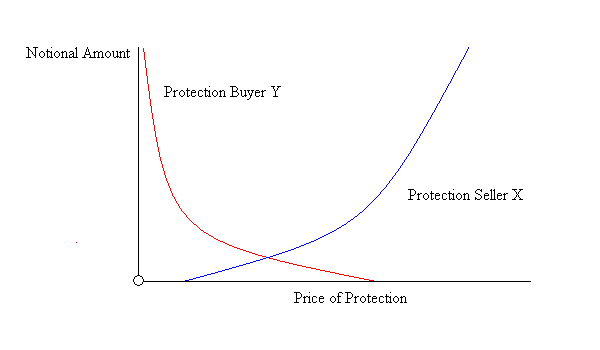
In the previous article, we plotted the expected payout of each party to a credit default swap as a function of the fee and each party’s subjective valuation of the probability that a default will occur. The simple observation gleaned from that chart was that if we fix the subjective probabilities of default, protection sellers expect to earn more as the price of protection increases and protection buyers expect to earn more as the price of protection decreases.  Thus, as the the price of protection increases, we would expect protection seller side “demand” to increase and expect protection buyer side “demand” to decrease.  But how can demand be expressed in the context of a credit derivative? The general idea is to assume that holding all other variables constant, the size of the desired notional amount of the CDS will vary with price. So in the case of protection sellers, the greater the price of protection, the greater the notional amount desired by any protection seller.

In order to further formalize this concept, we should consider each reference entity as defining a unique demand curve for each market participant. We should also distinguish between demand for buying protection and demand for selling protection. For convenience’s sake, we will refer to the demand for selling protection as the supply of credit protection and demand for buying credit protection as the demand for credit protection. For example, consider protection seller X’s supply curve and protection buyer Y’s demand curve for CDSs naming ABC as a reference entity. The following chart expresses the total notional amount of all CDSs desired by X and Y as a function of the price of protection.

supply-demand-credit-exposure1

As the price of protection approaches zero, Y’s desired notional amount should approach infinity, since at zero, Y is getting free protection and should desire an unbounded “quantity” of credit protection. The same is true for X as the price of protection approaches infinity.

Synthetic Bonds As Competing Goods With “Real” Bonds

Imagine a world without credit derivatives and therefore without synthetic bonds. In that world, there will be a demand curve for real ABC bonds as a function of the spread the bonds pay over the risk free rate, holding all over variables constant. Now imagine that credit default swaps were introduced to this world. We know that the cash flows of any bond can be synthesized using Treasuries and credit default swaps. For example, assume we have synthesized the cash flows of ABC’s bonds using the method described here. We would expect at least some investors to be indifferent between real ABC bonds and synthetic ABC bonds, since they both produce the same cash flows. Thus, the two are competing products in the sense that investors in real ABC bonds should be potential investors in synthetic ABC bonds. So because some investors will be indifferent between synthetic ABC bonds and real ABC bonds, synthetic ABC bonds will siphon some of the cash that would have otherwise gone to real ABC bonds. Thus, in a world with credit derivatives, we would expect there to be less demand for real bonds than would be present without credit derivatives. In the following chart we express the macroeconomic demand for real ABC bonds in terms of the spread over the risk free rate and the total par value desired by the market.

demand-with-credit-derivatives

Thus, the demand for credit derivatives diminishes the demand for real bonds. Although we cannot know exactly what the effect on the demand curve for real bonds will be, we can safely assume that it will be diminished at all levels of return, since at each level, at least some investors will be indifferent to real bonds and synthetic bonds, since each offers the same return.

Real Cash Losses Versus Wealth Transfers Through Derivatives

Economics already has a term to describe payouts under credit default swaps: wealth transfers. Although ordinarily used to describe the cash flows of tax regimes, the term applies equally to the payments under a credit default swap. As described in the previous article, there are no net cash losses under a credit default swap. There is a payment of money from one party to another, the net effect of which is a wealth transfer. That is, credit default swaps, like all derivatives, simply rearrange the current allocation of cash in the financial system, and nothing is lost in process (ignoring transaction costs, which are not relevant to this discussion).

When a real bond defaults, a net cash loss occurs. The borrower has taken the money lent to it by investors, lost it, and the investors are not fully paid back. Therefore, both the borrower and the investors incur a cash loss, creating a net cash loss to the economy. So, in the case of a synthetic ABC bond, upon the default of one of ABC’s bonds,  a wealth transfer occurs from the protection seller to the protection buyer and the net effect is null. In the case of a real ABC bond, upon the default of that bond, the investors will lose some of their principle and ABC has already lost some of the money it was lent, the net effect of which is a loss to the economy.

So every dollar siphoned away from real bonds by synthetic bonds is a dollar that will not be lost in the economy upon the occurrence of a credit event. If there were no credit derivatives, then that dollar would have been invested in real bonds and thereby lost upon the occurrence of a credit event. Therefore, the net losses to the economy upon the occurrence of a credit event is less with credit derivatives than without. In the following diagram, the two circles of each transaction represent the parties to that transaction. In the case of real bonds, one of the parties is ABC and the other is an investor. In the case of synthetic bonds, one is the protection seller and the other is the protection buyer of the credit default swap underlying the synthetic bond.

net-losses-with-derivatives

This diagram simply demonstrates what was described above. Namely, that with credit derivatives, some investors will choose synthetic bonds rather than real bonds, thereby reducing the amount of cash exposed to credit risk. Thus, rather than increase the impact of credit risk, credit default swaps actually decrease the impact of credit risk by placating the demand for exposure to credit risk with synthetic instruments that are incapable of producing net losses. However, there may be consequences arising from credit default swaps that cause actual cash losses to an economy, such as a firm failing because of its obligations under credit default swaps. But the failure is not caused by the instrument itself. The nature of the instrument is to reduce the impact of credit risk. The firm’s failure is caused by that firm’s own poor risk management.